

A Dubai property sale involves more than agreeing a price. A conveyancer coordinates the seller’s transfer requirements, reviews the agreement and supporting documents, follows up on developer approvals, and helps move the transaction towards registration. That is what a conveyancer does for the seller in Dubai: manages the procedural work between agreement and transfer.
Sellers still need to make decisions and provide documents, but a sale involves several connected milestones. This article explains how conveyancing supports the seller, what the work can cover, and how agreement terms, due diligence and developer approvals fit into the process.
You’ll also see how conveyancing fees differ from transfer-related costs, and why the work can change when a mortgage, outstanding charges or additional approvals are involved. The aim is to clarify the tasks, responsibilities and steps that carry a sale through to completion.
Key Takeaways
- A conveyancer coordinates the ownership transfer and related requirements, while the seller remains responsible for providing accurate documents and decisions.
- Separate professional conveyancing fees from government, registration, developer and other transaction costs when reviewing the sale budget.
- Review the MOU or sale and purchase agreement for clear payment terms, completion dates, deposit conditions and responsibilities.
- Ownership records, outstanding charges and developer approvals can affect the transfer timeline and handover readiness.
- Before appointing a conveyancer, understand which coordination and document-review tasks are included in the agreed scope.
Property Conveyancing in Dubai: What Does a Lawyer Do?
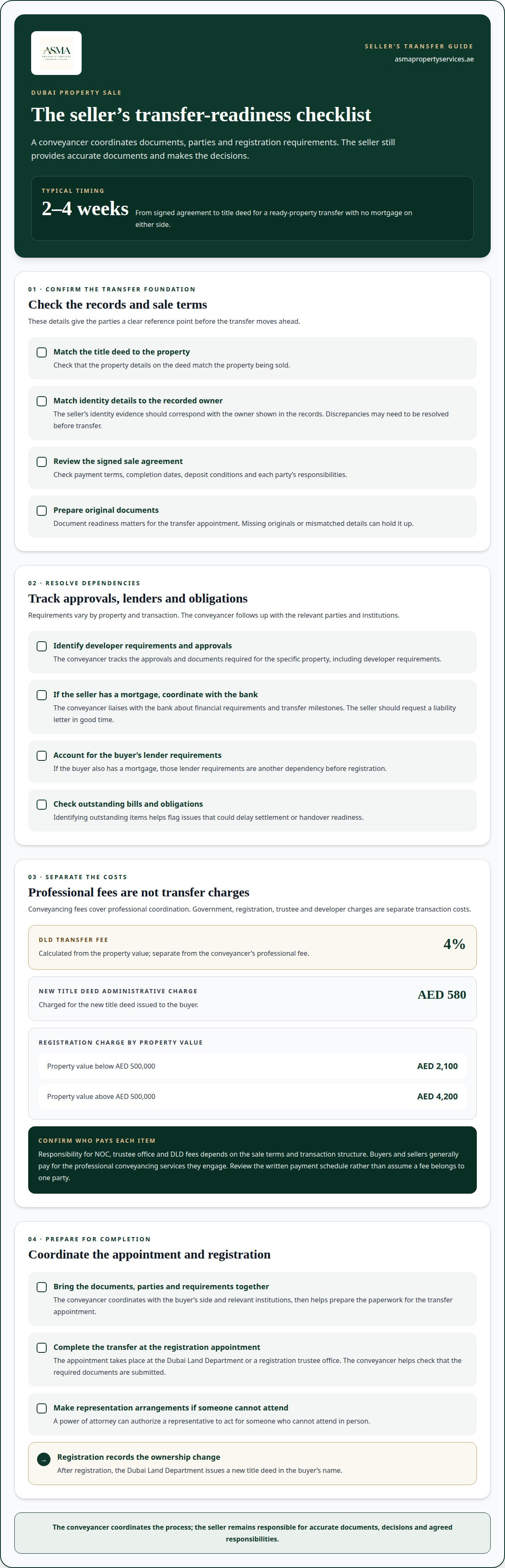
In practical terms, what a conveyancer does for the seller in Dubai is coordinate the documents, parties and registration requirements involved in transferring ownership. A ready-property transfer with no mortgage on either side typically takes two to four weeks from signed agreement to title deed.
Legal Transfer of Property Ownership
Conveyancing is the procedural and legal coordination that moves property ownership from seller to buyer through the applicable registration process. For a seller, it matters because signing an agreement alone doesn’t update the official ownership record. The conveyancer checks the title deed and the seller’s identity details, then coordinates the requirements for the agreed transfer. After registration, the Dubai Land Department issues a new title deed in the buyer’s name.
Checking ownership gives both parties a clear reference point for the transaction. For example, the property details on the title deed should match the property being sold, and the seller’s identity evidence should match the recorded owner. Any discrepancy may need to be resolved before transfer can proceed. The conveyancer also tracks the documents and approvals required for that specific property, rather than treating every Dubai sale alike.
Buyers and investors also rely on clear ownership records when assessing a purchase or planning a resale. In a Dubai resale, verifying the seller and transferring the title are central parts of conveyancing. The conveyancer coordinates these procedural requirements so the buyer’s registration follows the agreed sale. This differs from an agent’s focus on property selection, pricing and negotiation.
Transfer Coordination and Registration
Transfer coordination brings the transaction requirements, relevant parties and registration steps into one managed process. For the seller, that means tracking documents, the sale agreement, developer requirements and any lender milestones that affect readiness. The conveyancer coordinates with the buyer’s side and relevant institutions, then helps prepare the paperwork for the transfer appointment.
A mortgage adds coordination steps. If the seller’s property is mortgaged, the conveyancer liaises with the bank about financial requirements and transfer milestones. The seller should request a liability letter from the bank in good time. If the buyer also has a mortgage, the lender’s requirements are another dependency to coordinate before registration.
At completion, the conveyancer guides the parties through the transfer at the Dubai Land Department or a registration trustee office and checks that the required documents are submitted. A power of attorney can authorize a representative to act for someone who cannot attend in person. Registration records ownership in the buyer’s name, as evidenced by the new title deed.
What do conveyancing fees include in Dubai?
Professional conveyancing fees cover coordination, while government, trustee and developer charges are separate transaction costs. Knowing who pays each item and when it is due helps sellers avoid payment disputes and delayed handovers.
DLD Transfer and Title Deed
The Dubai Land Department (DLD) records the ownership transfer and issues the buyer’s new title deed. This registration matters because it completes the change in the official property record. The DLD transfer fee is stated as 4% of property value, while the new title deed carries an AED 580 administrative charge. These charges are distinct from the conveyancer’s professional fee.
Registration charges also vary by property value: AED 2,100 for properties below AED 500,000 and AED 4,200 for properties above AED 500,000. A conveyancer can include the applicable transaction charges in the completion schedule, alongside any professional fees and developer requirements. This itemisation helps the parties distinguish registration costs from fees for coordinating documents, appointments and transfer steps.
Original Documents and Transfer Appointments
Original documents and a transfer appointment are part of completing registration. The conveyancer coordinates document readiness, the appointment and submission requirements with the relevant parties. A missing original or a mismatch between identity evidence and property records can hold up the appointment. For example, the seller’s title deed and identity documents need to support the property and party details submitted for transfer.
Mortgage status affects the transaction route. In a sale involving the seller’s mortgage, bank requirements and the liability letter become key dependencies. A cash-to-cash sale has different lender requirements but still needs document preparation and appointment coordination. Checking outstanding bills and obligations also helps identify items that could delay settlement or handover.
Sale Fees and Payment Responsibility
Responsibility for NOC, trustee office and DLD fees depends on the sale terms and transaction structure. Buyers and sellers generally pay for the professional conveyancing services they engage. The agreement should also clarify how transaction charges are allocated. Sellers should review the written payment schedule before completion rather than assume every fee belongs to one party.
Trustee office registration charges depend on the property value, while the DLD transfer fee is calculated from the property value. These costs are separate from professional conveyancing fees. The conveyancer can coordinate the schedule and confirm the purpose of each amount before the transfer appointment.
The process runs from agreement and document preparation through payment readiness, the transfer appointment and DLD registration. Incorrect party or ownership details can obstruct registration; unresolved charges or mortgage requirements can delay handover. An itemised schedule gives both parties a clear view of outstanding steps and payment responsibilities.
Choosing a conveyancer and checking fee inclusions
A conveyancer’s scope should fit the property, ownership record and transaction route. For a seller, the useful comparison is not just the headline fee, but the work included, the steps managed and the items billed separately. A written appointment can set out document checks, mortgage coordination, payment scheduling and registration support, so both parties understand the service before completion work begins.
Start with identity and ownership checks. The conveyancer compares the seller’s identity evidence with the title record and checks that the property details match the asset being sold. If a company owns the property, or a representative acts under a power of attorney, the authority and party records must also align. A mismatch in a name, ownership detail or authority can obstruct the transaction and need correction before transfer.
Mortgage obligations need a separate review. A mortgaged property follows a different route from a sale without a mortgage because the lender’s requirements affect financial and transfer milestones. The conveyancer should identify bank dependencies and outstanding mortgage obligations in the transaction plan. Outstanding service charges, bills or developer penalties also matter because they can affect ownership or the amount available at settlement. Listing these items early helps prevent handover issues.
Payment control is another point to define. A conveyancer may prepare an itemised payment schedule and independently confirm each payee. The schedule should separate sale proceeds, agreed transaction charges and outstanding obligations, linking each payment to its purpose. For example, a seller should be able to distinguish a developer charge from a lender payment rather than rely on one unexplained total. Clear payee checks help reduce the risk of misdirected funds and payment disputes.
Ask the scope to specify who coordinates document collection, follows up with the bank or developer, prepares the completion schedule and handles registration requirements. It should also distinguish procedural coordination from legal advice on a dispute. If a dispute or unclear obligation appears in the records, its effect on transfer readiness should be identified and addressed in the transaction plan.
Conveyancing fees vary with transaction complexity, property value and the appointed scope; they may be fixed or calculated as a percentage. The service price depends on the case and is provided after a quote request. Mortgage involvement, ownership structure, required document review and coordination responsibilities shape the fee. A clear written breakdown lets sellers see which professional tasks are covered and which third-party charges remain separate.
Reviewing the MOU or sale and purchase agreement
An MOU or sale and purchase agreement records the terms the buyer and seller will follow to complete a property sale in Dubai. Reviewing the parties, payment terms and transfer conditions helps identify unclear obligations before they affect completion.
Preparing and Reviewing Sale Agreements
A conveyancer can review or prepare an MOU or sale and purchase agreement, checking that its written terms reflect the transaction the parties have agreed. The review can cover the deposit, completion date, payment obligations and consequences if either side fails to comply. These details matter because a mismatch between the parties’ understanding and the signed document can lead to disputes during the sale.
The seller’s representative drafts the contract, including the sale conditions, deal terms, transfer date and outstanding particulars. A conveyancer reviews these against the intended transaction. For example, the agreement should correctly identify the property and parties, state the completion arrangements, and specify which obligations remain before transfer. If the buyer relies on a mortgage, the contract should state the mortgage condition, subject to the buyer securing bank finance.
Deposit provisions also need careful reading. In the described Dubai sale process, the buyer and seller often sign an MOU with a deposit payment. The agreement should explain the consequences if the buyer withdraws or the seller fails to comply. In that process, the seller can retain the security deposit if the buyer backs out, while the seller may owe compensation for non-compliance. The precise wording matters: both parties need to understand the conditions attached to each outcome.
Agreement and Developer Requirements
The contract terms and property-specific requirements must align before transfer. A signed sale agreement cannot replace approvals or clearance required for the property. The conveyancer can identify developer requirements and link them to the agreed transfer date, payment milestones and outstanding particulars.
For a Dubai property, the review should also consider whether the agreement can proceed through the applicable registration process. Contracts that do not meet Dubai Land Department requirements or UAE property laws can lead to disputes or delays. The conveyancer can flag terms that need clarification before signature, then coordinate relevant requirements with the parties and developer.
For a luxury property, custom clauses may address payment schedules, handover timelines, quality specifications and developer obligations. Each clause should identify who must act, what must happen and how it relates to completion. If the agreement sets a handover date but leaves a developer obligation unresolved, the parties may face a timing dispute. Clear drafting links each condition to the transaction milestone it affects.
Legal due diligence and developer approvals
Due diligence checks the property, ownership details and approvals connected with a sale. In Dubai, developer requirements and outstanding obligations can affect transfer readiness.
Developer NOC and Service-Charge Clearance
A developer No Objection Certificate (NOC) confirms the developer’s position on a proposed property transfer. Service-charge clearance addresses outstanding amounts linked to the property. Both matter because unresolved charges or developer penalties can affect the property’s value or ownership and delay the sale.
The conveyancer can identify the developer’s requirements, coordinate the NOC request and follow up on service-charge clearance. For example, outstanding charges need to be addressed within the seller’s transaction plan. The buyer’s deposit and agreed transfer date should be considered alongside these requirements, so both parties understand what remains before completion.
Obtaining Developer and Authority NOCs
Obtaining an NOC involves coordinating the request and supporting requirements with the developer and relevant authorities. This matters because the buyer’s purchase cannot follow the intended transfer route while required approvals remain outstanding.
A conveyancer can communicate with the Dubai Land Department and developers to help the seller obtain a transfer NOC. The process may involve gathering property and party records, meeting developer requirements and resolving outstanding service charges. Each requirement should align with the sale agreement and planned transfer date. This gives buyers and sellers a clear view of approval status before final arrangements.
Due diligence also extends beyond the NOC. Before an agreement is signed, checks can cover property ownership, developer approvals, escrow account compliance, and zoning or usage permissions. For an off-plan investment, the conveyancer can review developer approvals, escrow compliance and contract terms. These checks help identify issues that could affect the transaction before the parties proceed with the sale or purchase.
DLD and Developer NOC Coordination
DLD and developer NOC coordination aligns approval requirements with the property transfer process. The two are connected, but developer clearance and registration serve different purposes.
The conveyancer coordinates with the developer to obtain its NOC and with the Dubai Land Department on transfer requirements. The seller’s property records, approval status and service-charge position should be brought together before registration arrangements. For example, delayed developer clearance can affect the agreed transfer schedule even after the buyer and seller have signed the sale contract.
For a sale involving a mortgage, lender milestones may also affect timing. Align the bank’s requirements, developer approval and DLD transfer steps in one transaction plan. Arrange support for mortgage coordination when lender requirements form part of the sale.
ASMA Property Services: conveyancing
ASMA Property Services coordinates conveyancing for sellers managing transfer documents, transaction milestones and registration requirements. Use its conveyancing service when you need support coordinating the sale alongside the agreement, developer approvals or mortgage requirements. The service connects the procedural work, from reviewing transaction requirements through to transfer coordination.
For ownership matters beyond a sale, ASMA Property Services also handles Property Gifting / Granting and power of attorney support. These services may suit a transfer of ownership as a gift or a situation where a representative needs authority to act. ASMA also coordinates Muslim and non-Muslim wills for property ownership planning.
Contact ASMA Property Services to discuss conveyancing support for your Dubai property sale.
Set the next transfer milestone
Bring in support before the sale schedule becomes difficult to change. Understanding what a conveyancer does for the seller in Dubai helps you decide which responsibilities to delegate and when to involve them. Set out your intended sale timeline, who is authorized to act, and any known ownership or financing arrangements. This gives the discussion a clear operational starting point.
ASMA Property Services provides conveyancing for sellers coordinating a property transfer. Property Gifting / Granting and power of attorney support can also help with related ownership or representation needs. Start with a focused discussion about the transaction and the coordination required.
Contact ASMA Property Services to discuss conveyancing for your Dubai property sale. A clear starting point can make the next milestone easier to manage.
Frequently Asked Questions
What is Conveyancing?
Conveyancing is the work involved in completing a property ownership transfer. For a seller, it connects the agreed sale with the checks, documents and registration needed to record the buyer as the new owner. Its practical value is coordination: if a bank requirement or developer approval affects the planned transfer, that dependency can be identified alongside the sale milestones instead of treated as a separate issue.
Are conveyancing fees percentage-based or fixed?
Conveyancing fees in Dubai may be fixed or calculated as a percentage, depending on the firm and the appointment. The scope also matters: a straightforward cash sale and a transfer involving mortgage coordination have different workstreams. Before proceeding, compare the written scope with the fee basis and identify which tasks it covers. Government, developer and registration charges are transaction costs, not automatically part of the professional conveyancing fee.
What documents does a seller need to provide to a Dubai conveyancer?
A seller should prepare the title deed, passport, Emirates ID, any power of attorney, and service-charge statements. These records help establish the property, registered owner and a representative’s authority. For example, if someone signs for the owner, the conveyancer needs the relevant authority document as well as identity evidence for the parties. A mortgage or company ownership can add records and coordination requirements specific to the transaction.
What are the Dubai Land Department requirements for transferring a property sale?
The transfer requires the parties’ property and identity records, the relevant sale agreement, and documents for the applicable registration route. Developer approvals or lender milestones can add requirements. The Dubai Land Department’s Request for Transfer of Ownership procedure is the authoritative reference for transfer steps. The conveyancer coordinates the file so submitted details match the intended parties and property, then follows registration through to the updated ownership record.
What are the seller's fees and costs for conveyancing in Dubai?
Seller costs can include the professional conveyancing appointment, allocated DLD and registration charges, developer charges such as an NOC, and mortgage-related obligations. The sale agreement and transaction structure determine how costs are divided between buyer and seller. VAT at 5% applies to many professional fees in Dubai. Ask for an itemised completion schedule that separates professional work from third-party charges and identifies each payment’s purpose.
How does a conveyancer handle a mortgage discharge for a Dubai property seller?
For a mortgaged property, the conveyancer coordinates with the seller’s bank to establish the liability and financial requirements affecting transfer. The seller should request a liability letter in good time. The conveyancer then aligns bank milestones and release paperwork with the transaction schedule, so the parties understand what must be completed before registration. The lender’s process and the outstanding balance shape this work.
How does a conveyancer coordinate the buyer, seller, banks, agents, and developer in Dubai?
The conveyancer tracks each party’s documents, approvals and transaction milestones against the agreed transfer plan. For example, the buyer’s financing timetable, the seller’s bank requirements and a developer’s NOC can all affect the same completion date. The conveyancer follows up on these dependencies and communicates what remains outstanding. Agents generally focus on property selection, pricing and negotiation; conveyancing coordination focuses on compliance and transfer readiness.
What legal checks does a conveyancer carry out before a Dubai property transfer?
Checks can include matching the title record to the property and parties, reviewing the agreement, and identifying developer approvals or outstanding service charges. For off-plan property, checks may also cover contract terms, developer approvals and escrow compliance. Zoning or usage permissions may be relevant to due diligence. These checks help surface discrepancies or unresolved obligations that could affect ownership, registration or the sale timeline.

Article by
Suhail Ibrahim
Suhail has guided more than 3,000 Dubai property transactions and built the reputation that leading brokerages rely on — calm under pressure, precise with paperwork, and always reachable when a deal needs completing.


