

The purchase price isn’t the deciding figure for a property-based UAE Golden Visa. The property valuation requirements for a UAE visa centre on the current assessed market value: qualifying property holdings must reach at least AED 2 million. In Dubai, an official evaluation certificate is required for the property route.
The document process matters as much as the threshold. Ownership records, mortgage details and property status can affect which supporting documents are needed. Valuation procedures also differ between emirates.
This guide explains what the valuation establishes, which documents are commonly required and how the AED 2 million threshold applies to jointly owned, mortgaged and multiple properties. It also outlines Dubai’s DLD process and the separate route through Abu Dhabi’s TAMM portal, so you can understand the steps before preparing an application.
Key Takeaways
- Use the current assessed market value, not the original purchase price, to understand whether property supports a visa application.
- Prepare ownership records and tailor supporting documents to the property’s status, including mortgage or off-plan arrangements.
- For jointly owned property, assess the applicant’s individual share as well as the total property value.
- Follow the valuation route for the emirate where the property is registered; Dubai and Abu Dhabi use different processes.
- Multiple eligible properties may be considered together when ownership and location requirements are met.
What Is a Golden Visa Property Valuation?
A Golden Visa property valuation establishes the property’s assessed market value for an investor visa application. For Dubai’s property route, the title deed and official valuation certificate serve different purposes: the deed records ownership, while the certificate supports the value assessment.
Certificates and Title Deed Values
The title deed identifies the registered owner and property. Its details connect the asset to the applicant, but its recorded value does not replace a current valuation certificate. The certificate records an assessed market value for the visa application.
For Dubai’s property route, an official evaluation certificate is required. You can obtain a valuation certificate through Dubai Land Department channels or the Dubai REST application. In Abu Dhabi, the process runs through TAMM. The appropriate route depends on where the property is registered.
Investor Visa Value Thresholds
The minimum property value for the 10-year investor Golden Visa route is AED 2 million. In Dubai, the applicant’s property or combined properties must meet that threshold, and the property must be wholly owned by the applicant. The assessed value, rather than the original transaction amount, is central to eligibility.
This threshold applies to the property investment route, not every Golden Visa category. For a jointly owned property, the applicant’s share must itself reach AED 2 million. A husband and wife seeking individual visas based on jointly held property need a combined portfolio of AED 4 million, with each share reaching AED 2 million.
Market Value Versus Purchase Price
Market value reflects the property’s assessed value at the time of the application; purchase price records what the owner paid earlier. A Dubai property bought for AED 1.6 million may meet the threshold if its later assessed value exceeds AED 2 million. A property bought for AED 2.2 million may fall short if its assessed value drops below AED 2 million.
The certificate is therefore a key evidence document. Property valuation requirements for a UAE visa focus on the current assessment, not simply the historic purchase contract or an amount recorded in an earlier transaction.
Property Eligibility and Ownership Shares
Ready and off-plan property may qualify. For an off-plan Dubai property, the application documents include a registered DLD Oqood Certificate and a recent statement of account showing payments made. Applicants may combine eligible properties registered in their name, provided the combined assessed value reaches AED 2 million and the properties are in designated freehold zones.
Mortgaged property may also qualify. Dubai applicants must provide a bank letter showing the amount paid and remaining balance; the Dubai service description requires evidence that AED 2 million has been paid. For a jointly owned property, each applicant’s registered share matters, not just the property’s total valuation.
Family sponsorship can follow the investor application. For jointly owned property held by spouses worth less than AED 4 million, one spouse may apply and sponsor the other. Dubai lists a 10-year family residence permit fee of AED 5,774.50, a family sponsorship file fee of AED 318.75, and AED 100 per sponsored person.
The application process includes valuation evidence, medical fitness testing and biometric registration in the UAE. Dubai Land Department lists a 7-10 business day service time and a total fee of AED 9,884.75 for the 10-year investor residence permit. The permit is valid for 10 years and renewable.
Documents required for property valuation
Build the valuation file around the property’s ownership record and current status. In Dubai, a valuation application requires a recent municipality map, valid for one year. Keep it with the title deed and application details, ensuring the documents identify the same property and registered owner. A mismatch in the name, unit or plot reference can complicate processing.
Use the documents that match the asset:
- Title deed: Shows the registered ownership details for a completed property. Use the deed that corresponds to the property being valued.
- Municipality map: Required for Dubai property valuation; it must be recent and valid for one year.
- Mortgage evidence: For a mortgaged Dubai property, provide a bank letter stating the amount paid and remaining balance.
- Off-plan records: Include the registered DLD Oqood Certificate and a recent statement of account showing payments made.
- Marriage certificate: Joint spousal ownership requires an attested marriage certificate for a UAE Golden Visa application.
Each document serves a distinct purpose. The title deed establishes ownership, and the municipality map identifies the property for valuation. Mortgage evidence sets out the payment position; for an off-plan purchase, the Oqood Certificate and account statement document the purchase. Keep the property identifiers consistent throughout, so the request can be matched to the correct asset and applicant.
Keep valuation documents separate from residence permit documents. The visa application requires a passport valid for more than six months. According to GDRFA, medical insurance is compulsory for UAE residence permit applications. These requirements apply to the residence application, not the valuation itself. A personal photo may be part of the application file, but it does not establish ownership or market value.
Before submission, organise valuation records by property and ownership status. Keep a separate deed or ownership record for each property. For shared ownership, make sure the applicant’s share is clear. For an off-plan purchase, include the registered Oqood record and payment statement rather than relying on a sale agreement alone.
For a file involving a visa valuation or a property transfer, property valuation support for visas can help organise the relevant property documents.
AED 2 million property valuation threshold
The property-investment route uses an assessed value of at least AED 2 million (د.إ 2,000,000). In Dubai, the threshold applies to the applicant’s qualifying property interest, not simply the figure stated in a purchase contract. The valuation evidence and ownership record must be read together when assessing whether the property supports a residence permit application.
How the threshold is applied
Use the current assessed market value at the time of application. A Dubai property bought for AED 1.6 million (د.إ 1,600,000) may meet the threshold if its assessed value later rises above AED 2 million (د.إ 2,000,000). A purchase price above the threshold does not settle eligibility either: a property bought for AED 2.2 million (د.إ 2,200,000) may fall short if its current assessed value is below AED 2 million (د.إ 2,000,000).
The distinction is important when reviewing the title deed. It supports the ownership record, while the valuation certificate establishes the relevant market assessment. Compare the assessed value with the threshold, then confirm that the deed identifies the applicant’s registered interest. A historic purchase price alone cannot replace this comparison.
Joint ownership and individual shares
For jointly owned Dubai property, the applicant’s share must reach AED 2 million (د.إ 2,000,000). The whole property’s value is not automatically treated as belonging to each co-owner. The ownership allocation recorded for each person is central.
Spouses seeking individual Golden Visas based on jointly held property face a separate combined threshold. Their portfolio must total AED 4 million (د.إ 4,000,000), with each spouse’s share independently reaching AED 2 million (د.إ 2,000,000). An attested marriage certificate is required for a joint spousal application. Where jointly owned property is worth less than AED 4 million (د.إ 4,000,000), one spouse may apply and sponsor the other.
Mortgage position and threshold evidence
A mortgage does not change the assessed property-value threshold. For Dubai, the overall property value must meet AED 2 million (د.إ 2,000,000), and the applicant needs bank documentation. The Dubai investor service description requires a bank letter showing that AED 2 million (د.إ 2,000,000) has been paid. The letter should also show the amount paid and remaining balance.
For a practical review, compare three records: the current valuation certificate, the title deed, and the bank letter where a mortgage applies. Check that the applicant’s registered share, assessed value and payment evidence align with the AED 2 million (د.إ 2,000,000) threshold. A purchase amount, mortgage balance or co-owner’s share should not be mistaken for the applicant’s assessed qualifying interest.
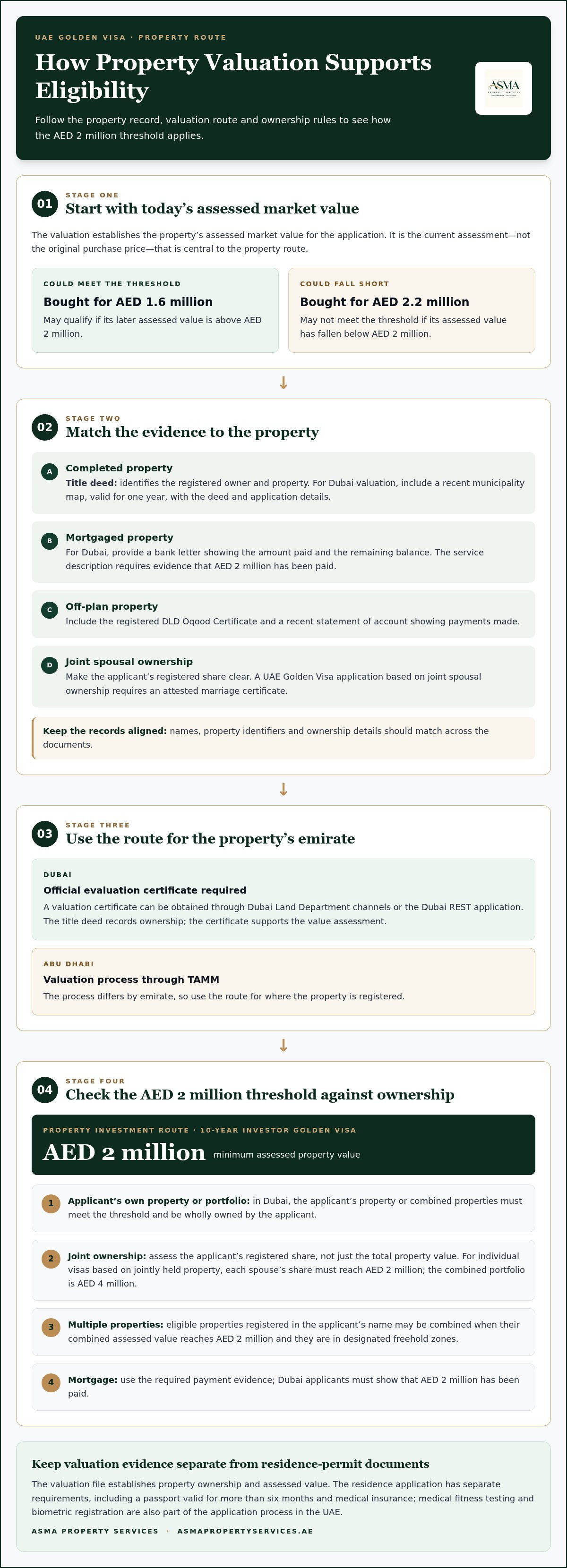
DLD and emirate-specific valuation processes
Start with the emirate where the property is registered. Dubai valuation applications use Dubai Land Department channels or the Dubai REST application; Abu Dhabi applications go through TAMM. The property’s location determines where to submit the request and which certificate supports its assessed value.
Dubai Land Department process
For a Dubai property, submit the valuation request through an official DLD channel or Dubai REST. Match the details in the request to the ownership records and municipality map. DLD valuation fees vary by property type:
- Residential apartment: د.إ 4,000.
- Vacant residential or commercial land: د.إ 2,000.
- Agricultural land with buildings: د.إ 6,000.
These are valuation fees, separate from residence permit charges. Select the correct property category before submission, as land and apartment fees differ. Keep the certificate with the application file so the assessed value can be reviewed alongside the title deed.
Certificate timing and submission
A DLD valuation certificate has no statutory expiry date. GDRFA typically expects a recently issued certificate when the Golden Visa application is submitted. In practice, obtain the certificate close enough to the residence application for it to reflect the property’s current market position.
Before submitting, check the certificate’s property identifiers and ownership details against the title deed and applicant’s records. For jointly owned property, make sure the applicant’s share is identifiable. For a mortgaged property, include the bank letter with the valuation file, as the residence application also relies on mortgage documentation.
Abu Dhabi and other emirate routes
In Abu Dhabi, TAMM administers the Golden Visa property valuation process. Certificates issued through TAMM are usually delivered within three working days. Dubai REST and the DLD fee schedule do not describe this process; use the portal for the emirate where the property is registered.
This matters if you own property in one emirate and live in another. The property’s registration location determines the valuation route. Keep the resulting certificate with the title deed and visa submission documents, then follow the relevant residence application channel.
Organise the application in order: identify the emirate where the property is registered, submit the valuation request through its official route, then assemble the certificate with ownership and supporting records. Keep passport details consistent throughout. If the residence application includes a sponsor, separate the sponsor’s documents from the valuation evidence so each record serves its intended purpose.
Can multiple properties be combined to meet the UAE property visa threshold?
Yes. An applicant may combine multiple qualifying properties registered in their name when their combined assessed value reaches د.إ 2 million. The properties must be located within designated freehold zones. Count the assessed value of each eligible asset, not its original purchase price, then compare the combined figure with the threshold.
Ownership is the first check. Each property included in the calculation must be registered in the applicant’s name. A home registered solely to a relative or business cannot simply be added to the applicant’s personal portfolio. Check each title deed and confirm the registered owner before including the property’s valuation in the total.
Next, check the property’s location. Eligible properties must be in designated freehold zones. A portfolio can include properties in different locations, but each asset being counted must meet the location requirement. Keep the title deed and valuation certificate for each property together, matching ownership and assessed value asset by asset.
Build the combined value calculation
Use current assessed values for all qualifying properties. Add those values together, then check whether the portfolio reaches د.إ 2 million. For example, if one valuation certificate is below the threshold, another eligible property may contribute to the combined assessed value. The relevant calculation uses each asset’s assessment at application time, rather than its historical purchase amount.
Keep the calculation traceable with a simple property schedule listing each property’s location, registered owner, title deed details and assessed value. Match every entry to its supporting documents. This helps identify an asset that cannot be counted, such as one outside a designated freehold zone or registered to someone else.
Separate portfolio value from ownership shares
Combining multiple properties does not remove the individual ownership-share test. For jointly owned property, the applicant’s share must independently reach د.إ 2 million for the Dubai property route. A portfolio calculation should therefore distinguish property value from the applicant’s share of that value. Do not treat the full value of a jointly held asset as belonging to one co-owner.
Spousal applications use a separate threshold. For individual Golden Visas based on jointly held property, the combined portfolio must total د.إ 4 million, with each spouse’s share reaching د.إ 2 million independently. Keep both ownership records clear, and include an attested marriage certificate for the joint spousal application.
Before submitting, check each property against three points: registration in the applicant’s name, location in a designated freehold zone, and current assessed value. Then separate jointly owned assets and calculate the applicant’s share. For help arranging valuation evidence across a property portfolio, arrange property valuation support.
ASMA Property Services: conveyancing
ASMA Property Services supports property owners with visa valuations and conveyancing when documentation or ownership records need organising around a property transaction. Its valuation service can help prepare valuation evidence for a visa application, while conveyancing supports the legal and administrative steps in a property transfer.
For a property gift, ASMA’s Property Gifting / Granting service supports the change of ownership. Power of Attorney support can help when an owner needs representation for property matters. These services address different needs, so the next step depends on whether you need valuation, a transfer or authority to act.
Contact ASMA Property Services to discuss the property documentation or conveyancing support you need.
Prepare the next property step
Once the valuation file is assembled, keep its purpose clear. A visa application, property transfer and change of ownership each follow a different administrative path. Organising documents around the intended transaction helps keep the next step focused.
Property valuation requirements for a UAE visa may form part of a wider ownership matter. ASMA Property Services provides conveyancing for property transactions, Property Gifting / Granting for ownership transfers, and Power of Attorney support when representation is needed. Choose the service that matches your task, and keep valuation and transfer documents distinct.
Move forward with a defined scope and the relevant property records. Contact ASMA Property Services to discuss your property matter and identify the appropriate next step.
Frequently Asked Questions
What if the property is valued below AED 2 million?
If the assessed value is below AED 2 million (د.إ 2,000,000), that property alone falls short of the property-investment threshold. The application may still meet the threshold through other eligible properties registered in the applicant’s name. Add their current assessed values, then confirm each asset meets the ownership and location criteria. A purchase price above the threshold doesn’t replace a lower current assessment.
What property value is required for a UAE investor or Golden Visa?
For the UAE property-investment Golden Visa route, eligible property holdings must have an assessed value of at least AED 2 million (د.إ 2,000,000). The relevant figure is the current assessment, not the original purchase amount. Applicants considering a different investor or Golden Visa route should distinguish its criteria from property-based eligibility, since the property threshold applies to the property-investment route.
Does the UAE Golden Visa require property worth AED 2 million?
For the property-investment route, yes: qualifying holdings must reach AED 2 million (د.إ 2,000,000) in assessed value. This is not a universal property requirement for every Golden Visa category. For example, a property assessment is relevant to a property-based application, while applicants using another eligibility route assess that route’s criteria instead.
What property ownership documents and valuation certificates are required for a UAE visa?
For a Dubai valuation file, prepare the title deed and recent municipality map, valid for one year. For a mortgaged property, include a bank letter stating the amount paid and remaining balance. For off-plan property, include the registered DLD Oqood Certificate and a recent payment statement. Joint applications by spouses also require an attested marriage certificate. Keep property identifiers consistent across the records.
How is property value calculated for UAE visa eligibility: purchase price, market value, or paid amount?
Eligibility uses the current assessed market value, rather than the historical purchase price. For a mortgaged Dubai property, these figures serve different purposes: the property’s overall value must meet the threshold, while a bank letter documents payments and the remaining balance. The Dubai investor service description requires evidence that AED 2 million (د.إ 2,000,000) has been paid for a mortgaged property.
Do UAE property visa requirements differ by emirate or visa type?
Yes. Dubai property valuations use Dubai Land Department channels or the Dubai REST application, while Abu Dhabi administers the process through TAMM. The property route also differs from other Golden Visa eligibility categories. First identify the property’s registered emirate and the visa route being used. These determine the valuation process and applicable eligibility criteria.
What happens to a UAE property visa if the property is sold, transferred, or falls below the required value?
Selling a qualifying property without acquiring a replacement of equivalent value results in Golden Visa cancellation. A transfer or gift changes the ownership record, so continued eligibility depends on the property interest retained. A lower valuation before application can leave the property below the threshold. A decline in value and a sale are distinct situations; the stated sale rule concerns selling without an equivalent replacement.

Article by
Suhail Ibrahim
Suhail has guided more than 3,000 Dubai property transactions and built the reputation that leading brokerages rely on — calm under pressure, precise with paperwork, and always reachable when a deal needs completing.


