

Without a registered will, Sharia inheritance rules may apply to a non-Muslim’s estate in the UAE. Bank accounts, including jointly held accounts, may be frozen until a court issues a probate order, and a surviving spouse may receive only a limited share. A non-Muslim will in Dubai can set out how assets should pass and nominate guardians for minor children.
Planning a will involves more than deciding who inherits. The registration route affects the process, language and scope, while attestation is an important step in formally recording the will.
This overview explains who can make a non-Muslim will in Dubai, what may happen without one, and how DIFC and ADJD options differ. It also covers guardianship provisions, supporting documents and attestation formalities, helping you understand the key decisions before preparing a will.
Key Takeaways
- Without a registered will, inheritance and access to estate assets may involve court processes. Understand the possible consequences before deciding whether to make a will.
- Compare DIFC and ADJD registration by language, asset coverage and process to identify the route that fits your circumstances.
- Check the eligibility rules for your chosen route, including the requirements that apply to non-Muslim testators and the assets covered.
- Include clear guardian nominations for minor children, and consider naming a substitute guardian in case your first choice cannot act.
- Prepare for attestation by organising the draft will and supporting documents, including a certified Arabic translation where required.
What is the main difference between a DIFC Will and an ADJD Will for non-Muslims?
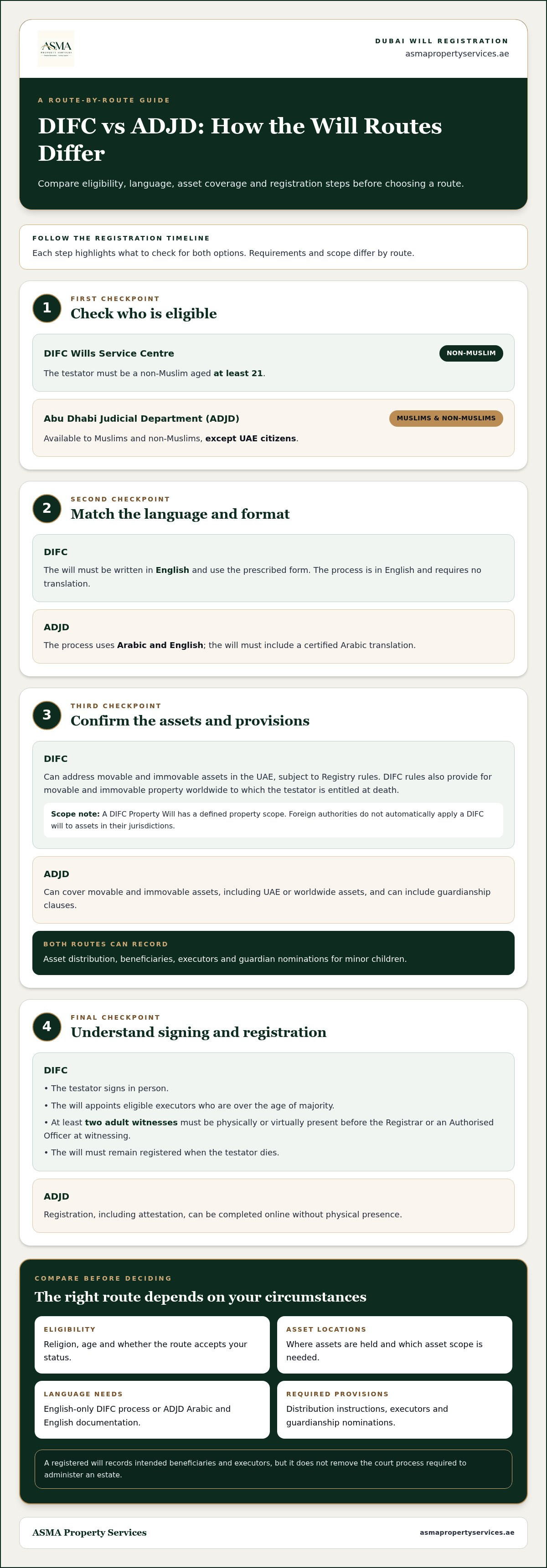
The main differences are the registration authority, language and process. The DIFC Wills Service Centre registers English-language wills under DIFC rules. The Abu Dhabi Judicial Department (ADJD) registers wills through the Abu Dhabi Civil Family Court and requires a certified Arabic translation. Both routes can address asset distribution and guardianship, but their requirements and scope differ.
Without a registered UAE will, Sharia inheritance rules may apply to a non-Muslim’s estate. The resulting shares may not match the person’s intentions, and a surviving spouse may receive only a limited share. Bank accounts, including jointly held accounts, may be frozen until a court issues a probate order. A registered will records intended beneficiaries and names executors, but it does not remove the court process required to administer an estate.
At the DIFC Wills Service Centre, a testator must be a non-Muslim aged at least 21. The will must be written in English, use the prescribed form and appoint executors over the age of majority. The testator signs in person. Under Article 9(1) of the DIFC Wills and Probate Registry Rules, at least two adult witnesses must be physically or virtually present before the Registrar or an Authorised Officer at witnessing. The will must remain registered when the testator dies.
For registration, prepare the will in the required format, appoint eligible executors, and follow the Registry’s signing and witnessing steps. DIFC wills can address movable and immovable assets in the UAE, subject to Registry rules. The DIFC process is in English and requires no translation. A Property Will has a defined property scope, so match the will type to the assets it needs to cover.
ADJD wills are available to Muslims and non-Muslims, except UAE citizens. The process uses Arabic and English, and the will must include a certified Arabic translation. Registration, including attestation, can be completed online without physical presence. ADJD wills can cover movable and immovable assets and include guardianship clauses. This route may suit someone who prefers an Arabic-based judicial process or broader asset provisions.
Both routes allow a testator to record their wishes rather than rely solely on default inheritance rules. A will can name beneficiaries, executors and guardians for minor children. Couples may also consider mirror wills, which are two separate wills with corresponding instructions. The appropriate route depends on eligibility, asset locations, language needs and the provisions required.
Eligibility for non-Muslim wills in Dubai
Eligibility depends on the registration route, the testator’s status and the assets covered. Dubai Law No. (15) of 2017 governs the administration of estates and implementation of wills of non-Muslims in the Emirate of Dubai, according to Dubai Legislation Portal. Article 3 of Dubai Law No. 15 of 2017 applies to wills and estates of non-Muslims in Dubai, including in the DIFC, according to Dubai Legislation Portal.
For a will made under Dubai’s non-Muslim wills law, the testator must be at least twenty-one years old. DIFC Wills are for non-Muslims, while Dubai Courts registration is available to non-Muslim adults with Dubai-connected assets. The routes are not interchangeable by default. Religion, age, residence and asset locations help determine which registration option fits.
The DIFC Courts Wills Service accepts registrations from residents and non-residents with assets in the UAE and/or elsewhere. Under Article 11 of the DIFC Wills and Probate Registry Rules, a will can dispose of movable and immovable property anywhere in the world to which the testator is entitled at death. This makes the DIFC route relevant to an expatriate with Dubai property and overseas accounts. It does not mean foreign authorities automatically apply the will to assets in their jurisdictions.
For assets held outside the UAE, compare the will’s wording and the registration route’s scope with the asset locations and ownership records. A Dubai apartment, foreign bank account and company shares may all need careful identification. DIFC registration can include UAE assets, and its rules also provide for worldwide property. Clearly describe the chosen beneficiaries and executors to reduce uncertainty during administration.
A public will notarised in the UAE is completed before a Notary Public in the relevant emirate. Dubai Courts and the Abu Dhabi Judicial Department (ADJD) also have registration routes. ADJD wills are available to Muslims and non-Muslims, except UAE citizens. The ADJD route can cover UAE or worldwide assets, and its registration process uses Arabic and English documentation.
Expats can choose a will format to suit their estate. A full will can set out broad distribution instructions; a DIFC Property Will is designed for UAE real estate, and a Business Owners Will can address corporate shareholdings. Mirror wills are two separate wills with corresponding terms, often used by spouses. A guardianship will can record nominations for minor children. Match the format to the assets, beneficiaries and appointments that need coverage.
Guardianship provisions for minor children
A will can record whom parents want to care for their children if both parents die. Without a registered will, a UAE court may decide guardianship. Naming a preferred guardian gives the court a clear record of the parents’ choice and distinguishes care arrangements from instructions for distributing the estate.
Both DIFC and Abu Dhabi Judicial Department (ADJD) wills allow parents to nominate guardians for minor children. Under Article 9(1) of the DIFC Wills and Probate Registry Rules, a DIFC will may appoint a guardian for a minor who habitually resides with the testator in Dubai or Ras Al Khaimah. Non-Muslims in Dubai can name guardians for children under 21 in their wills.
Draft the nomination with practical details. Identify each child by full name and date of birth, then clearly name the preferred guardian. Include a substitute guardian in case the first nominee cannot act. A substitute matters if the chosen person is unavailable, unwilling or unable to take responsibility. State the order of preference unambiguously.
Consider the children’s circumstances before selecting nominees. Parents may weigh the existing relationship, the guardian’s ability to provide day-to-day care and whether siblings can remain together. Discuss the appointment with each proposed guardian before signing, and confirm the substitute is willing to act as well. These steps help ensure the will reflects a considered family plan.
Keep guardianship instructions separate from inheritance directions. A guardian’s role concerns a child’s care; an executor administers the estate and carries out the testator’s instructions. The same person may be appointed to both roles, but the will should state each appointment separately. Clear drafting helps prevent confusion between meeting a child’s needs and handling inherited assets.
Review guardianship nominations when family circumstances change. A move from Dubai, a change in a child’s usual residence or a change in the nominated guardian may mean the provisions no longer reflect the family’s intentions. Update the will through the relevant registration process rather than relying on informal notes. For an ADJD will, include guardianship clauses and complete the required Arabic translation.
Parents should also consider the child’s age and the scope of the appointment. The guide recommends naming a guardian and, ideally, a substitute for children under 18. DIFC provisions refer to a minor habitually residing with the testator in Dubai or Ras Al Khaimah. Review each child’s residence and each nominee before registration, so the wording addresses the actual family arrangements.
Choosing between a DIFC will and an ADJD will
Under Article 1(1) of the UAE Personal Status Law for non-Muslims, a non-Muslim may choose home-country law for specified personal matters. That choice doesn’t automatically settle every UAE inheritance issue; compare each route against your assets, wishes and documentation needs.
DIFC and ADJD Jurisdiction and Procedures
DIFC Wills are registered through the DIFC Courts Wills Service and use an English-language process. Subject to Registry requirements, the rules allow a will to cover movable and immovable property worldwide. ADJD wills are registered through Abu Dhabi’s Civil Family Court under the UAE Civil Personal Status Law. The ADJD route can cover UAE or worldwide assets and uses Arabic and English documentation. Compare the process, language and intended asset coverage.
DIFC Will Types and Property Limits
The DIFC Registry offers different will types for specific asset categories. A DIFC Property Will can cover up to five UAE real estate units; a Business Owners Will can cover up to five UAE corporate shareholdings. A full will can address broader property, while a guardianship will records nominations for minor children. List each property, account and shareholding before choosing a type. The asset category and number of holdings determine whether its scope fits.
DIFC and ADJD Will Law Systems
DIFC wills operate under a Common Law framework, with proceedings and documentation in English. ADJD registration is part of Abu Dhabi’s judicial system and follows the UAE Civil Personal Status Law for non-Muslims. This difference matters when choosing the process and language for recording instructions. Choosing a home-country law for specified personal matters does not by itself determine how every UAE asset will be treated. Consider asset locations and the applicable route together.
DIFC Will Fees and Amendments
DIFC costs depend on the registration type and later Registry transactions. Registration, amendment and cancellation have separate charges; an amendment may also involve the wills draftsman’s legal fees. Consider these as separate cost components when planning changes. Review the will after acquiring property, changing beneficiaries or replacing an executor. Before submitting an amendment, identify the affected clauses and confirm the current Registry charge schedule, as the transaction type determines the applicable charge.
Attesting a non-Muslim will in Dubai
Attestation records a will through the chosen registration route; the procedure is not the same across the UAE. For Dubai Courts or a UAE Notary Public, prepare the will in Arabic and English and sign before the notary. DIFC registration follows a separate Registry process, with witnessing before the Registrar or an Authorised Officer. Choose the route first, then prepare documents to meet its requirements.
For an ADJD will, Federal Decree-Law No. 41 of 2022 governs the civil personal status route for non-Muslims. The will must have a certified Arabic translation. ADJD registration, including attestation, can be completed online without physical presence. Direct will attestation in Abu Dhabi is reserved for UAE residents. These are distinct procedural details: the online route and direct Abu Dhabi attestation should not be treated as interchangeable.
Assemble the supporting documents before submitting the application. The listed documents include:
- A copy of the testator’s passport.
- An Emirates ID copy.
- The draft will in the required language format.
- Children’s birth certificates when the will includes guardianship provisions.
Check that names and identifying details match across the draft, passport and Emirates ID. For example, a spelling difference between a passport and property record can lead to avoidable clarification during processing.
Dubai Courts and ADJD registrations can take from a few days to several weeks. Document completeness and translation needs affect the timeline. A complete draft and supporting records can help avoid pauses caused by missing information. If the will includes guardianship clauses, prepare the relevant birth certificates with the rest of the submission rather than adding them later.
DIFC registration uses its own signing and witness procedure. Under Article 9(1) of the DIFC Wills and Probate Registry Rules, at least two adult witnesses must be physically or virtually present before the Registrar or an Authorised Officer at witnessing. The testator signs in person, and the will must be written in English in the prescribed form. This differs from the Arabic translation requirements of an ADJD will.
Attestation and registration create a formal record, but the estate still requires a legal process after death. Execution of a non-Muslim will in the UAE requires a procedure before a UAE court, including probate steps for the assets covered. A will can guide distribution of Dubai real estate and other covered property, while default Sharia inheritance rules may apply when no registered will governs. For help preparing the will and supporting documents, arrange will documentation support.
ASMA Property Services: conveyancing
ASMA Property Services supports clients who need to move from will planning to related property administration. Its Non Muslim Wills service covers will preparation and registration, while conveyancing supports property transactions connected to estate planning. If your plans include transferring property as a gift, ASMA also provides Property Gifting / Granting.
Turn to ASMA Property Services for support with a will, a property transfer or the documentation connecting them. A power of attorney may also be relevant when someone needs authority to act on another person’s behalf. The appropriate service depends on the task and documents involved. Contact ASMA Property Services to discuss your requirements.
Put your estate instructions into action
Take a practical next step: assemble your current ownership records, beneficiary intentions and any property plans. This creates a clear working file for preparing a non-Muslim will in Dubai and coordinating related decisions. Review it when ownership or family arrangements change, so your instructions continue to reflect your intentions.
ASMA Property Services supports related administration through conveyancing, Property Gifting / Granting and power of attorney services. These may be relevant when your plans involve transferring property or authorising someone to act on your behalf. Keep each task distinct and identify the documents needed for the action you intend to take.
For support with the next step, contact ASMA Property Services to discuss your requirements. A clear file and a defined task make it easier to move from planning to execution.
Frequently Asked Questions
What happens if a non-Muslim dies without a Will in the UAE?
Sharia inheritance rules may apply, and the estate’s distribution may not follow the deceased person’s preferences. A court process is required to administer the estate, and bank accounts may be frozen until a probate order is issued. Relatives, for example, may need to wait for court procedures before accessing funds. A will records beneficiaries, executor appointments and other instructions for estate administration.
Can I amend my Non-Muslim Will later?
Yes. You can amend a registered will through the relevant Registry or authority, following its procedure. Amendments to a DIFC Will are handled through the DIFC Wills Service; update the registered document rather than relying on an informal note. Review it after a major change, such as acquiring property, changing an executor or revising a beneficiary’s share. Keep the amended version aligned with your current asset records.
Do I need a Will lawyer to make a Non-Muslim Will in the UAE?
A lawyer is not listed as a mandatory registration step in the DIFC requirements described here. Those requirements focus on eligibility, the prescribed written form, signing and witnessing. Professional drafting support can still help make beneficiary instructions, executor appointments and asset descriptions clear. This can be particularly useful when the estate includes several properties, overseas accounts or guardianship provisions that need to be coordinated in one document.
Do I need to be a UAE resident to make a DIFC Property Will?
No. DIFC Wills registration is available to residents and non-residents with assets in the UAE and/or elsewhere. A DIFC Property Will can cover up to five UAE real estate units. For example, a non-resident who owns Dubai property can consider this route and match the will type and listed assets to the intended coverage. Eligibility and the Registry’s prescribed requirements still apply.
Executive summary: which will should an expat choose?
Choose based on asset locations, language needs and the provisions you require. The DIFC route uses English and, under its rules, can cover worldwide property. ADJD provides an Arabic-based process and can cover UAE or worldwide assets. For example, an expat with Dubai real estate, overseas accounts and guardianship instructions should compare each route’s scope against the complete asset list before choosing.
Can a non-Muslim make a will in Dubai?
Yes. A non-Muslim adult with Dubai-connected assets can register a will through an available UAE route, including Dubai Courts or the DIFC Courts Wills Service. DIFC eligibility requires the testator to be non-Muslim and at least 21 years old. A non-Muslim will in Dubai can record intended beneficiaries, appoint executors and include other provisions within the chosen route’s rules.
What laws govern wills for non-Muslim residents in Dubai?
Dubai Law No. (15) of 2017 governs the administration of estates and implementation of non-Muslim wills in Dubai, including the DIFC. The ADJD route is governed by Federal Decree-Law No. 41 of 2022. The UAE Personal Status Law for non-Muslims also addresses specified personal matters and home-country law choices. The governing rules depend on the registration route and the matters addressed.
How can non-Muslims register a will in Dubai, and what are the steps?
First, identify the assets, beneficiaries, executor and any guardian nominations to include. Next, choose a route, such as Dubai Courts, the DIFC Wills Service or ADJD, and prepare the draft in the required format and languages. Gather identity documents and supporting records, including children’s birth certificates for guardianship clauses. Then complete the selected authority’s signing, witnessing, translation and registration requirements.

Article by
Suhail Ibrahim
Suhail has guided more than 3,000 Dubai property transactions and built the reputation that leading brokerages rely on — calm under pressure, precise with paperwork, and always reachable when a deal needs completing.


