

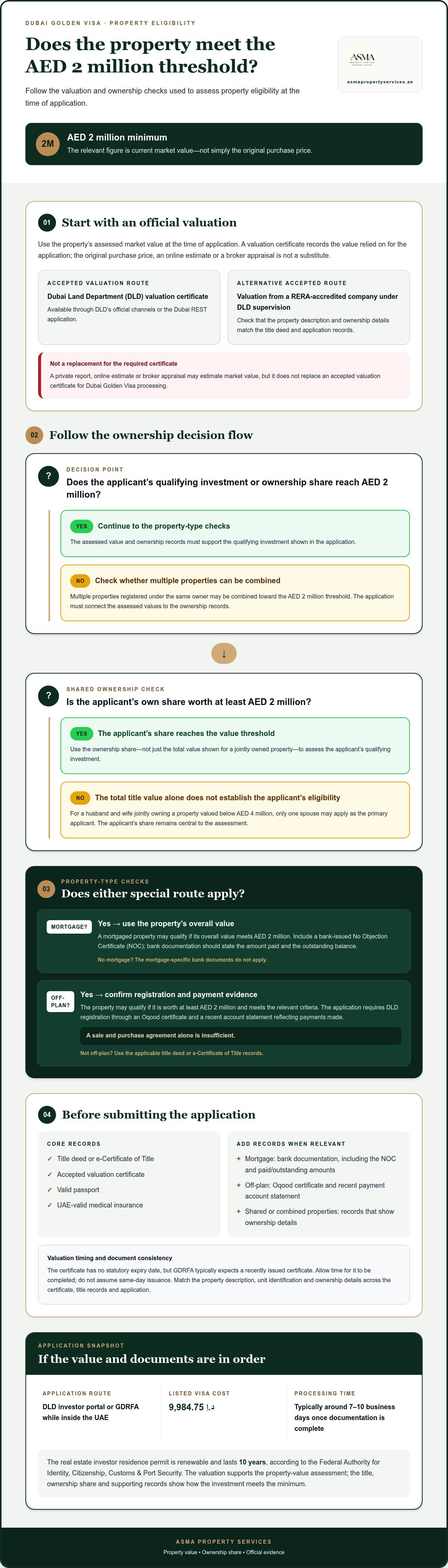
The purchase price isn't the deciding figure: Dubai's Golden Visa property threshold is AED 2 million in current market value. A property valuation for a Dubai Golden Visa establishes whether the property meets that threshold at the time of application. For mortgaged property, eligibility is assessed using the property's overall value, with bank documentation supporting the application.
The difference between market value and purchase price can affect how a property is assessed, especially if its value has changed since purchase or it is jointly owned. An official valuation certificate records the value used in the application. An online estimate or broker appraisal is not a substitute.
This guide explains what the valuation covers, which property features influence the result, and how the AED 2 million minimum is assessed for sole owners, co-owners and mortgage holders. It also outlines the role of official valuation certificates and the practical next steps for arranging a valuation in Dubai.
Key Takeaways
- Understand how the AED 2 million threshold applies to your ownership share, including jointly owned property.
- Learn why an official valuation certificate matters and which valuation routes support a Dubai Golden Visa application.
- Separate current market value from the original purchase price when assessing eligibility.
- See how location, size, condition and market performance shape a property valuation.
- Identify the additional bank documentation relevant to mortgaged property and how multiple properties may contribute to the threshold.
What Is a Golden Visa Property Valuation?
A property valuation for a Dubai Golden Visa assesses whether the property meets the AED 2 million eligibility threshold. The valuation establishes the property’s value for the application; it is not simply a copy of the original purchase price. For Dubai property owners, the title deed must state a property value of at least AED 2 million.
The threshold applies to the applicant’s qualifying investment. If ownership is shared, the applicant’s share matters. Multiple properties registered under the same owner may be combined toward the AED 2 million threshold. The valuation therefore needs to connect the assessed property value with the ownership records submitted for the residence permit.
Are off-plan properties eligible, and what payment conditions apply? Yes, an off-plan property may qualify if it is worth at least AED 2 million and meets the relevant criteria. The application requires DLD registration through an Oqood certificate, plus a recent account statement reflecting payments made; a sale and purchase agreement alone is insufficient.
Can mortgaged properties qualify for a Dubai Golden Visa? Yes. The property’s overall value must meet AED 2 million, and the application needs a bank-issued No Objection Certificate. The bank documentation should state the amount paid and outstanding balance; the required evidence depends on the financed property and application route.
Can jointly owned property or a spouse’s property qualify? Yes, if the applicant’s share meets the AED 2 million threshold. For a husband and wife jointly owning a property valued below AED 4 million, only one spouse may apply as the primary applicant. The ownership share, not just the combined title value, is central to eligibility.
What are the application steps, fees and processing times? Prepare the title deed or e-Certificate of Title, valuation, valid passport and UAE-valid medical insurance; add the relevant bank documents for a mortgage or Oqood and payment statement for off-plan property. Apply through the DLD investor portal or GDRFA while inside the UAE. The listed 10-year property-investor visa cost is د.إ9,984.75, with processing typically around seven to ten business days once documentation is complete.
The Federal Authority for Identity, Citizenship, Customs & Port Security states that the real estate investor residence permit is renewable and lasts 10 years. The valuation supports the property-value assessment; the title, ownership share and supporting records show how the investment meets the minimum.
Property valuation and official evaluation certificates
For a Golden Visa property application in Dubai, the assessment relies on an official valuation, not an informal estimate. The certificate records the assessed property value for the application.
For eligibility, the property value must meet the AED 2 million threshold. The renewable real estate investor residence permit lasts 10 years, according to the Federal Authority for Identity, Citizenship, Customs & Port Security.
Dubai Land Department Valuation Certificates
The Dubai Land Department valuation certificate provides an official assessment for a Dubai property. Owners can obtain it through DLD’s official channels or the Dubai REST application. The certificate is used to establish market value for the Golden Visa application, so check that the property and ownership details match the title deed and application records.
A private valuation report, online estimate or broker appraisal does not replace the accepted certificate for Dubai Golden Visa processing. The accepted document is a DLD valuation certificate or a valuation from a RERA-accredited company under DLD supervision. This distinction matters: a report may estimate a property’s market value without meeting the application’s documentation requirements.
A valuation reflects more than a figure on a page. The assessment considers comparable transactions, location, property condition and prevailing market dynamics. A RICS-compliant valuation aligned with IVSC requirements can provide an evidentiary standard for institutional stakeholders and regulatory authorities. However, it should not be confused with the specific certificate required for a visa application.
Certificate Validity and Timing
A Dubai Golden Visa valuation certificate has no statutory expiry date. GDRFA typically expects a recently issued certificate when you submit the application. Arrange the valuation close to submission so the evidence is current for review.
Do not assume the DLD certificate will be issued on the same day. Treat the valuation as a separate application milestone and allow time for it to be completed. Keep the title deed, ownership details and property information consistent across documents. For off-plan property, ensure the valuation evidence matches the registered records and account documentation.
Before submission, compare the certificate’s property description with the title deed or e-Certificate of Title. Resolve any differences in unit identification, ownership details or property type across the documents. The file should also include the remaining Golden Visa documents, such as passport details and any mortgage or off-plan records relevant to the case.
The certificate supports the property value assessment; it does not replace the residence permit application or its other requirements. Property owners arranging a visa-related evaluation can use property valuation for visa applications as the next administrative step.
Current market value versus purchase price
Dubai Golden Visa property eligibility uses the property’s current market value at the time of application, not its original purchase price. The purchase contract records an earlier transaction; the valuation reflects the property’s assessed value when you apply. The AED 2 million threshold is therefore tested against current value, not the amount originally paid.
This distinction can change the eligibility outcome. A property bought below the threshold may qualify if its current market value reaches at least AED 2 million. A property purchased above the threshold may no longer meet it if its assessed value falls below that level by application time. The relevant figure is the current assessment.
Use the valuation date as the reference point when preparing the real estate application. Compare the official assessment with the AED 2 million threshold, then align it with the ownership documents submitted for the visa. The original purchase price remains useful background, but it does not replace the current valuation in the eligibility assessment.
For a mortgaged property, distinguish the total property value from the amount already paid toward the loan. Eligibility may be based on the property’s total market value rather than mortgage payments made, provided the application includes the required bank No Objection Certificate. Bank documents support the financed-property application, but do not change the market value being assessed.
- Purchase record: Shows the price agreed at the earlier transaction.
- Current valuation: Establishes the property value used at application time.
- Mortgage evidence: Includes the bank NOC supporting the application for financed property.
For example, compare a purchase contract showing a value below AED 2 million with a current official assessment that meets the threshold. The current figure is the relevant eligibility measure. If the assessment is below AED 2 million, an older purchase price above that amount does not establish that the threshold is met.
Before submitting, check that the valuation and ownership records are consistent. Confirm that the assessed property matches the title deed and that the applicant’s ownership interest is clear. For a mortgaged property, include the bank NOC with the supporting documents. This links the current valuation to both the applicant and the property under review.
The value assessment concerns eligibility for a property-based residence permit, not the original transaction alone. The Federal Authority for Identity, Citizenship, Customs & Port Security states that the real estate investor residence permit lasts 10 years and is renewable. For that 10-year term, the application’s property-value evidence remains distinct from the historical purchase record.
Dubai property valuation factors
A Dubai property valuation considers location, size, physical condition and current market performance. Together, these factors shape the assessed market value; no single feature determines the result on its own.
Location sets the property in its local market context. Comparable transactions show how similar properties in the area have been valued. For example, an apartment should be compared with relevant local properties, not simply with one in another part of Dubai. Location helps determine which comparisons are meaningful.
Size defines the property being assessed. A larger unit and a smaller unit in the same building are different valuation subjects. Confirm that the details used for the assessment match the title and the unit under review. A mismatch can make the valuation harder to reconcile with the official ownership documents.
Physical condition is another part of the assessment, considered alongside comparable transactions and location. Make sure the property can be accurately identified and inspected where required. Recent interior and exterior photographs are among the documents listed for apartment valuation, providing a visual record of the unit.
Current market performance places the other factors in the context of prevailing market dynamics. Comparable transactions and broader market patterns help show how the property’s features relate to its current market value. The assessed figure is an official valuation, not a calculation based only on size or a seller’s expectations.
- Match the records: Align the unit details used for valuation with the title deed or ownership record.
- Prepare property evidence: Gather relevant photographs and property information for the valuation file.
- Read the result in context: Consider location, size, condition and market patterns together.
For a Dubai residency application, these factors help explain the property value on the official certificate. They do not replace the visa’s ownership and supporting-document requirements. Sponsor eligibility, a bank objection letter for a mortgaged property and the authority’s application requirements are separate from the valuation itself.
Review the valuation against the property description before using it in the application. If the assessed value seems unexpected, consider the factors that may have influenced it: comparable transactions, recorded size, documented condition and prevailing market performance. This gives the owner a specific basis for understanding the certificate, rather than relying on the purchase price or an informal estimate.
Minimum property investment for a 10-year Golden Visa
For a renewable 10-year Dubai property investor residence permit, the property purchase value must be at least د.إ2 million at the point of application. In 2026, multiple qualifying properties can be combined when they meet the ownership and registration conditions.
Minimum Property Investment
The د.إ2 million minimum applies to the applicant’s qualifying property investment. One property or several properties may count, provided they are wholly owned in the applicant’s name and registered in designated freehold zones. The key test is the qualifying ownership and value shown by the property records, not simply the total value of assets connected to a household.
For example, properties valued at د.إ1.2 million and د.إ800,000 could reach the threshold if both are registered to the same applicant and satisfy the applicable conditions. This is an illustration of the arithmetic, not an eligibility decision. Compare each property’s ownership record and qualifying value before including it in the application.
Minimum Property Value Eligibility
The minimum property value for a Dubai Golden Visa in 2026 is د.إ2 million. A single property can meet that figure, or qualifying properties can be combined under the same applicant’s ownership. For more than one property, confirm that each record identifies the applicant and that the properties sit within designated freehold zones.
Co-ownership changes the calculation. A non-spouse co-owner’s share must independently be worth at least د.إ2 million for the Golden Visa investor category. For spouses seeking separate visas, each spouse’s share must also independently reach د.إ2 million. A jointly owned property below د.إ4 million allows only one spouse to apply as the primary applicant.
Multiple-property eligibility does not mean adding together every property owned by relatives. The relevant properties must be registered in the applicant’s name, and the applicant’s ownership shares must support their own threshold. Title deeds and valuation records link each property’s value to the applicant’s share. Keep these documents consistent before submission.
Once the property threshold is established, prepare the residence permit file separately. The application documents include a title deed or e-Certificate of Title, a valid passport and, for existing UAE residents, an Emirates ID. Golden Visa holders may sponsor eligible family members, including children, but family sponsorship is separate from meeting the property investment minimum.
Use the ownership records to map which properties and shares support your application. Arrange a Golden Visa property valuation to support the value documentation for your qualifying investment.
ASMA Property Services: conveyancing
ASMA Property Services supports Dubai property owners with valuations for visas and conveyancing. The team can help when you need a valuation for a visa application or support with a property transaction involving ownership records.
A valuation provides property-value evidence, while conveyancing supports the legal and administrative steps in a property transfer. If you are arranging a gift or transfer, Property Gifting / Granting may also be relevant. A power of attorney can support property matters handled by an authorised representative, while Non Muslim Wills are for separate estate-planning needs.
These services address different stages: a visa valuation concerns assessed property value, while conveyancing concerns the transaction and its documentation. Visit asmapropertyservices.ae to discuss your Dubai property matter with ASMA.
Put the Next Property Step in Order
A property valuation for a Dubai Golden Visa is one part of a wider property and documentation process. Once your valuation records are ready, identify the next step: align the property paperwork with the transaction or ownership change you need to complete.
ASMA Property Services provides conveyancing for property transactions, Property Gifting / Granting for ownership transfers, and power of attorney for representation in property matters. Each serves a different need, so your next step depends on whether you are transferring ownership, completing a transaction or arranging representation.
Clear documentation makes it easier to move from valuation evidence to the relevant property action. If you need support with that step, contact ASMA Property Services. You can set out your property matter and proceed with a practical next step.
Frequently Asked Questions
Can I qualify for the Golden Visa through real estate investment?
Yes. Dubai’s real estate investor route allows an application for a renewable 10-year residence permit when the qualifying property investment meets the applicable value and ownership conditions. The Federal Authority for Identity, Citizenship, Customs & Port Security states that the permit lasts 10 years. Before applying, map the title deed, ownership share and valuation evidence to the same applicant. That helps keep the property records and visa file aligned.
What do I need before applying?
Prepare the property valuation and title deed or e-Certificate of Title, then assemble the personal documents for the residence application. The passport must be valid for more than 6 months, and UAE-valid medical insurance is required. Existing UAE residents also need an Emirates ID. A mortgage adds bank documentation; an off-plan property requires its registered Oqood certificate and a recent account statement reflecting payments made.
What if the property is valued below AED 2 million?
A valuation below AED 2 million does not meet the property-value condition for that property on its own. Review whether other properties registered under the same applicant can be combined, and check the applicant’s recorded ownership share. For shared ownership, the total title value alone may not establish an individual applicant’s eligibility. The relevant documents must show which property interests belong to the person applying.
Does Dubai Golden Visa property value count the purchase price or current valuation?
The assessment uses current market value at the time of application, not the original purchase price. For example, if the purchase contract and a later official valuation show different values, the later market assessment is the relevant property-value evidence. Keep both records to explain the transaction history, but use the accepted valuation document to support the current assessment in the visa file.
How do I obtain a property valuation certificate for a Dubai Golden Visa?
Request the certificate through the Dubai Land Department’s official channels or the Dubai REST application. The assessment considers comparable transactions, location, property condition and prevailing market dynamics. Provide accurate property and ownership details so the certificate identifies the same asset shown in the title documents. A broker appraisal, online estimate or private report does not replace the accepted certificate for Golden Visa processing.
Which Dubai authority issues the property valuation certificate, and what documents are required?
The Dubai Land Department provides the official valuation route, including through Dubai REST. For an apartment valuation, the file can include the title deed, Emirates ID for a UAE-resident owner, and recent interior and exterior photographs. Off-plan applications use a registered Oqood certificate and a recent account statement showing payments. Documents vary by property type, so match the evidence to the asset being assessed.
What are the risks of relying on a property valuation that falls below the Golden Visa threshold?
A valuation below the threshold does not establish that the property meets the property-value condition. The application may lack sufficient valuation evidence for that property. Before submitting, review eligible properties registered to the same applicant and calculate the ownership interest supported by the records. Do not substitute an older purchase price, online estimate or broker appraisal for the accepted valuation evidence required for the application.

Article by
Suhail Ibrahim
Suhail has guided more than 3,000 Dubai property transactions and built the reputation that leading brokerages rely on — calm under pressure, precise with paperwork, and always reachable when a deal needs completing.


