

Living abroad does not prevent you from starting the DIFC Will process: pre-registration checks can be completed remotely through the DIFC Courts Virtual Registry. Among the Dubai will options for property owners, a DIFC Property Will can cover up to five UAE properties or a share in up to five properties.
Choosing a Will is only part of the decision. The document should suit the assets it covers and how you want your estate administered.
This article explains how DIFC Wills, foreign Wills and UAE inheritance rules relate to Dubai property. It also outlines the role of executors and supporting estate-planning documents, helping you understand how the options fit together before deciding what to put in place.
Key Takeaways
- DIFC Wills can be registered through a remote process, and the right will type depends on the assets and arrangements you want it to cover.
- A DIFC Property Will covers UAE real estate, subject to its property limit; broader assets may require a different estate-planning approach.
- A foreign will may not automatically make the administration of Dubai property straightforward. Local recognition and inheritance rules can affect what happens next.
- Without a registered will, an estate may be handled under applicable UAE inheritance rules, with property distribution proceeding through the courts.
- Executors and supporting documents matter: understand who will administer the estate and how the documents work together before relying on a will alone.
Can a DIFC Will Help Protect Your Dubai Property?
A DIFC Will can set out how eligible UAE assets should pass to beneficiaries. To compare Dubai will options for property owners, consider the number of properties, account ownership, company interests and family circumstances.
DIFC Wills and Dubai Courts Options
The DIFC Wills Service offers Will types for specific assets and broader estates. Dubai Courts Wills are issued locally in Arabic for UAE-based assets, with an English translation available. The distinction matters because the routes have different registration requirements and intended asset coverage.
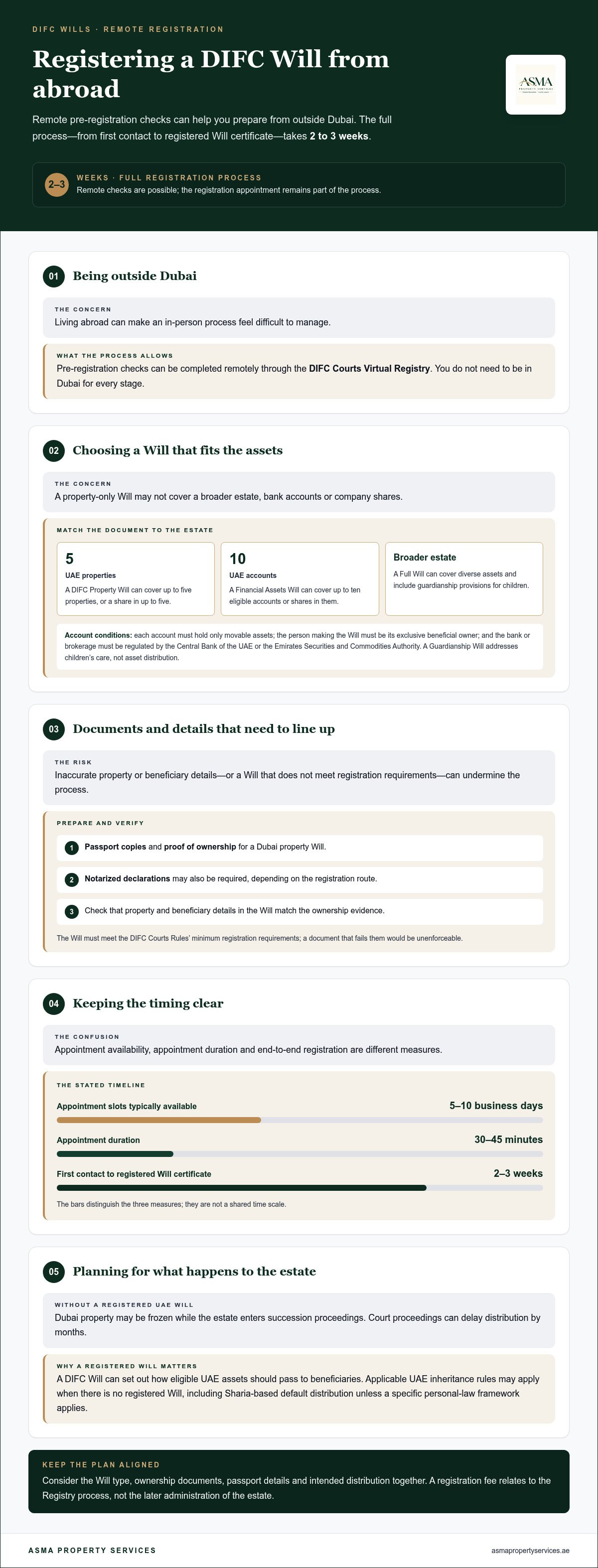
A DIFC Property Will covers up to five UAE properties or a share in up to five properties. Owners with more properties or a broader estate may consider a Full Will, which can cover diverse assets and include guardianship provisions for children. A Guardianship Will addresses children’s care, not asset distribution.
Dubai Courts Wills are issued in Arabic for UAE-based assets, with an English translation available. Processing is described as similar to DIFC Wills, subject to appointment availability. A property-only Will may not cover bank accounts or company shares, so compare Dubai will options for property owners against the estate’s full range of assets.
Property planning may also connect with residency planning. According to Dubai Land Department, its Golden Visa Investor service is available to real estate investors with property valued at AED 2,000,000 or more and provides a 10-year renewable residence permit. The visa and a Will serve separate purposes: one concerns residence, the other estate distribution.
Wills for Jointly Owned and Company-Held Property
A Will can direct only the interest the deceased owns, not another owner’s share. For jointly owned Dubai property, identify the registered ownership share and state how that interest should pass. The co-owner’s rights remain separate.
Property held by a company differs from property held personally. A DIFC Business Owners Will applies to shares in companies incorporated in the UAE and established in accordance with UAE Federal Law. It addresses the owner’s shares, not the company’s property as if the owner held it personally.
For example, if a UAE company holds a Dubai apartment, the relevant estate asset may be the owner’s company shares. The company’s records and the Will should therefore be considered together. A Business Owners Will can address eligible shares, while a Full Will may suit owners with a broader mix of property and assets.
Bank and brokerage holdings may need separate coverage. A DIFC Financial Assets Will can cover up to ten separate UAE accounts, or shares in up to ten accounts. Each account must hold only movable assets, and the person making the Will must be its exclusive beneficial owner. The bank or brokerage must be regulated by the Central Bank of the UAE or the Emirates Securities and Commodities Authority.
Can You Register a DIFC Will From Outside Dubai?
Yes. A DIFC Will can be checked and registered remotely through the DIFC Courts Virtual Registry, so the owner does not need to be in Dubai for every stage. The process from first contact to registered Will certificate takes 2 to 3 weeks.
For an expat who dies without a registered UAE Will, Dubai property may be frozen while the estate enters succession proceedings. The courts may apply Federal Law No. 28 of 2005, the Personal Status Law, and default inheritance rules may include Sharia-based distribution unless a specific personal-law framework applies. Court proceedings can delay distribution by months, affecting beneficiaries who need to manage, sell, or transfer the property.
Registration starts by choosing a Will that matches the assets you intend to cover. An online Property Will process includes drafting and pre-registration checks. The DIFC Courts Wills Registry can conduct those checks in person or remotely through its Virtual Registry. The Will must meet the DIFC Courts Rules’ minimum registration requirements; a document that fails them would be unenforceable.
For a Dubai property Will, prepare passport copies and proof of ownership. Notarized declarations may also be required, depending on the registration route. The Registry needs accurate property and beneficiary details, so the asset description in the Will should match the ownership evidence.
Appointment timing and registration timing are separate. DIFC Will appointment slots are typically available within 5 to 10 business days, and an appointment takes approximately 30 to 45 minutes. The full process, from first contact to certificate, takes 2 to 3 weeks. Remote pre-registration checks reduce the need to travel for that stage; the registration appointment itself remains part of the process.
DIFC registration fees differ by Will type. Property Wills and Full Wills are distinct registration categories, while Mirror Wills apply when spouses register together. The format depends on whether the estate includes only real estate or a broader mix of assets. A registration fee relates to the Registry process, not the later administration of the estate.
For owners with Dubai property and beneficiaries abroad, the practical next step is to align the ownership documents, passport details, and intended distribution before submitting the Will. If you are preparing a Non-Muslim Will alongside UAE property planning, the Non-Muslim Wills service is a relevant place to continue.
Can foreigners inherit Dubai property?
Foreign beneficiaries can inherit Dubai property, but the ownership type and applicable inheritance framework affect what they receive and how it is administered. Freehold rights, a registered Will and any home-country rules all matter.
Yes. Non-Muslim property owners can register a DIFC Will covering eligible UAE assets, including Dubai real estate.
Muslim property owners’ estates are handled under the applicable inheritance rules. Under the described Sharia succession formula, a spouse receives one-eighth when the deceased has children, or one-quarter without children; a son receives twice a daughter’s share.
Property Ownership and Inheritance Rights
Freehold ownership gives the owner permanent rights that can pass to heirs, while leasehold arrangements have a defined term. This distinction matters because inherited rights depend on the registered form of ownership.
Under Dubai Law No. 7 of 2006, freehold ownership has no time limit. Foreign nationals may acquire freehold property only in areas designated under Regulation No. 3 of 2006. Freehold owners can sell, transfer, or lease their property, and heirs may inherit it. Leasehold ownership does not include the land itself; the property reverts to the landlord when the lease ends.
Inheritance Rules for Non-Muslim Expats
UAE inheritance rules for non-Muslim expats include a civil personal-status framework, while a registered Will can provide for estate distribution. This matters to beneficiaries because a Will can set out the intended distribution instead of leaving the estate to default rules.
Federal Decree-Law No. 41 of 2022 on Civil Personal Status took effect in the UAE in February 2023. Non-Muslim expats may apply their home country’s inheritance laws if they have a registered Will. DIFC Wills can cover UAE-wide assets, including Dubai Land Department-registered apartments and villas.
Inheritance Rules for Muslim Property Owners
For Muslim property owners, succession follows the inheritance framework that applies to their circumstances. Distribution affects each beneficiary’s share, including those of a spouse and children, so the estate plan should account for family structure and ownership.
Under the described formula, a surviving spouse receives one-eighth of the estate if the deceased has children, and one-quarter if there are no children. Sons receive twice the share of daughters. These shares concern estate distribution, not a separate transfer of property during the owner’s lifetime.
Off-plan property also requires planning. For example, a buyer might die in 2027 before an apartment purchased for AED 2 million reaches its scheduled handover in 2029. The Will should address the buyer’s interest in that property, not only completed assets.
Home-country rules can remain relevant after inheritance planning in the UAE. Since 6 April 2025, the UK has used long-term UK residence rules when determining whether overseas assets may fall within UK Inheritance Tax. A Dubai property owner with ties to another country should consider how its rules treat overseas property and beneficiaries.
Why a foreign will may not automatically cover Dubai property
A Will prepared abroad may refer to overseas assets without clearly covering Dubai real estate. UAE rules, local registration records and recognition procedures affect how the document applies.
Will Validity Across the UAE
Whether a Will is valid across the UAE depends on its legal framework and the assets it covers. A Will accepted in one country may still require local recognition before it can deal with Dubai property.
Property registered with the Dubai Land Department is subject to UAE law first. Recognition of a foreign Will in UAE courts can take months, creating a separate administration step for beneficiaries. ADJD Civil Wills are valid across all seven Emirates, offering a UAE-wide option rather than relying only on a document prepared abroad.
Checking Existing Will Coverage
An existing Will covers Dubai property only if its terms and legal recognition extend to that asset. Review the wording carefully: a Will may name existing property, describe a general category of future acquisitions, or exclude overseas real estate.
Start by checking whether the document identifies UAE assets, names the intended beneficiaries and addresses later purchases. For example, a Will that refers only to a home in another country may not clearly cover a Dubai apartment. A general clause for future property acquisitions may be relevant, but local recognition remains a separate issue.
Rental income also deserves explicit attention in the estate plan. If a Dubai apartment is rented, identify the property and state how its associated rights and income should be handled. This distinguishes the real estate itself from income arising before it is transferred to beneficiaries.
Property Included in a UAE Property Will
A DIFC Property Will addresses real estate assets exclusively and states how they should be distributed. Its defined scope matters when an estate includes Dubai property alongside bank accounts, business interests, or other assets.
A DIFC Will can cover UAE-wide assets belonging to non-Muslim owners, including apartments and villas registered with the Dubai Land Department. If you plan to buy another property, the Will can refer to a general category of future acquisitions as well as existing assets. Clear descriptions help connect the intended distribution to the relevant ownership records.
Before relying on a foreign Will, compare its asset wording with the Dubai Land Department registration details and intended beneficiaries. Check whether it addresses future purchases and rental income, then consider whether UAE recognition is needed. These distinctions determine whether the document’s stated intentions can be applied to the Dubai real estate in the estate.
Estate-planning documents and executors
A Will is the central estate-planning document, but it works alongside decisions about who will administer the estate and which assets it covers. For Dubai residents and owners living abroad, check that the named people, property records and supporting documents align.
An executor administers the estate under the Will. Choosing one is a practical decision, not just a matter of entering a name on a document. Consider whether the person can communicate with beneficiaries, locate records and manage assets in more than one country. For an owner with a Dubai apartment and foreign accounts, clear records help the executor identify which assets fall under each document.
Keep the asset schedule consistent with ownership records. A Dubai Land Department title record, company shareholding document and bank account details describe different interests. A Will should distinguish a personally owned apartment from shares in a company that owns property. This helps the executor identify the estate asset without treating company property as personally held real estate.
Guardianship planning is separate from asset distribution. A DIFC Guardianship Will allows parents to appoint interim and permanent guardians for their children, but addresses care arrangements rather than inheritance. A Full Will can include guardianship provisions. Someone who registered a Full Will can later amend it to add them after starting a family.
For a Full Will, the mandatory provisions are set out in Schedule 1 of the DIFC Courts Wills Registry Rules. This makes the document’s required content a key drafting consideration. A Will that does not meet the applicable registration requirements can create problems at the point of administration, when the executor needs a clear instrument for the estate.
The DIFC Courts strongly advise people preparing a Will to consider legal advice. The Wills Service publishes a list of legal practitioners who have met minimum standards relating to knowledge of the Rules and drafting DIFC Courts Wills. This guidance is relevant when a document must coordinate Dubai real estate, family arrangements and assets held elsewhere.
Organise supporting records with the Will rather than leaving the executor to reconstruct them. Keep the current Will, ownership evidence, beneficiary details and any later amendment in an accessible set of records. If a property is gifted or ownership changes, update the relevant records so the estate documents reflect the current position.
For a coordinated UAE estate plan, arrange a UAE Will and power of attorney to address asset distribution and practical authority during your lifetime.
ASMA Property Services: conveyancing
ASMA Property Services supports Dubai property owners with conveyancing and related property documentation. Its team can help when estate-planning decisions need to align with property ownership, a transfer or a gift.
ASMA’s services include Non Muslim Wills, power of attorney and Property Gifting / Granting. They address distinct needs: setting out intended inheritance, authorising someone to act on your behalf, or arranging a property gift. Conveyancing supports the property transaction and transfer process; it does not replace advice on which inheritance rules apply to your circumstances.
For owners living abroad, coordinating the Will and property records can clarify what needs attention locally. Contact ASMA Property Services to discuss the relevant property process, or visit ASMA Property Services online.
Set Your Dubai Property Plan in Motion
Turn estate-planning decisions into clear property records and practical arrangements. Keep ownership details, beneficiary intentions and any authority you grant consistent. This gives your representatives a defined starting point if they need to manage a Dubai asset on your behalf.
The right Dubai will options for property owners depend on how the property is held and what you want to happen next. A Will addresses inheritance; property documentation and authority arrangements serve separate purposes. Keep those roles distinct when planning a purchase, transfer or gift.
ASMA Property Services offers conveyancing, Property Gifting / Granting and power of attorney services for property owners handling related matters. These services can support the property transaction or authority process alongside your estate-planning arrangements.
Contact ASMA Property Services to discuss the property process you need to put in place. A clear next step can help keep your Dubai ownership arrangements organised.
Frequently Asked Questions
Does Your Home Country's Law Matter?
Yes. Your home country’s inheritance rules may affect how overseas assets are treated, including Dubai property. A UAE Will can clarify your intended distribution locally, but it doesn’t automatically settle tax questions abroad. For example, since 6 April 2025, the UK has used long-term UK residence rules when determining whether overseas assets may fall within the scope of UK Inheritance Tax. Consider each country’s rules separately.
What About Joint Ownership With Your Spouse?
Your Will can address the share you own, not your spouse’s separate share. Start with the ownership record and confirm how the property is registered before describing it in your estate plan. If both spouses want matching arrangements, DIFC Mirror Wills are an option. Each spouse should consider their own assets, beneficiaries and intended distribution rather than treating the property as one undivided estate asset.
What Happens to a Dubai Expat’s Property When They Pass Away?
Without a registered UAE Will, a deceased expat’s Dubai property may be frozen while inheritance is addressed through court succession proceedings. Default rules may apply, including Sharia-based distribution, unless a specific personal-law framework applies. Distribution can be delayed by months. Beneficiaries should expect the estate administration process to establish the applicable succession route before the property can be dealt with, rather than assume they can immediately sell or transfer it.
What Types of Wills Can Dubai Property Owners Make?
Options include a DIFC Property Will, Full Will, Financial Assets Will, Business Owners Will and Guardianship Will. A Property Will focuses on real estate; a Full Will can cover a broader estate. Financial Assets and Business Owners Wills address eligible accounts and UAE company shares. A Guardianship Will concerns children’s care, not asset distribution. The right type depends on the assets and family arrangements the document needs to address.
What Is the Difference Between a DIFC Will and a Dubai Courts Will?
A DIFC Will is registered through the DIFC Courts Wills Service and can cover eligible UAE assets belonging to non-Muslim owners. A Dubai Courts Will is issued locally in Arabic for UAE-based assets, with an English translation available. The choice affects the document’s format, registration route and intended coverage. Consider the assets involved and whether the Will needs to cover property alone or a broader estate.
Can a Dubai Will Cover Property in Other Emirates or Countries?
A DIFC Will can cover eligible UAE assets beyond Dubai. ADJD Civil Wills are valid across all seven Emirates. Neither option means a UAE Will automatically controls property in another country. For an overseas apartment, check how the country where it is located handles foreign Wills and local property. Clearly identify UAE and overseas property in your estate-planning documents.
What Are the Current Fees for Registering a Will in Dubai?
DIFC registration fees depend on Will type. A single DIFC Courts Property Will costs د.إ 7,500; two Property Wills as Mirror Wills cost د.إ 10,000. A DIFC Full Will costs د.إ 10,000 for one person or د.إ 15,000 for a mirror couple. These are registration fees, not a quote for drafting or professional advice. Check which Will category fits the assets being covered.
How Do You Register or Update a Will in Dubai Step by Step?
First, select a Will type based on your assets and intended beneficiaries. Gather passport copies and proof of property ownership; notarized declarations may also be required, depending on the route. Submit the document for pre-registration checks, which DIFC can conduct remotely through its Virtual Registry. Complete the registration appointment and keep the certificate with your estate records. If your circumstances or assets change, arrange an amendment so the document reflects your current intentions.

Article by
Suhail Ibrahim
Suhail has guided more than 3,000 Dubai property transactions and built the reputation that leading brokerages rely on — calm under pressure, precise with paperwork, and always reachable when a deal needs completing.


