

A remote property ownership update in Dubai can be completed without the owner travelling to the emirate or appointing a representative. For a transaction using a Power of Attorney, Dubai Land Department Circular No. 29/R/2025 requires it to authorise the specific real estate action and identify the property by title deed or Oqood number. Joint ownership doesn’t remove the need for transaction documents to match the property record.
Remote handling can reduce travel, but the steps and costs depend on the type of ownership change. For a sale transfer, the Dubai Land Department fee is 4% of the property value. According to the Dubai Land Department, it is split 2% between buyer and seller, although they may agree a different allocation.
This guide explains how to prepare for a remote property ownership update in Dubai, including identity checks, supporting documents and transaction costs. It also covers when legal support can help international owners coordinate the process and keep the paperwork aligned with the intended change.
Key Takeaways
- Identify whether the change affects a registered owner, ownership share, or supporting personal details; the record change determines the documents and steps involved.
- Prepare property identifiers and identity documents before starting a remote submission, and ensure the details match the existing title deed or Oqood record.
- For foreign-issued documents, understand how notarization, attestation, and Arabic translation may affect their use in Dubai.
- For inheritance, marriage, divorce, or a name change, align the supporting legal documents with the specific update requested in the property record.
- Dubai Land Department sets the minimum property-value threshold for its Golden Visa property route at AED 2 million.
Legal and compliance support for international owners
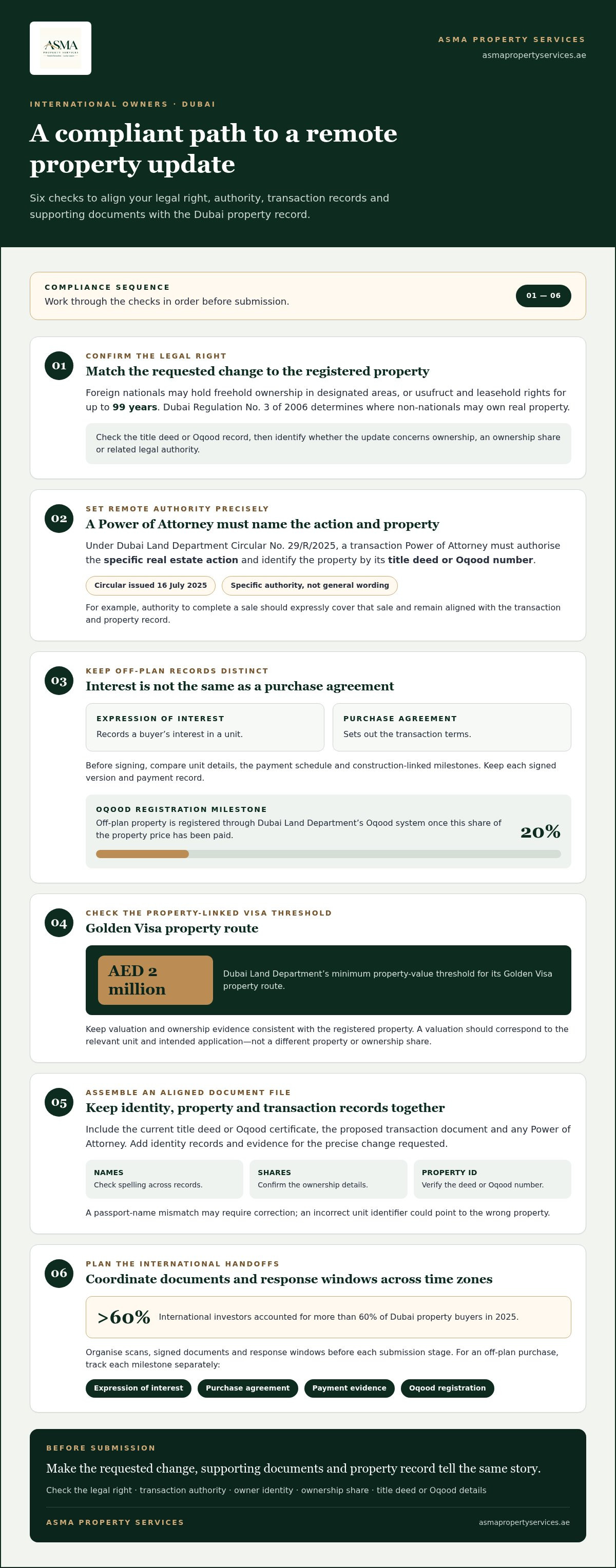
- Map the legal right before changing a Dubai property record. Foreign nationals can hold freehold ownership in designated areas, or usufruct and leasehold rights for up to 99 years. Dubai Regulation No. 3 of 2006 determines where non-nationals may own real property. Match the intended update to the title deed or Oqood record, then identify whether it changes ownership, a share, or related legal authority.
- Set up remote authority carefully if you cannot attend in person. A transaction Power of Attorney must identify the specific real estate action and the property by title deed or Oqood number under Dubai Land Department Circular No. 29/R/2025, issued on 16 July 2025. For example, authority to complete a sale should expressly cover that sale, rather than rely on general wording. Keep the document aligned with the transaction and the property record.
- Separate an expression of interest from a binding purchase agreement for off-plan property. An expression of interest records a buyer’s interest in a unit; the purchase agreement sets out the transaction terms. Before signing, compare the unit details, payment schedule, and construction-linked milestones across the documents. Off-plan property is registered through Dubai Land Department’s Oqood system once 20% of the property price has been paid. Preserve each signed version and payment record.
- Use the official Golden Visa property threshold when assessing a property-linked application. Dubai Land Department sets the minimum property-value threshold for Dubai’s Golden Visa property route at AED 2 million. Keep valuation and ownership evidence consistent with the registered property details. A valuation for gifting or visa purposes should correspond to the relevant property and intended application, not a different unit or ownership share.
- Build an international-owner file around identity, property and transaction records. Keep the current title deed or Oqood certificate, the proposed transaction document and any Power of Attorney together. Check spelling, ownership shares and property identifiers across each record before submission. A mismatch between a passport name and the deed may require a correction; an incorrect unit identifier could point to the wrong property.
- Plan communications around time zones and the transaction sequence. International investors accounted for more than 60% of Dubai property buyers in 2025. An owner in another country can organise scans, signed documents, and response windows before each submission stage. For an off-plan purchase, track the expression of interest, purchase agreement, payment evidence, and Oqood registration as separate milestones. This keeps investment paperwork ordered without treating early interest as completed ownership.
What owner details can be updated remotely in Dubai property records?
- Start by defining the change you need recorded. A remote update may concern the registered owner, an ownership share or personal details linked to an existing record. These are different requests, not interchangeable edits. For example, correcting a spelling discrepancy does not transfer ownership. Write the intended outcome in one sentence, then compare it with the current title deed or Oqood record.
- Separate identity corrections from changes in legal ownership. A changed name or passport detail concerns the owner’s identity information. Adding or removing a co-owner, changing a registered share or transferring property changes the ownership position. Identify which applies before preparing documents. If the request affects a share, specify the current and intended ownership arrangements in the supporting paperwork.
- Use the property identifier shown on the official record. Locate the title deed number for a completed property or the Oqood number for an off-plan property. Compare it with the unit and owner details in your request. Dubai’s remote registration process uses an audio-visual call and other authentication methods to verify buyers and sellers before a property deed transfer. Keep identification documents available for verification.
- Describe each personal-detail correction precisely. Record the existing entry, the corrected entry and the reason for the change. For example, if a passport renewal changes its number, distinguish that document update from a legal name change. Submit consistent identity records and use the same spelling across forms. This gives reviewers a clear comparison between the existing record and requested correction.
- For a title or ownership-share change, identify the legal transaction behind it. A sale, gift or grant requires transaction documents that match the intended result. A property gift, for example, is not simply a correction to an owner’s contact details. State who owns the property now, who should own it after completion and the relevant share. The deed or Oqood record should correspond to that outcome.
- Organise the submission as a change file. Include the current property record, identity documents, the precise amendment requested and transaction evidence if ownership itself will change. Keep copies together and use consistent names and property identifiers. For a remote property ownership update in Dubai, this preparation helps distinguish an administrative correction from a transaction that changes registered ownership.
- If the intended change is a gift or grant, structure the request around that transaction rather than describing it as a simple detail edit. Dubai property ownership update support can help organise the paperwork for the requested record change.
What documents are required to update Dubai property ownership records from abroad?
- Start with a clear written description of the requested update. State whether it concerns an identity correction, an ownership transfer or a change to a registered share. Include the owner’s full name and the property identifier. This instruction helps organise supporting documents around the actual transaction, rather than mixing unrelated paperwork or submitting documents for a different type of change.
- Include the current property record: the title deed for a completed property or the Oqood record for an off-plan property. Copy the property identifier exactly as shown. Compare the owner’s name, unit details and any recorded share with the proposed update. Dubai Land Department property registration records identify the property being transferred, so consistent identifiers matter.
- Prepare identity documents for each owner whose details or rights are affected. Keep passport information consistent with the current record and requested change. For a remote transaction, owners and other parties may also need to complete identity verification through an audio-visual call and other authentication methods before a deed transfer. Keep relevant identity documents accessible during verification.
- If a representative will act for you, include a transaction-specific Power of Attorney. Dubai Land Department Circular No. 29/R/2025, issued on 16 July 2025, requires the authority to specify the real estate action and identify the property by title deed or Oqood number. For example, authority to complete a transfer should name that action and the property, not rely on broad wording alone.
- Attach the document that establishes the basis for the change. A sale or gift should be supported by the relevant transaction paperwork; a name correction should be supported by records showing the changed detail. For an ownership-share change, state the current and intended shares clearly. Align each supporting document with the requested outcome and the names on the property record.
- Arrange transaction records in a usable sequence. Place the property record first, followed by identity documents, the written request, authority documents and transaction evidence. Use clear file names, such as “title deed” or “signed transfer document.” Keep legible copies of signed pages and store originals securely. This sequence makes the evidence for each requested amendment easier to follow.
- Keep payment instructions separate from the document file. Dubai Land Department rules require transaction funds to be paid directly into the property owner’s UAE bank account; a Power of Attorney holder cannot receive those funds on the owner’s behalf. Keep bank account details and transaction records with the file, and make sure payment arrangements reflect the registered owner.
Do foreign documents need notarization, UAE embassy attestation, or Arabic translation for a Dubai ownership update?
- Classify each foreign document before arranging formalities. A birth certificate, marriage certificate, court order and Power of Attorney serve different purposes. Note the document’s issuing country, language, purpose and intended use in the Dubai property update. This creates a document-by-document plan instead of applying the same process to every paper.
- Distinguish notarization from attestation. Notarization generally records or authenticates a signature or document execution. Attestation concerns the formal authentication chain for a document issued in another country. They address different steps. For example, a signed Power of Attorney and a civil-status certificate may follow different routes because their issuers and purposes differ.
- Map the document’s route from its country of issue to its use in Dubai. Record the issuing authority and whether the document is original or certified. Then identify the authentication stages required for that document and destination. A court-issued document may need different treatment from a privately signed declaration.
- Assess Arabic translation separately from authentication. Translation makes a document’s contents accessible in Arabic; on its own, it does not authenticate the issuing authority or signatures. If a foreign-language court order supports an ownership change, keep the original-language document and its Arabic translation together. Check that names, dates, property references and legal terms match.
- Compare translated names with the Dubai property record. A passport may use a different transliteration from a marriage certificate or title deed. Note each spelling variation and keep identity evidence with the relevant document. For instance, documents supporting a name change should connect the prior name with the current identity.
- Use each document’s purpose to decide what belongs in the file. A Power of Attorney authorises a representative; a court order may evidence a legal outcome; a civil certificate may explain a personal-status change. Keep unrelated records separate. Label each file by document type, issuing country and the ownership update it supports.
- Sequence formalities before sending originals or arranging signatures. List the required notarization, authentication, attestation and translation actions for each document. Complete them in the required order for the issuing country and intended use. A translated copy prepared before the final authenticated document may need replacement if the underlying version changes.
- Assemble a final comparison set: the source document, authentication evidence, Arabic translation where needed and matching identity records. Document attestation can help prepare foreign-issued paperwork for formal use. Review every page for legibility, consistent names and matching document references before adding it to the Dubai ownership update file.
What are the rules for updating ownership records after inheritance, marriage, divorce, or a name change
- First, establish whether the event changes the legal owner or only their recorded details. Inheritance, divorce and a gift can affect ownership rights. Marriage or a name change can explain differences between identity records. Write down the exact outcome requested, such as correcting the owner’s name or registering a successor.
- For an inheritance-related update, assemble official documents establishing the deceased owner’s identity, the applicant’s relationship and the basis for the requested ownership change. Keep the current title deed or Oqood record with those papers. Together, the documents should connect the property, former owner and proposed successor without relying on an unexplained name or share.
- Separate proof of inheritance from the property record itself. A will, court document or other official succession record serves as evidence; the title deed shows the registered property details. Organise both sets together. Record the property identifier and proposed ownership details on a cover sheet to keep the requested change clear throughout the submission.
- After marriage, compare the name on the property record with current identity documents. Marriage alone does not complete an ownership transfer. If the requested update changes the registered owner or ownership share, state that separate outcome and include supporting documents. If only a name differs, clearly connect the previous and current names.
- For divorce, identify the property outcome recorded in the relevant legal documents. A divorce record and an agreement about property are not necessarily the same evidence. Arrange the supporting documents to show whether the request concerns a name correction, a transfer or a change in shares. Match each requested change to its documentary basis.
- For a name change, gather official evidence linking the former name to the current one. Compare spelling across the passport, property record and supporting certificate or court record. If transliteration differs, list both versions and identify where each appears. This helps explain the discrepancy without treating it as a change of owner.
- Use the title deed or Oqood number to connect every supporting record to the correct Dubai property. Keep identity evidence, legal documents and the requested amendment in separate, clearly labelled files. For a remote submission, consistent names and property identifiers make the review easier to follow and help distinguish a personal-status event from an ownership transfer.
- Before submission, prepare a short sequence: current property record, identity documents, event-related legal evidence, and the precise update requested. For a succession or ownership-share change, arrange a remote ownership update with the paperwork organised around that outcome.
ASMA Property Services: conveyancing
ASMA Property Services supports owners managing Dubai property transactions from abroad. Turn to its conveyancing service when an ownership change requires coordinated transaction paperwork, or when a gift or grant needs to be reflected in property records. Power of Attorney support can help arrange representation for a defined real estate action. ASMA also offers Muslim and non-Muslim wills coordination.
The right support depends on the legal outcome: a conveyance, a property gift, or authority for a representative. Keep the property record and relevant legal documents ready to explain the requested change. ASMA Property Services can help with the related property process. Contact ASMA Property Services or visit asmapropertyservices.ae to discuss your matter.
Put the next ownership step in motion
Before starting a remote property ownership update in Dubai, define the result you need: a corrected personal detail, a changed ownership share or a completed transfer. Use that outcome to organise the transaction file and keep decisions about documents, authority and costs connected to one clear purpose.
For international owners, the next step is coordinating the legal work with the property record. ASMA Property Services provides conveyancing, Property Gifting / Granting and Power of Attorney support for relevant transactions. This can help when an ownership change involves more than correcting an administrative detail, such as documenting a gift or authorising a representative.
Bring the intended outcome and available property documents into the discussion. Contact ASMA Property Services to discuss the conveyancing or ownership support your matter requires. A clear starting point helps move the process forward with purpose.
Frequently Asked Questions
How can overseas owners update Dubai property ownership details with the Dubai Land Department?
Overseas owners can complete eligible Dubai property transactions remotely through the remote registration system. First, identify whether the request changes title or corrects an existing owner detail. Then use the relevant registration route and complete the required identity checks, including an audio-visual call where applicable. A sale transfer and a passport-detail correction, for example, are distinct requests. Confirm that the final registered record reflects the intended change.
Can Dubai property ownership updates be completed online through the DLD or Dubai REST app?
Remote registration is available for Dubai property transactions, but an app login alone does not complete every ownership update. The steps depend on whether the request transfers title, changes an ownership share or corrects an owner detail. Use the Dubai Land Department channel applicable to the transaction and complete its verification requirements. A title transfer requires registration of the transaction, not only an online change to contact information.
Can an overseas owner authorize a representative to update Dubai property records, and what power of attorney is required?
Yes. A representative can act under a Power of Attorney that identifies the specific property action and property reference. Dubai Land Department Circular No. 29/R/2025 requires the authority to identify the property by title deed or Oqood number. A sale Power of Attorney can be valid for up to two years; a purchase Power of Attorney can be valid for up to five years. The authority should match the intended transaction.
What are the Dubai Land Department fees and processing times for updating property ownership details?
Costs depend on the transaction type. For property registration, the stated DLD fee is AED 2,000 plus 5% VAT below AED 500,000, or AED 4,000 plus 5% VAT at AED 500,000 or more. Preparing and attesting a transaction Power of Attorney typically takes 15 to 30 business days; this is not a general DLD update timeframe.
What risks or common delays affect remote Dubai property ownership updates, and how can owners verify the change?
Document mismatches can interrupt a submission. Different name spellings, an incorrect property reference or authority that omits the required action can lead to rework. Compare the final record with the owner’s identity document and the property’s title deed or Oqood details. After a completed transfer, confirm that the updated title deed reflects the intended ownership. Keep submitted documents and registration confirmation together as the transaction record.

Article by
Suhail Ibrahim
Suhail has guided more than 3,000 Dubai property transactions and built the reputation that leading brokerages rely on — calm under pressure, precise with paperwork, and always reachable when a deal needs completing.


