

A Dubai property transfer involves document checks, approvals, settlement of outstanding obligations and registration of ownership with the Dubai Land Department. For peace of mind conveyancing in Dubai, buyers should account for the 4% DLD transfer fee on most transactions and confirm that ownership, payment and transfer documents are in order before the final appointment.
The paperwork and costs can feel less predictable than the purchase itself. This guide explains what peace of mind conveyancing in Dubai involves, what government charges and professional fees cover, and how ownership rules depend on a property’s location and tenure. It also shows how due diligence can identify issues such as unpaid service charges, mortgage requirements or incomplete documents before they disrupt a transfer.
You’ll learn how the process moves from agreement review to title deed registration, what can affect progress, and how a Power of Attorney can help when a buyer or seller cannot attend in person. The aim is to clarify the steps, responsibilities and costs so you can prepare the right documents and make informed decisions at each stage.
Key Takeaways
- Map the transfer from agreement review through approvals and title deed registration so each party knows what must be completed.
- Separate government charges from professional fees and identify which transaction details affect the total cost.
- Check whether the property’s location and tenure allow the ownership structure you intend as a foreign buyer.
- Review ownership records, mortgages, service charges and transfer documents early to reduce avoidable delays.
- Understand how a Power of Attorney can support a property transfer when a buyer or seller cannot attend in person.
What Does Conveyancing in Dubai Involve?
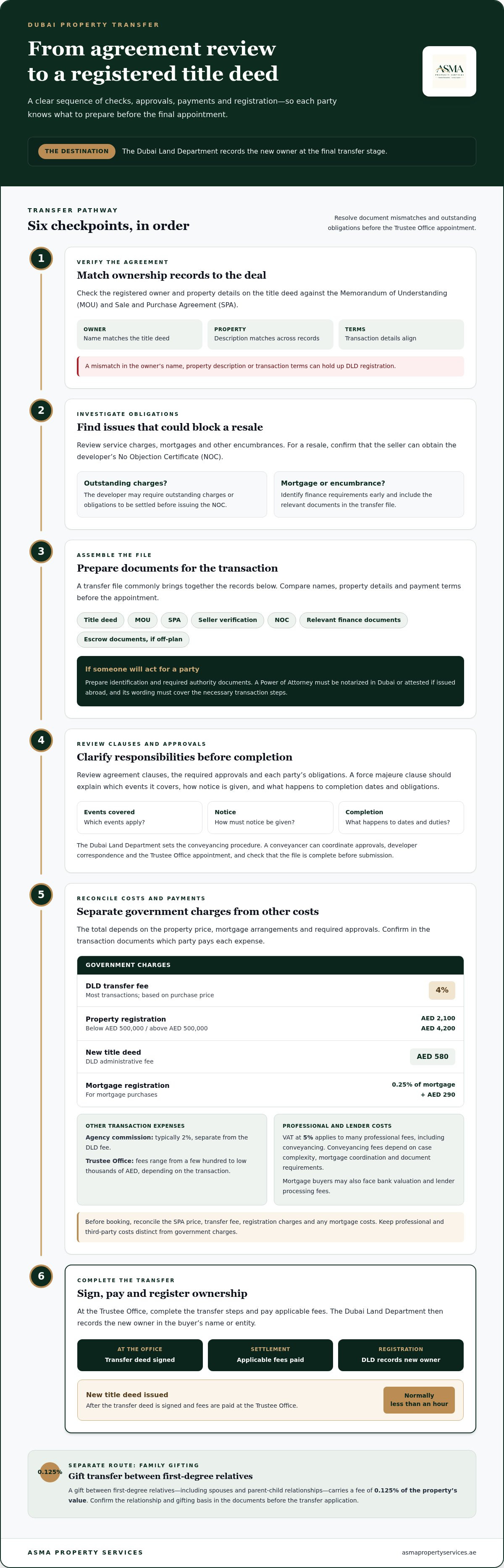
Conveyancing coordinates the checks, approvals and registration needed to transfer property ownership. In Dubai, the Dubai Land Department records the new ownership at the final transfer stage.
Property Searches and Due Diligence
A title check confirms the registered owner and property details against the title deed. Before signing, compare these details with the Memorandum of Understanding (MOU) and Sale and Purchase Agreement (SPA). A mismatch in the owner’s name, property description or transaction terms can hold up registration at the Dubai Land Department.
Due diligence also covers outstanding service charges, mortgages and other encumbrances. For a resale, confirm that the seller can obtain the developer’s No Objection Certificate (NOC), which confirms there is no objection to the transfer. The developer may require outstanding charges or obligations to be settled before issuing it.
These checks connect directly to the transfer process. The Dubai Land Department sets the conveyancing procedure and records the new owner. A conveyancer can coordinate approvals, developer correspondence and the trustee office appointment, while checking the file is complete before submission.
Review the agreement clauses as well as the ownership records. A force majeure clause should explain which events it covers, how notice must be given, and what happens to completion dates and each party’s obligations. Clear wording helps both parties understand their contractual position if an event disrupts the transaction.
Family gifting follows a separate fee route. In Dubai, a gift between first-degree relatives, including spouses and parent-child relationships, carries a fee of 0.125% of the property’s value. Confirm the relationship and gifting basis in the documents before the transfer application.
Documents and Registration Status
A Dubai property transfer file commonly includes the title deed, MOU, SPA, seller verification, NOC and relevant finance documents. An off-plan transaction may also involve escrow documentation. Before the trustee office appointment, compare names, property details and payment terms across the records.
Buyers and sellers should prepare identification and any authority documents required for their transaction. If a representative will act for a party, the Power of Attorney must be notarized in Dubai or attested if issued abroad. Errors in its wording can put the transfer at risk, so ensure the authority covers the necessary transaction steps.
“Peace of Mind Conveyancing” does not, by itself, establish that a firm is licensed or registered in Dubai. The relevant status belongs to the specific firm or professional; the Dubai Land Department controls the conveyancing procedure, and a DLD-certified conveyancer is described as supporting compliance and reducing documentation errors.
At registration, the parties complete the transfer steps and the Dubai Land Department records ownership in the buyer’s name or entity. The 4% DLD transfer fee applies to most transactions. Confirm the applicable transfer documents, approvals and payment arrangements before the appointment to reduce the risk of an incomplete application.
What Are Conveyancing Fees?
Dubai property transaction costs include government charges, third-party expenses and professional fees. Separate these categories when budgeting: the Dubai Land Department (DLD) transfer fee is distinct from conveyancing or agency fees. Your total depends on the property price, mortgage arrangements and required approvals.
Government Charges and Registration
For most transactions, the DLD transfer fee is 4% of the property purchase price. For example, calculate that percentage against the agreed price, then add the separate registration and title deed charges. Property registration costs AED 2,100 for properties below AED 500,000, and AED 4,200 for properties above AED 500,000.
A new title deed carries an AED 580 DLD administrative fee. The transfer process includes DLD approvals, payment of applicable fees and registration of the new owner. Once the transfer deed is signed and fees are paid at the Trustee Office, a new title deed is normally issued in less than an hour. For peace of mind with conveyancing in Dubai, keep this issuance step distinct from the earlier approval and payment stages.
Mortgage purchases add lender-related costs. Mortgage registration costs 0.25% of the mortgage amount plus AED 290. Buyers may also face bank valuation and lender processing fees. Include these separately from the DLD transfer fee, since they relate to the financing rather than the property’s purchase price alone.
Other Transaction Expenses
Agency commission is typically 2% in Dubai and remains separate from the 4% DLD transfer fee. Trustee Office processing fees range from a few hundred to low thousands of AED, depending on the transaction.
VAT at 5% applies to many professional fees, including conveyancing. Professional conveyancing fees depend on the case and are given after a quote request; factors include transaction complexity, mortgage coordination and document requirements. Separating these costs supports peace of mind when arranging conveyancing in Dubai and helps distinguish professional fees from government charges.
Before booking the Trustee Office appointment, reconcile the SPA price, transfer fee, registration charges and any mortgage costs. Confirm in the transaction documents which party pays each expense. A clear breakdown helps both parties prepare payment arrangements and reduces administrative delays at the final transfer stage.
For a transfer involving several approvals or financing documents, Dubai property conveyancing can coordinate the transaction steps and DLD requirements.
Freehold and leasehold ownership for foreign buyers
For a foreign buyer, the ownership right depends on the property’s location and tenure. Non-UAE nationals can purchase freehold property in designated Dubai freehold zones. Outside those zones, they may hold leasehold interests for 99 years. Conveyancing due diligence should establish which right applies before the buyer commits.
Confirm the Property’s Tenure
Dubai Marina, Downtown Dubai, Palm Jumeirah, Jumeirah Lakes Towers and Business Bay are designated freehold areas. Even in these locations, verify the specific property’s title and registered ownership. The area name alone does not replace a title check.
For a property outside a designated freehold zone, review the leasehold terms and the stated 99-year period. Confirm the interest described in the property documents, rather than relying on an agent’s shorthand or a listing description. This distinction affects what right transfers to the buyer at registration.
Before signing, compare the property details and seller’s name on the title deed with the proposed transaction documents. The Dubai Land Department records ownership at the final transfer stage. Resolve any discrepancy between the registered owner, seller and agreement before submitting the transfer application.
Review the Agreement and Deposit
The buyer and seller set the main transaction conditions during negotiations through a Memorandum of Understanding (MOU). Review it alongside the Sale and Purchase Agreement (SPA). Check the agreed price, payment schedule, completion steps, handover obligations and any conditions tied to financing or approvals.
A buyer usually pays a deposit of 10% of the property being acquired. The agreement should state how the deposit is handled and what obligations apply to each party. Read those terms before payment, especially if completion depends on a mortgage, developer approval or another transaction milestone.
Consistent records are central to protecting both buyer and seller. Verify the seller’s legal ownership and compare the title deed with the MOU and SPA. For a mortgaged property, identify the required clearance steps and include them in the transaction schedule. For a resale, allow for the developer NOC and any outstanding service charges.
Conveyancing support can help review ownership documents and transaction terms before signing. Buyers can also consider whether to register ownership personally, jointly or through a company, taking long-term ownership and inheritance implications into account. Sellers benefit from clear completion duties, approval requirements and payment milestones in the SPA.
These checks support an orderly transfer, but they do not replace reading the signed terms. Record agreed changes in the MOU or SPA before proceeding. Identifying a tenure mismatch, unclear deposit condition or inconsistent seller details early gives the parties a chance to resolve it before the final registration appointment.
Legal due diligence and ownership verification
Peace of mind conveyancing in Dubai starts with matching the seller’s identity and ownership records to the property documents. The Dubai Land Department registers ownership, while the title deed identifies the registered owner and property. Resolve differences in names, unit details or ownership shares before submitting transfer documents.
Verify Ownership and Transaction Records
Start with the title deed, then compare its property details with the Sale and Purchase Agreement (SPA). Confirm that the seller named in the SPA matches the registered owner. If a company owns the property, check that the contracting entity matches the ownership record and its representative is authorized to act.
Review the SPA’s payment terms, completion conditions and handover obligations against the transaction the parties agreed. For a mortgaged property, establish the required settlement and release steps. Identify outstanding service charges and other obligations that could affect the developer’s No Objection Certificate (NOC) or readiness for transfer.
For an off-plan purchase, verify that the developer and project are registered with the Dubai Land Department and RERA. Review the payment documentation and confirm that payments go into a government-approved escrow account. These checks help buyers assess the project and payment route before proceeding under the SPA.
Check Authority and Finance Documentation
Review the NOC, title deed, SPA and finance documents together as one transaction file. A secondary-market transfer requires the developer’s NOC confirming paid service charges and no outstanding seller obligations. Missing approval or inconsistent property details can interrupt the application at the trustee office.
Buyers using a mortgage should coordinate lender requirements with the transfer sequence. The file may need finance documents, settlement information and approvals before registration. Check that the buyer’s and seller’s names, property identifiers and agreed payment arrangements are consistent across the records.
A Power of Attorney can authorize a representative to handle transaction steps when a buyer or seller cannot attend. It must be notarized in Dubai or attested if issued abroad. Check that the representative’s authority covers the required actions, including signing documents and attending the final transfer. Errors in the Power of Attorney can put the transaction at risk.
Organize documents by transaction stage: ownership evidence, signed contracts, developer approvals and finance records. Reconcile them before the appointment, rather than discovering a mismatch during submission. For peace of mind conveyancing in Dubai, resolve any seller-name discrepancy between the title deed and SPA before the appointment to help keep registration on track.
Conveyancing delays and common pitfalls
In Dubai, transfer delays usually start before the trustee appointment. The developer’s No Objection Certificate (NOC), mortgage clearance, document accuracy and party readiness all affect the timeline. A standard property transfer takes 7-14 business days, depending on buyer and seller readiness, mortgage clearance, developer approval and Dubai Land Department processing.
Allow for Developer and Bank Processing
An NOC application typically takes 5-15 working days, depending on the developer. Submit the application with the required property and ownership details, then track outstanding service charges or seller obligations. If charges remain unpaid, the developer may need settlement before issuing approval.
Mortgage transactions typically take 45-75 days because of bank processing. The buyer’s lender and the seller’s bank may each have steps to complete before transfer. Align valuation, finance approval, mortgage settlement and release requirements with the SPA timeline. A delay at either bank can affect the final appointment.
For a cash purchase, confirm the transfer fee and payment arrangements before booking. For a financed purchase, include mortgage registration and lender processing in the schedule. The 4% DLD transfer fee applies to most transactions; it is separate from mortgage registration charges and other transaction costs.
Prevent Documentation and Attendance Issues
Names, property details and payment terms should match across the title deed, SPA and trustee application. A spelling difference or incorrect unit reference can lead to a rejected or paused submission. Compare each document with the registered ownership record before attending the transfer appointment.
Attendance can also affect the transfer process. If a buyer or seller cannot attend, a Power of Attorney can authorize a representative to handle transaction steps, including the final transfer at the trustee office. It must be notarized in Dubai or attested if issued abroad. Make sure it covers the required actions and that the representative brings the correct documents.
Keep the developer, lender, buyer, seller and conveyancing representative aligned on the completion sequence. Confirm who will obtain approvals, settle outstanding charges, prepare payment and attend the appointment. A missed handoff between parties can extend the process even when every individual document is ready.
Before the appointment, use a final readiness check:
- Confirm the developer NOC and settlement of relevant charges.
- Align the buyer’s funds, transfer fee and bank requirements.
- Match identification and transaction documents across the file.
- Confirm attendance or prepare a valid Power of Attorney.
Arrange Dubai conveyancing support to coordinate transaction documents, approvals and transfer steps.
ASMA Property Services: conveyancing
ASMA Property Services handles conveyancing for buyers and sellers completing Dubai property transfers. The service coordinates transaction documents and progression through transfer requirements, including mortgage steps and remote representation.
Turn to ASMA’s conveyancing service when you need help organizing a transfer and aligning the required paperwork. For a family property transfer, Property Gifting / Granting supports the gifting process. A Power of Attorney can enable representation when a party cannot attend in person. ASMA also coordinates Muslim and Non-Muslim Wills for clients planning property succession.
Choose the service that fits your transaction: a sale or purchase, a family gift, authorized representation or estate planning. Visit asmapropertyservices.ae to discuss your Dubai property matter with ASMA.
Set Your Property Transfer in Motion
A peace-of-mind approach to conveyancing in Dubai starts by defining the outcome you want: a purchase, sale, family transfer or authorized representation. Set that objective before taking the next administrative step. It gives each document, instruction and decision a clear purpose and keeps the transaction focused on the ownership outcome you intend.
ASMA Property Services provides conveyancing for Dubai property transactions, as well as Property Gifting / Granting and Power of Attorney support. Each service addresses a different need: transferring ownership through a sale or purchase, arranging a family gift, or authorizing someone to act in a property matter. Identify the route that fits your circumstances, then proceed with the relevant support.
For a clear next step, contact ASMA Property Services to discuss your property transaction. A considered plan can make the process easier to manage from the outset.
Frequently Asked Questions
How much is the Dubai Land Department transfer fee?
The Dubai Land Department (DLD) transfer fee is 4% of the property purchase price for most transactions. It is calculated on the agreed purchase price, not the conveyancer’s professional fee. Keep it separate from registration charges, trustee office processing, agency commission and any mortgage costs when preparing your transaction budget. For a family gift, the applicable fee structure differs, so identify the transaction type before estimating the total.
How long does the conveyancing process take?
A straightforward secondary-market transaction typically takes 30-60 days from signing the Sale and Purchase Agreement (SPA) to receiving the title deed. A mortgage transaction typically takes 45-75 days because bank processing adds steps. The trustee appointment itself is only one milestone; developer approvals, lender requirements and party readiness affect the overall timeline. For planning, align the SPA completion date with the expected approval and finance steps.
What are the steps for buying property in Dubai with a conveyancer?
A buyer typically moves through these stages in order:
- Agree transaction terms with the seller and record them in the MOU.
- Review the SPA, title details and ownership records.
- Arrange financing and identify lender requirements, if applicable.
- Obtain the developer NOC and address relevant outstanding obligations.
- Prepare transfer documents and payment arrangements.
- Attend the trustee office appointment and complete registration.
After registration, confirm that the title deed shows the buyer’s correct name or entity.
What Dubai Land Department and trustee office fees apply to a property transfer?
Alongside the 4% DLD transfer fee, property registration costs AED 2,100 below AED 500,000 and AED 4,200 above AED 500,000. A new title deed carries an AED 580 DLD administrative fee. Trustee office processing typically ranges from a few hundred to low thousands of AED. Mortgage registration adds 0.25% of the mortgage amount plus AED 290. These charges are separate from professional fees and agency commission.
What risks and checks should buyers consider when choosing a Dubai conveyancer?
Check that the service covers title and seller verification, SPA review, developer NOC coordination, outstanding service charges and mortgage documentation. Find out how approvals will be tracked and the trustee office file prepared, since missing or inconsistent documents can delay submission. For off-plan property, due diligence includes checking developer and project registration with the Dubai Land Department and RERA, as well as escrow-account compliance. UAE law doesn’t require buyers to hire a lawyer for Dubai property transactions.

Article by
Suhail Ibrahim
Suhail has guided more than 3,000 Dubai property transactions and built the reputation that leading brokerages rely on — calm under pressure, precise with paperwork, and always reachable when a deal needs completing.


