

A Dubai property gift transfers ownership without payment to an eligible relative or qualifying company, and can form part of succession planning. Property gifting in Dubai is generally available between parents, children, spouses, and qualifying companies. According to the Dubai Land Department, the gift-transfer fee is 0.125% of the property’s current official value.
The transfer involves more than changing the name on a title deed. Eligibility, property valuation, supporting documents, and registration all affect the process, while overseas relationship documents may need legalisation. The registration itself can take approximately 20 minutes after all documents are submitted, though preparing the transfer can take longer.
This guide explains who can receive a property gift in Dubai, how valuation and registration work, and what can affect the process. It also covers how a lifetime transfer may support succession planning and when gifting may not be the right route. You’ll have a clearer picture of the steps before deciding how to proceed.
Key Takeaways
- Identify whether the intended recipient qualifies before preparing the transfer, and gather relationship or company-ownership evidence.
- Understand how the official property valuation affects the reduced gift-transfer fee and which registration charges may also apply.
- Separate the registration appointment from the full preparation timeline; document legalisation, valuation, and NOC collection can add time.
- Use a lifetime transfer as one succession-planning option, while considering how ownership changes may affect future control and transfers.
- Follow the registration steps in order, from checking property status and documents to valuation and title deed issuance.
What is a property gift transfer?
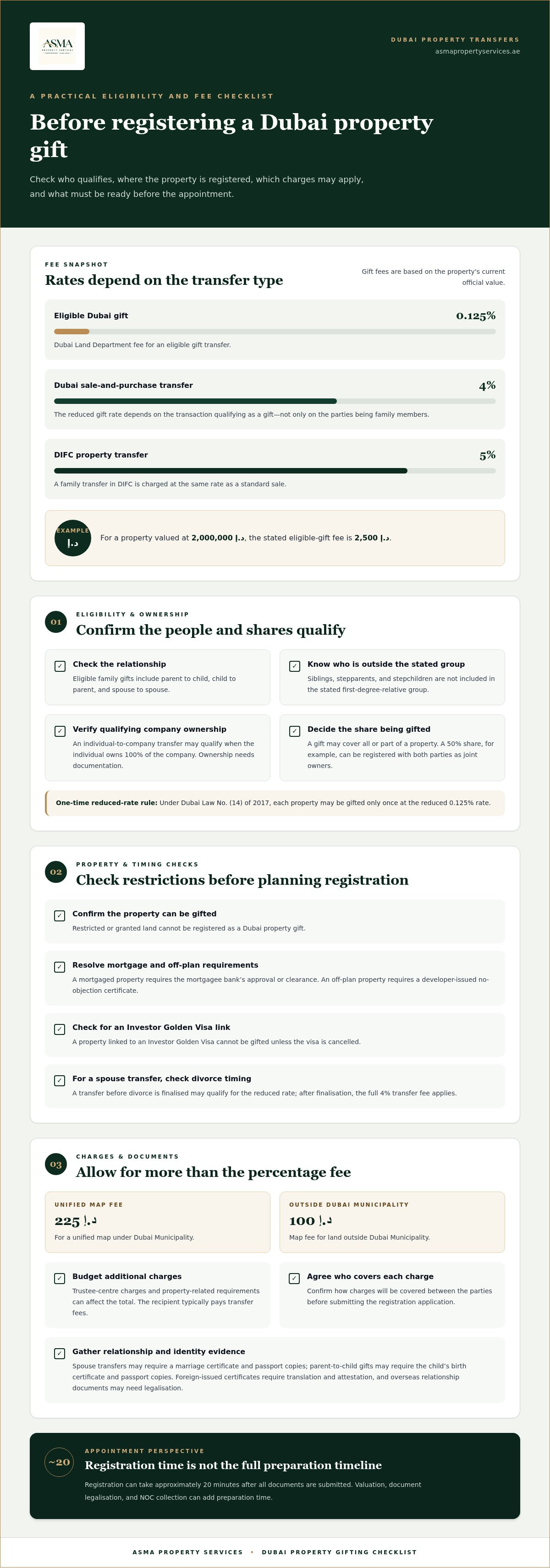
- Classify the transaction before calculating fees. A property gift transfers ownership without payment, unlike a sale-and-purchase transfer. In Dubai, the Dubai Land Department gift-transfer fee is 0.125% of the property's current official value. The official valuation sets the basis for this charge. For example, a property valued at د.إ 2,000,000 has a stated gifting fee of د.إ 2,500. This reduced rate applies to eligible gifts, not every transfer between family members.
- Confirm that the recipient and property qualify for the reduced rate. Dubai gift registration covers transfers without compensation to first-degree relatives, including parents, children, and spouses, as well as qualifying company transfers. A gift can cover the whole property or a share, such as 50%, with both parties recorded as joint owners. Property owners should identify the intended share before preparing documents. The registered share determines the recipient’s ownership interest after transfer.
- Compare the gift rate with the standard transfer charge. A sale-and-purchase transfer in Dubai carries a stated 4% fee on the property value, while an eligible gift uses the reduced 0.125% rate. The distinction depends on the transaction qualifying as a gift, not simply on the parties being family members. Under Dubai Law No. (14) of 2017, each property may be gifted only once at the reduced 0.125% rate. Treat that restriction as part of the estate and future-transfer plan.
- Budget for charges beyond the percentage fee. Administrative charges may also apply to Dubai property gifts. A unified map fee under Dubai Municipality is د.إ 225; land outside Dubai Municipality has a map fee of د.إ 100. Trustee-centre charges and property-related requirements can also affect the total. The recipient typically pays transfer fees. Confirm who will cover each charge between the parties before submitting the registration application.
- Check the property’s registration jurisdiction before applying the Dubai gift rate. A family property transfer in DIFC is subject to a 5% transfer fee, the same as a standard sale. That differs from Dubai’s reduced gift-transfer rate, so the property’s location matters. For a Dubai property, prepare the valuation and confirm the transaction’s eligibility before registering. Marriage transfers also require attention to timing: a transfer before divorce is finalised may qualify for the reduced rate, while one after finalisation is subject to the full 4% transfer fee.
Eligible relatives and company ownership
In Dubai, eligible recipients include parents, children, spouses, and qualifying companies. Siblings, stepparents, and stepchildren are not included in the stated first-degree-relative group. Key risks include failing the relationship or property eligibility rules, incomplete evidence, and restrictions related to mortgages, off-plan property, or a Golden Visa.
- Confirm that the recipient meets the eligible relationship requirements before preparing documents. Qualifying family relationships are parent to child, child to parent, and spouse to spouse. Siblings, stepparents, and stepchildren fall outside the stated first-degree-relative definition. For a spouse-to-spouse gift, prepare the marriage certificate and passport copies. A Dubai Courts letter confirming the marriage may also be required in some cases.
- For a parent-to-child gift, gather relationship evidence alongside identity documents. The listed evidence includes the child’s birth certificate and passport copies. UAE citizens can provide a marriage contract or Family Book as supporting documentation. For a child’s birth certificate, applicants must also provide proof of paternity or kinship from their embassy in the UAE. Foreign-issued certificates require translation and attestation through the relevant authorities.
- Check the company ownership structure for a corporate gift. A transfer between an individual and a company may qualify when the individual owns 100% of that company. Corporate documents may be needed to establish both ownership and the qualifying relationship. A company-to-shareholder transfer therefore depends on documented ownership, not simply a family connection or business role. Align the transfer records with the company’s ownership documents.
- Confirm that the property is eligible for gift registration before arranging the trustee appointment. Restricted or granted land cannot be registered as a Dubai property gift. A mortgaged property requires the mortgagee bank’s approval or clearance. An off-plan property requires a developer-issued no-objection certificate. A property linked to an Investor Golden Visa cannot be gifted unless that visa is cancelled. These restrictions can determine whether the proposed transfer can proceed.
- Check the parties’ identification and authority documents. Both parties need identification and contact details, and an Emirates ID may form part of the identification record. If a representative acts for either party, include the relevant power of attorney documents and the representative’s details. Overseas relationship evidence also needs legalisation. These checks help the trustee verify the donor, recipient, relationship, and registered ownership before processing the gift.
For administrative help with eligible gift transfers, use Dubai property transfer support.
Transfer timelines
Allow time for both document preparation and registration. The DLD appointment is the final stage, not the whole process.
-
Compare Gift and Sale Transfer Timelines
When comparing a gift with a sale, separate preparation time from registration time. Dubai gift registration may take two to four weeks overall, including valuation, NOC collection, and document attestation. A foreign certificate requiring legalisation can extend preparation to four to six weeks. The registration appointment itself is not the full transfer timeline.
- Prepare relationship and property documents before booking registration. Missing evidence can delay submission, especially when foreign documents are needed to establish a first-degree relationship. Organise the title deed, affection plan, identification, contact details, and relevant NOC. Complete any required translation or attestation before arranging the trustee-office appointment. This keeps document preparation distinct from registration time.
-
Complete the DLD and Trustee-Office Process
Submit the completed application and supporting documents through the required registration process. After all documents are submitted, the DLD’s stated service time for registering a gift is approximately 20 minutes. A transfer between an individual and a company can qualify when the individual owns 100% of the company. Prepare corporate records that establish ownership and the qualifying relationship.
- Arrange a power of attorney if someone will act for either party. Include the relevant POA document and the representative’s details with the application. The Dubai Land Department issued Circular No. 29/R/2025 on 16 July 2025, setting out POA verification procedures for Dubai real estate transactions. Build verification and document preparation into the schedule, particularly when the representative or document is foreign.
- Track each milestone rather than relying on a single estimated completion date. First, collect identity and relationship evidence. Next, complete valuation and obtain any required NOC. Then submit the file for registration. The two-to-four-week estimate includes preparation as well as processing, while complex legalisation can extend the timeline to four-to-six weeks. Record when each certificate is ready and when the application is submitted. Registration can proceed once the file is complete.
A legal power of attorney is required in Dubai property gift registration when someone acts on behalf of the parties. Personal documents can require a lengthy legalisation process, so a Dubai property transfer may take 4-6 weeks.
Property valuation and registration steps
Complete the valuation and prepare the required documents before submitting the gift registration application.
-
Obtain a Property Valuation
Request a valuation to establish the government charges for the gifted property. The Dubai Land Department uses the property’s current official value for this calculation. Smart valuation is available for apartments and villas. Valuation charges depend on property type and location, so distinguish them from registration and title deed charges when planning.
For gifted land, submit a property evaluation request at a Real Estate Trustee Center before applying for registration. The land assessment is not a later registration formality: the valuation must come first. Keep the valuation record with the property documents so the registration file reflects the assessed value.
- Assemble the supporting documents before filing. Include the title deed and affection plan, along with identification and contact details for both parties. Add the NOC and any relevant power of attorney documents. For a spouse transfer, include the marriage certificate as relationship evidence. Foreign-issued certificates may require translation and attestation, so complete those steps before submitting the file.
-
Register the Property and Review Costs
Submit the valuation and supporting documents for registration through a Real Estate Trustee Center. Review each charge separately: gift-transfer fee, registration charges, valuation, and title deed issuance. The Dubai Land Department title deed certificate issuance fee for Dubai property gift registration is AED 250. The stated minimum gift-registration fee is AED 2,000; additional charges depend on the property and registration requirements.
- Check that the registered ownership reflects the gift instruction. Confirm the recipient’s name and the share being transferred before the new title deed is issued. If the gift covers only part of the property, make sure the recorded share matches that arrangement. This final review links the valuation, application, and ownership record without changing the agreed gift terms.
- Keep the valuation and registration records together after completion. Retain the assessed value, submitted documents, fee records, and issued title deed in one transaction file. For a family gift, include attested relationship evidence, such as a marriage certificate where relevant. These records support future estate planning and clarify which ownership interest was gifted and registered.
Property gifting as succession planning
- Define the succession outcome before transferring ownership. Decide whether the aim is to provide a home for a spouse, allocate an investment to a child, or simplify future administration for parents. Property gifting in Dubai transfers ownership during the donor’s lifetime; it does not simply record an intention for later. List each property, its current owners, and the intended recipient. This makes the proposed transfer a deliberate estate-planning decision.
- Match each intended recipient to an eligible relationship. Gifts can be made between parents, children, and spouses, while siblings and other relatives fall outside the stated first-degree group. If a parent plans to gift property to a child, keep the birth certificate and passport evidence with the planning file. For a spouse, retain the marriage certificate and identity documents. These records link the family relationship to the change in ownership.
- Choose whether to transfer the whole property or a defined share. A partial gift, such as 50%, leaves the donor and recipient recorded as joint owners. Set out who will hold each share and how the arrangement fits the family’s intended use of the property. Joint ownership creates a continuing relationship between owners; a full transfer instead places the entire registered interest with the recipient. Record the decision before preparing registration documents.
- Consider the consequences of completing the gift during the owner’s lifetime. The recipient becomes the registered owner of the gifted interest, so the donor no longer holds that transferred share. A property can receive the reduced gift-transfer rate only once. A later ownership transfer may be treated as a sale-and-purchase transaction and attract the standard transfer fee. Include this future-transfer limitation in your long-term property gifting plan in Dubai.
- Coordinate the property decision with the wider estate plan. A property transfer covers only the gifted real estate; it does not document arrangements for other assets. Review the title deed, ownership shares, any mortgage or visa restriction, and the family’s intended distribution together. Keep valuation and registration records alongside relationship documents. This creates a clear file for the recipient and supports consistent family planning. A lifetime gift should fit the broader distribution plan, not replace it.
For a structured review of your family’s property transfer and succession planning, arrange property gifting support.
ASMA Property Services: conveyancing
ASMA Property Services handles conveyancing and Property Gifting / Granting for Dubai property owners planning an ownership transfer. The team can coordinate the gift process, prepare transfer documentation, and arrange a power of attorney for a representative. For broader succession planning, Non Muslim Wills can address assets beyond the property being gifted.
The right route depends on the intended recipient, the property’s status, and the documents required for registration. Aligning the transfer with succession planning helps clarify what changes now and what remains covered by a will. ASMA Property Services also provides property valuations for gifting and visas, which can form part of transfer preparation.
Contact ASMA Property Services or visit asmapropertyservices.ae to discuss your property transfer.
Set the transfer plan in motion
Make the next step a coordinated decision, not a standalone form submission. Before changing ownership, align the property transfer with your wider family and estate plans. Decide what ownership should look like after the gift, who will manage the process, and whether a representative needs authority to act. A clear plan keeps the transfer connected to its long-term purpose.
For property gifting in Dubai, ASMA Property Services supports transfers through conveyancing, Property Gifting / Granting, and power of attorney services. This is a practical next step when you’re ready to move from planning to documented action or need coordination through the transfer process.
Contact ASMA Property Services to discuss your property transfer. A clear plan puts the next decision within reach.
Frequently Asked Questions
Can I issue a POA for property gifting online?
A representative can handle the transfer under a legal power of attorney, but an online request alone does not authorise them. Dubai Land Department procedures include verification of powers of attorney used in real estate transactions. The applicable execution route depends on where the parties sign and how the document is issued. The POA should clearly authorise the representative to act for the donor or recipient in the property transfer.
Which Properties Can Be Gifted in Dubai?
Eligible Dubai properties can be gifted when the property and recipient meet registration requirements. Expatriates can gift property in eligible freehold areas where foreign ownership is permitted. Restricted or granted land cannot be registered as a gift. For an off-plan property, obtain the developer’s no-objection certificate. A mortgaged property also needs the mortgagee bank’s approval or clearance before the transfer can proceed.
How much will it cost?
The transfer charge for an eligible gift is 0.125% of the property’s current official value, according to the Dubai Land Department. Other costs may include valuation, trustee registration, map charges, and title deed issuance. For example, the title deed certificate issuance fee is separate from the percentage transfer charge. The property type, location, valuation, and required documents determine which additional registration charges apply.
What Is Property Gifting (Hiba) and How Does It Work Under UAE Law?
Hiba means a gift: ownership transfers to the recipient without payment. For Dubai real estate, the gift must be registered so the recipient’s ownership appears on the title deed. The donor identifies the recipient and the share being transferred, then submits the required documents for valuation and registration. A gift changes ownership during the donor’s lifetime and is distinct from instructions in a will.
What are the restrictions?
Dubai’s reduced gift route is limited to qualifying relationships and eligible company transfers; a sibling or stepchild doesn’t qualify as a first-degree relative. Each property may receive the reduced 0.125% rate only once under Dubai Law No. (14) of 2017. Property restrictions also matter: a mortgage requires bank approval or clearance, while a property linked to an Investor Golden Visa cannot be gifted unless that visa is cancelled.
What documents will I need?
Prepare the title deed, affection plan, identification, and contact details for both parties. Add the developer’s NOC where required, along with any power of attorney and representative details. Relationship evidence depends on the gift: a parent-child transfer uses birth certificate and passport evidence, while spouses provide a marriage certificate. Foreign-issued relationship documents require translation and legalisation before submission. Company transfers also need corporate documents establishing ownership and the qualifying relationship.
What is needed for the Gifting Process?
Start by confirming the recipient relationship and property status, then organise identity, ownership, and relationship records. Arrange valuation, obtain any required NOC or mortgage clearance, and submit the complete registration file through the applicable process. If a representative is acting, include a legal power of attorney. After registration, review the new title deed to ensure the recipient’s name and gifted ownership share match the agreed transfer.
How does gifting property in Dubai work?
The owner transfers all or part of the property to an eligible recipient without payment. Registration records the new ownership on the title deed; after a partial gift, the donor and recipient can remain joint owners. Valuation establishes the basis for government charges, while property status and supporting documents shape the application. The final registered deed confirms the recipient’s legal ownership interest.

Article by
Suhail Ibrahim
Suhail has guided more than 3,000 Dubai property transactions and built the reputation that leading brokerages rely on — calm under pressure, precise with paperwork, and always reachable when a deal needs completing.


