

A seller delay doesn’t automatically end a Dubai property sale. The common delays in Dubai property sales must be assessed against the contract date, grace language and default clause. Most off-plan Sale and Purchase Agreements provide a 6-12-month grace period beyond the anticipated completion date.
A missed date can disrupt moving plans, mortgage arrangements and other commitments. The SPA sets out the timeline and any delay provisions, so the response depends on its terms and whether the completion period, including any grace period, has passed.
This article explains why delays happen, what buyer protections may apply and how to respond when a seller or developer misses a deadline. It also covers the records to keep, written communication and when conveyancing support can help clarify the next step in the transaction.
Key Takeaways
- Compare the agreed completion date with the SPA’s grace period and default clause before deciding how to respond.
- Construction, supply-chain, approval and financing issues can delay a project; a delay alone does not mean the development will fail.
- Review whether off-plan instalments are linked to construction milestones and keep payment and project records together.
- Check the SPA for delay compensation terms and keep evidence of costs or losses connected to the delay.
- Keep communications in writing and preserve notices, bank letters and appointment records to support any escalation.
Is Seller Delay Common in the Dubai Property Market?
Delays can happen in Dubai property sales, but the reason matters. For off-plan buyers, the SPA’s completion date, grace period and default clause define the immediate contractual position.
Developer schedules can shift because of planning approvals, construction capacity, material supply, financing pressure or changes to project scope. A delay alone does not mean a development will fail. Compare written updates with the SPA and reported project progress.
Cash and Mortgage Sale Timelines
A cash sale avoids the buyer’s mortgage approval and valuation stages, while a financed sale depends on both. Lender review, valuation, buyer funds and seller mortgage release can each affect the agreed transfer date. There is no single typical duration: readiness of the parties, documents, NOC and bank procedures determines the timeline.
Required Documents and Missing Paperwork
Sale paperwork brings together identity documents, the title deed, signed sale contract and any mortgage-related bank documents. Missing or inconsistent names, expired identification, an unavailable title deed or incomplete lender paperwork can interrupt the file before transfer. Buyers and sellers should compare documents with the transaction details early. Unresolved service charge arrears or a property dispute can also delay clearance.
Developer NOCs and Sale Fees
A developer NOC confirms that the developer’s transfer requirements have been addressed; its processing can hold up a sale if account balances or supporting papers remain unresolved. NOC fees depend on the developer and transaction, and no reliable amount is available here. A market answer gives the Dubai Land Department transfer fee as 4% of property value, generally paid by the seller; other costs depend on the transaction and its outstanding obligations.
Transfer Timing and Mortgage Liabilities
Offer-to-transfer timing includes agreement, document preparation, NOC processing and the final Dubai Land Department transfer. Transfer duration depends on appointment readiness and whether the transaction file is complete; no single processing time applies here. An outstanding mortgage can require a bank liability letter and repayment coordination before the title can transfer. Buyers using finance also need approval and valuation completed in time. Review the SPA’s grace period, default terms, penalties, interest provisions and termination process; most Dubai off-plan SPAs provide a 6-12-month grace period. Refunds after cancellation depend on the reason, project status and contractual or legal process.
What Legal Protections Do Buyers Have Against Delays?
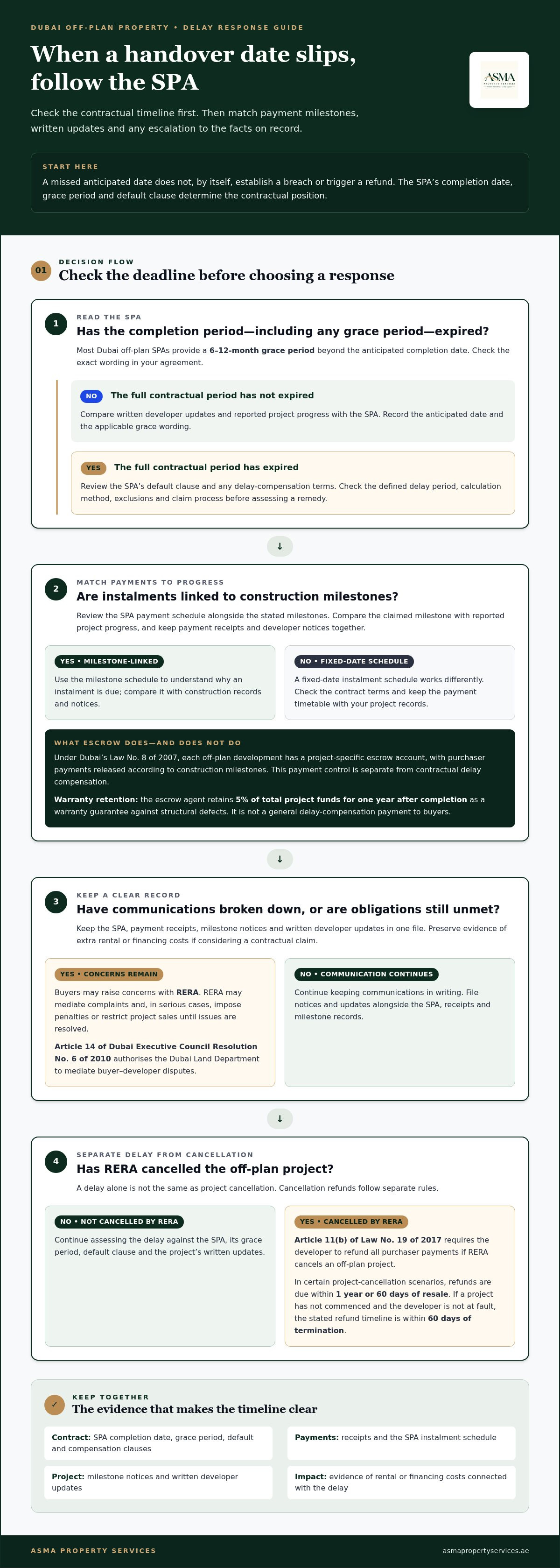
For Dubai off-plan purchases, protections operate through the project escrow account, construction-linked payment arrangements and the Sale and Purchase Agreement. These mechanisms can help buyers track how payments relate to progress, but a delay is not automatically a breach or a trigger for a refund.
Project Escrow and Payment Controls
Dubai’s Law No. 8 of 2007 requires a project-specific escrow account for each off-plan development. Purchaser payments are held in escrow and released according to construction milestones, rather than being treated as unrestricted project funds. This structure links payment flow to work completed and supports oversight of project financing.
Review the SPA payment schedule alongside the stated construction milestones. Keep payment receipts and developer notices together, then compare the claimed milestone with reported project progress. A milestone-linked plan helps buyers understand why an instalment is due. A fixed-date instalment schedule works differently, so the contract terms matter.
The escrow rules also require the escrow agent to retain 5% of total project funds for one year after completion as a warranty guarantee against structural defects. This retention is a safeguard for a defined period after completion, not a general delay-compensation payment to buyers. Escrow protection and contractual remedies serve different purposes.
Escalation and Project Cancellation
If developer communication breaks down or contractual obligations remain unmet, buyers may raise concerns with RERA. RERA may mediate complaints and, in serious cases, impose penalties or restrict project sales until issues are resolved. Article 14 of Dubai Executive Council Resolution No. 6 of 2010 authorises the Dubai Land Department to mediate buyer-developer disputes.
Keep the SPA, payment receipts, milestone notices and written developer updates in one file. A clear record shows what was promised, what was paid and where progress differs from the contract. Buyers facing extra rental or financing costs should preserve evidence of those expenses when considering a contractual claim.
Cancellation has separate rules. If RERA cancels an off-plan project, Article 11(b) of Law No. 19 of 2017 requires the developer to refund all purchaser payments. In certain project-cancellation scenarios, refunds are due within 1 year or 60 days of resale. If a project has not commenced and the developer is not at fault, the stated refund timeline is within 60 days of termination.
Keeping Financing Steps Aligned
Project escrow does not resolve a buyer’s individual mortgage requirements. Keep lender correspondence aligned with the SPA instalment dates and construction records, so payment timing and financing obligations remain clear. For transactions involving bank requirements, mortgage coordination can support the financing steps connected with a property transaction.
SPA penalty clauses and delay compensation
A Dubai off-plan Sale and Purchase Agreement may set out compensation for delayed handover. Review the exact clause before treating a stated completion date as the trigger for compensation. The agreement may define the delay period, calculation method, exclusions and claim process. The reason for delay can also matter, particularly if the SPA addresses force majeure or other extensions.
Dubai off-plan SPAs typically provide delay compensation of 10-12% of the property value per year of delay. This is a reported contractual range, not an automatic payment rate for every real estate purchase. The SPA determines whether the clause applies, when the calculation begins and whether a grace period must first expire. Buyers should read the compensation wording alongside the completion date and any extension terms.
Liquidated damages are pre-agreed penalties in a purchase agreement for a specified breach, such as delayed completion. Their amount and trigger depend on the contract. A clause may define a daily, monthly or annual calculation, but use only the period and method written into the SPA. Keep the signed agreement and written handover notices to establish the relevant dates.
Where a buyer seeks damages for breach, Article 295 of the UAE Civil Transactions Law provides for monetary damages, including actual losses and directly resulting lost profits. Buyers can claim compensation for delayed completion where they can show loss. Keep dated evidence of directly connected costs, such as additional rental payments or financing expenses, and separate those records from general household spending.
For illustration, a property valued at AED 1.5 million could produce estimated potential compensation of AED 105,000 to AED 135,000 per year under the stated 10-12% range. This calculation shows how the percentage translates to a property value; it does not replace the SPA’s wording. Confirm the contractual basis, delay period and calculation before relying on an estimate.
The reason for delay can affect contractual obligations. Article 273 of the UAE Civil Transactions Law provides for obligations to be suspended when an unforeseen event prevents performance. An SPA may also contain a force majeure clause describing extensions. Match the developer’s written explanation to the clause, and retain notices, progress updates and delivery records.
Keep the claim structured: identify the SPA clause, record the anticipated and actual handover dates, calculate any stated amount, and document the loss. If the clause is unclear or the developer disputes liability, the dispute may require formal legal consideration. A January 2026 report described a Dubai court decision involving delayed-handover compensation, but each buyer’s contractual rights turn on the relevant agreement and evidence.
SPA grace periods and extension clauses
Most Dubai off-plan Sale and Purchase Agreements provide a 6-12-month grace period beyond the anticipated completion date. The grace period affects how buyers read the timeline, but it does not erase the original date. Identify both dates in the SPA and record when the stated completion period ends. That distinction helps buyers assess whether a delay falls within the agreed framework.
Read the extension clause alongside the grace-period wording. Dubai off-plan SPAs may include force majeure provisions allowing extensions in extraordinary situations. The clause defines which circumstances can support an extension and how it affects the anticipated handover date. Do not assume every construction setback qualifies. Compare the developer’s stated reason with the contract language.
Article 273 of the UAE Civil Transactions Law provides for contractual obligations to be suspended when an unforeseen event prevents performance. This legal provision and an SPA’s force majeure wording are related considerations, but they are not interchangeable. The agreement remains the central record of the promised date, the permitted extension and any notice process specified for the parties.
Set out the dates in a simple timeline: the SPA completion date, the end of any grace period, each written extension notice and the revised handover date. Attach the relevant developer correspondence to each entry. This record helps distinguish an agreed extension from a missed date and supports a clearer review of the contract’s compensation or default clauses.
- Completion date: Record the date stated in the signed SPA.
- Grace period: Calculate its end using the agreement’s wording.
- Extension: Save the developer’s stated reason and notice.
- Payment: Compare instalment dates with the SPA schedule.
A delay does not, by itself, suspend every payment obligation. Check the SPA’s payment terms separately from its completion and extension clauses. An instalment linked to a construction milestone, for example, differs from one tied to a fixed date. Keep payment receipts and milestone notices together to show what became due and when.
Dubai property buyers should distinguish an extension from a cancellation or compensation claim. An extension may change the contractual handover timeline, but it does not automatically rewrite other SPA terms. Once the grace period ends, compare the actual status with the relevant clause, notices and stated reasons. This gives buyers a clearer basis for deciding which contractual step applies.
Steps for handling seller delays
Respond to a missed date with the SPA, a written record and a clear completion plan. In Dubai property sales, distinguish a seller’s delay from an off-plan developer delay: the contract, payment status and transfer stage determine the next step.
- Compare the dates and terms. Set the contractual completion date beside any grace period and written extension. Record the actual position against each milestone. If the grace period has expired, identify the SPA clauses covering default, compensation or termination. Don’t treat a revised estimate as a contract amendment unless the parties have agreed to it in writing.
- Request a specific update. Ask the seller or developer to state the outstanding step, responsible party and expected completion action in writing. Keep emails, notices and appointment records together. For an off-plan purchase, compare the update with construction progress and the SPA’s payment schedule. Escrow arrangements and construction-linked instalments may also help clarify payment status.
- Protect your completion readiness. Keep funds ready when the contract requires them and preserve bank letters, payment evidence and transfer appointments. If a mortgage is involved, verify mortgage-release steps before exchanging contracts. For a buyer using finance, keep lender approval and valuation milestones visible; a delay in either can affect the transfer plan.
- Escalate with a documented record. If communication breaks down or contractual obligations remain unmet, buyers may raise off-plan concerns with RERA. The Dubai REST app is identified as an official channel for complaints about a Dubai property developer. A complaint should be supported by the SPA, dated correspondence, payment records and a concise timeline of missed obligations.
- Assess remedies before changing course. Compare the facts with the SPA’s compensation and termination wording before withholding payment or cancelling. Buyers can pursue claims for delayed completion where they can show loss. Keep evidence of directly related rental or financing expenses. A cancellation route may depend on project status and the applicable process, so preserve the complete transaction record.
Investors and owner-occupiers benefit from one file containing the SPA, notices, bank letters, receipts and appointment records. If a delayed transaction prompts a separate ownership transfer by gift, review property gifting and granting options before proceeding.
Keep written communications together with notices, bank letters and appointment records. Buyers can file a complaint with the Dubai Land Department when delays exceed reasonable limits.
ASMA Property Services: conveyancing
ASMA Property Services provides conveyancing for buyers and sellers managing a Dubai property transfer. Turn to conveyancing when delays involve transaction documents, contract milestones or transfer coordination. The service helps organise required steps and move the file towards completion.
For a separate ownership transfer, Property Gifting / Granting may be relevant. A power of attorney can support property matters when an owner needs representation. These services address different transaction needs; they do not replace reviewing the SPA’s delay, compensation or termination terms.
To discuss conveyancing or another property matter, contact ASMA Property Services.
Set the Next Property Milestone in Motion
Use the common delays in Dubai property sales to plan your next transaction more effectively. Give each outstanding task a named owner, written status and clear dependency. This creates a practical working record for buyers, sellers and investors, even when the completion date changes. Focus on the next decision, not just the missed date.
For support with the transaction itself, ASMA Property Services provides conveyancing. Its Property Gifting / Granting and power of attorney services can also help with related ownership arrangements. These address distinct requirements, so choose the service that matches the legal step you need to complete.
Contact ASMA Property Services about your property transaction to discuss the relevant next step. With a clear record and the right administrative support, you can move forward with greater control.
Frequently Asked Questions
How to Prepare Financially for Possible Delays?
Build a reserve around the costs that continue if completion moves: rent, mortgage payments, storage and temporary accommodation. Dubai buyers are advised to maintain an emergency fund covering 6-12 months of rent or mortgage payments. List each ongoing commitment and its due date, then keep the reserve accessible. If buying with finance, map lender payment dates against the SPA schedule to identify where a delay could create a cash-flow gap.
What Does “Delayed Completion by Seller” Mean?
A seller delay occurs when the seller has not completed an action required by the agreed date, holding up the transfer or handover. For example, the buyer may be ready while the seller’s mortgage release or required paperwork remains incomplete. Compare the missed action with the signed contract: a delay is not automatically a breach if the agreement allows more time or another condition remains outstanding.
What are the most common causes of delays in Dubai property sales?
Common delays in Dubai property sales can stem from financing pressure, contractor capacity, supply-chain disruption, labour shortages or pending approvals. The cause depends on the transaction: a resale may stall over a mortgage release, while an off-plan handover may depend on construction progress. Identifying the blocked milestone helps buyers distinguish a temporary administrative hold from a longer project delay and focus follow-up on the responsible step.
What are the steps to resolve or prevent delays in a Dubai property sale?
Start with one transaction timeline covering the contract date, pending approvals, bank dependencies and transfer appointment. Assign each open item to the responsible party, then request written updates on its status. Keep document versions and receipts in the same file. If a date changes, record the reason and its effect on dependent tasks, such as mortgage funds or moving arrangements.
What risks or penalties can sellers face if a Dubai property sale is delayed or a contract deadline is missed?
A seller who misses a deadline may face consequences set out in the contract, including agreed compensation, default procedures or a buyer’s right to seek a remedy. The outcome depends on the missed obligation, any applicable grace or extension clause, and evidence of loss. Sellers should respond promptly to written notices, document the reason for delay and not assume a deadline change is agreed without written agreement.
How long does a typical Dubai property sale take from offer to transfer?
There is no single typical duration. The timeline depends on the parties’ readiness, document preparation, NOC processing, bank procedures and whether the transaction file is complete.
How long does Dubai Land Department property transfer take?
There is no single processing time. It depends on appointment readiness and whether the transaction file, including the documents and NOC, is complete.
How do service charge arrears, unpaid bills, or property disputes delay a Dubai sale?
Unresolved service charge arrears or property disputes can delay clearance. They may also hold up the developer NOC if account balances or supporting documents remain unresolved.

Article by
Suhail Ibrahim
Suhail has guided more than 3,000 Dubai property transactions and built the reputation that leading brokerages rely on — calm under pressure, precise with paperwork, and always reachable when a deal needs completing.


