

The first step in how to transfer property in Dubai is to identify the type of ownership change. A sale, gift, inheritance and record update can follow different routes, with different documents and approvals. Start by defining the change before gathering paperwork, so you can prepare for the procedure that applies to your case.
A Dubai property transfer may involve the Dubai Land Department (DLD), a registration trustee, the developer and, where a mortgage is involved, the bank. This guide explains the main routes, common milestones and the information to organise before registration.
You’ll see how the process differs by route, where approvals and mortgage coordination may fit, and how registration completes the ownership change. ASMA Property Services coordinates conveyancing paperwork, approvals and transaction milestones, drawing on experience with more than 3,000 successful property transfers since 2022. Start by classifying the transfer, then prepare for the steps that match it.
Key Takeaways
- For how to transfer property in Dubai, first classify the change as a sale, gift, inheritance, mortgage release or record update.
- Map the route’s likely milestones before preparing documents, including approvals or lender coordination that may apply.
- Use the reason for the change, the parties involved and any dependencies to distinguish the main ownership-change routes.
- Compare ownership records, identity details, property information and transaction purpose before submission, and resolve inconsistencies early.
- Conveyancing coordination can organise paperwork, approvals and milestones while DLD remains the registration authority.
How to Transfer Property in Dubai: Start by Identifying the Change
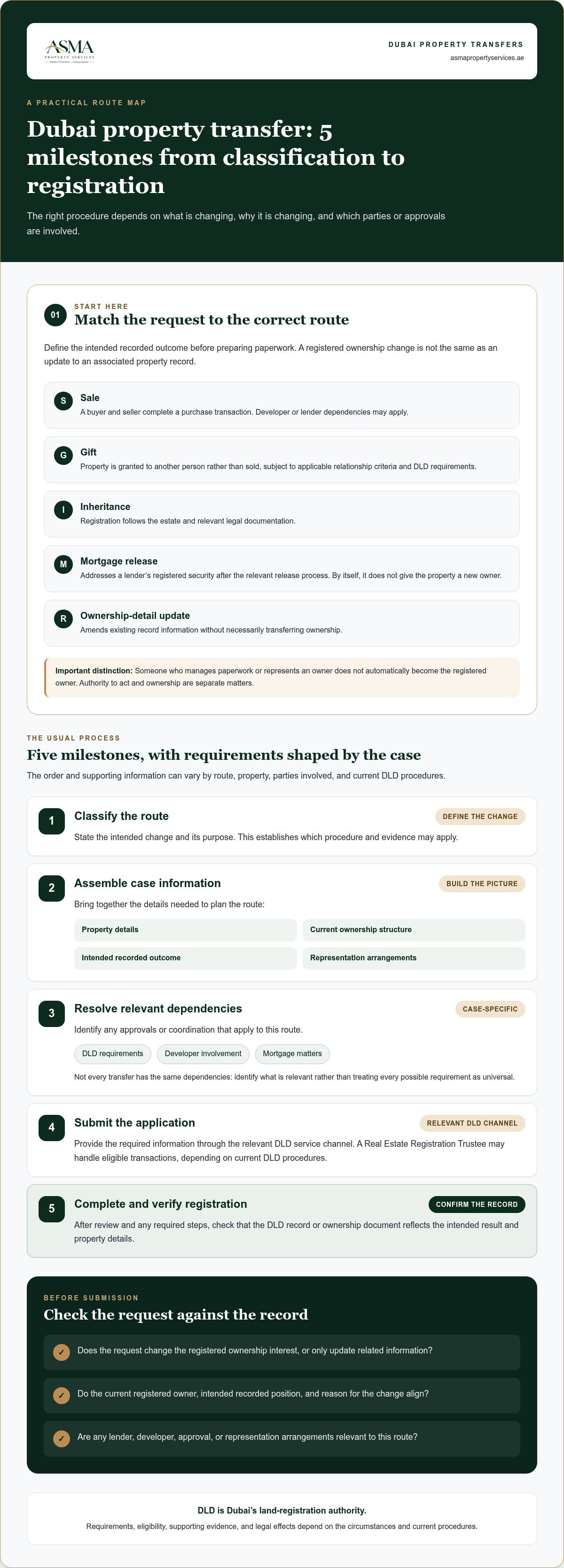
Before preparing documents, define the change to be recorded. A property transfer can mean a formal change in registered ownership or an update to a related property record. These are not necessarily the same transaction. The route depends on what is changing and why: a purchase should not be handled as a family gift, an inheritance or a correction to existing details.
The Dubai Land Department (DLD) is Dubai’s land-registration authority. Its records reflect registered property interests and related entries. Begin by stating the intended outcome, then identify the DLD procedure that applies. Eligibility, supporting evidence and legal effects depend on the circumstances and current requirements.
Which Dubai property transfer route matches your situation?
Choose a route based on the transaction’s purpose. A sale involves a buyer and seller completing a purchase. A gift or grant transfers property without a sale, subject to the applicable relationship criteria and DLD requirements. Inheritance concerns registration following a death. A mortgage release addresses a registered lender interest after the relevant release process.
- Sale: Ownership changes through a purchase transaction, with possible developer or lender dependencies.
- Gift: Property is granted to another person rather than sold.
- Inheritance: Registration follows the estate and relevant legal documentation.
- Mortgage release: The lender’s registered security is addressed. This does not, by itself, give the property a new owner.
- Ownership-detail update: Existing record information is amended, without necessarily transferring ownership.
These categories are a starting point, not a determination of eligibility. One case can involve more than one dependency, such as a sale that also requires mortgage coordination. Identify the route before preparing documents so the submission reflects the actual change.
What does a registered ownership transfer change?
The registered owner is the person or entity recorded as holding the property interest. Someone who manages paperwork, represents an owner or coordinates the transaction does not automatically become the registered owner. Authority to act and ownership are separate matters; the required evidence and registration steps depend on the route.
After registration, the title deed or applicable DLD record provides evidence of the recorded position. Check that it reflects the intended owner and property details. An update to contact, identity or other administrative information may change an associated record without changing beneficial ownership. Treat a request as an ownership transfer only if the registered interest itself is changing.
For a practical route assessment, set out the current registered owner, the intended recorded position, the reason for the change and any known lender or developer involvement. This concise summary clarifies the next steps and helps distinguish an ownership change from a record correction before paperwork and registration begin.
The Usual Dubai Property Transfer Process, from Preparation to Registration
Once the route is clear, organise the transaction around its requirements. The usual milestones are classification, information gathering, resolving dependencies, submission and registration. Their order and supporting documents can vary by route, property and parties involved. A sale may involve developer or lender steps; another route may not.
- Classify the route. Record the intended change and its purpose. This establishes which procedure and evidence may apply.
- Assemble case-specific information. Bring together the property details, current ownership structure, intended outcome and any representation arrangements. These details provide the basis for planning the next steps.
- Resolve dependencies. Identify any applicable approvals, mortgage matters or developer involvement. Not every transfer has the same dependencies.
- Submit the application. Provide the required information through the relevant DLD service channel. A Real Estate Registration Trustee may handle eligible transactions, depending on current DLD procedures.
- Complete registration. After review and any required steps, verify that the DLD record or ownership document reflects the intended result.
What happens before a Dubai transfer is submitted?
Preparation means establishing the property, the registered ownership structure and the change being requested. Note whether someone will act on an owner’s behalf, and identify any relevant lender, developer or other participating party. Then map the approvals and information needed for the chosen route. This is a planning framework, not a universal document checklist: the sequence and requirements depend on the procedure and current DLD rules.
Separate common milestones from case-specific requirements. Identifying the property and intended change is part of the initial assessment. Developer approval or mortgage coordination, by contrast, applies only where relevant. Treating every possible requirement as universal can create unnecessary work; overlooking an actual dependency can interrupt submission.
How does registration complete the ownership change?
Submitting an application starts the review stage. It does not, by itself, prove that the requested change has been registered. The application must meet the applicable route’s requirements before the record is updated or an ownership document is issued. There is no single completion time for every case, so avoid planning around an assumed fixed timeline.
After registration, compare the updated DLD record or issued document with the intended result. Check the recorded ownership and relevant property details. The official Dubai Land Department website provides current information on service channels, route eligibility and issuance procedures. These can vary by transaction type, so use the information for the applicable service rather than assuming one channel or sequence fits every transfer.
Coordinating documents, approvals and milestones can reduce administrative follow-up. ASMA Property Services provides Dubai conveyancing coordination for property-transfer administration, while DLD remains the registration authority.
Sale, Gift, Inheritance, or Mortgage Release: How the Dubai Routes Differ
The route follows the reason for the change, not simply the fact that a property record needs attention. A sale transfers ownership through a buyer-seller transaction. A gift, inheritance, mortgage release and ownership-detail update each have a different trigger and administrative purpose. This comparison can help narrow the route before you prepare for the next stage of how to transfer property in Dubai.
| Route | Trigger | Parties involved | Possible dependency |
|---|---|---|---|
| Sale | Purchase transaction for consideration | Buyer and seller | Developer approval or lender coordination, where applicable |
| Gift | Transfer without consideration | Grantor and recipient | Eligibility and supporting evidence under current DLD requirements |
| Inheritance | Ownership registration following a death | Relevant successors and authorities involved in the succession process | Succession documentation and applicable authority procedures |
| Mortgage release | Removal of a registered mortgage interest | Property owner and lender | Lender release process and relevant registration steps |
| Ownership-detail update | Correction or amendment to an existing record | Registered owner and relevant parties, as applicable | Evidence supporting the requested record change |
When does a Dubai property sale follow a different route?
A sale is defined by a buyer-seller transaction and the consideration agreed for the property. Its transfer steps can involve more than the two parties. A developer’s no-objection process or lender coordination may apply, depending on the property and financing position; neither is universal. Buyers need transaction-specific preparation, so buyer-focused conveyancing guidance is more relevant to purchase-side details than a gift or record-update process.
How do gifts, inheritance, and mortgage records differ?
A gift transfers property without consideration, subject to applicable DLD eligibility rules. Inheritance follows the relevant succession and authority process; its documentation and legal effect depend on the circumstances and current rules. A mortgage release addresses the lender’s recorded interest, not a purchase or change of owner. These distinctions affect which parties and dependencies matter, so do not assume one route’s evidence or sequence applies to another.
An ownership-detail update is narrower. It corrects or amends an existing record and does not automatically change beneficial ownership. For example, changing an administrative detail is not the same as registering a new owner. Define the intended result first, then identify whether the request concerns ownership, succession, a lender interest or record accuracy.
This overview is a route-selection aid, not legal advice or a complete eligibility checklist. Gift eligibility, required documents, fees and inheritance law depend on the case and current rules. Use the applicable DLD procedure for the transaction. This keeps the process aligned with its legal basis and avoids treating distinct registration outcomes as interchangeable.
Prepare for a Dubai Property Transfer and Reduce Avoidable Delays
Preparation starts with a clear, consistent account of the transaction. Before gathering case-specific documents, align four points: the property, its current registered ownership, the people involved and the reason for the change. This framework can reveal gaps early without treating one route’s document list as a universal requirement.
What information should owners organise first?
Set out the property details, current ownership, intended buyer or recipient, and purpose of the transfer. Note whether any party will act through a representative or is located outside the UAE. This gives the transaction team a working picture of the case and helps identify whether representation arrangements, translations or document attestation may be relevant under current requirements.
- Property: Use the available ownership record to identify the property consistently.
- People: Compare party names and identity details across the information being prepared.
- Purpose: State whether the change is a sale, gift, inheritance, mortgage release or record update.
- Dependencies: Note any lender, developer, co-owner or representative connected to the case.
Use this as a preparation framework, not an exhaustive checklist. Supporting evidence depends on the selected route and individual circumstances. A party located outside the UAE or represented by someone else may bring additional considerations. Match translation, attestation and representation requirements to the current procedure rather than assuming they are the same as for another transaction. A dedicated Dubai property transfer checklist and document guide can provide route-specific detail.
Which issues can hold up a transfer submission?
Inconsistent details can prompt follow-up. A name that differs between an ownership record and identity information, an unclear property reference, or evidence that does not support the stated transaction purpose may need clarification. The same applies when case-specific documents are incomplete. These issues do not automatically prevent registration, but resolving them before submission can reduce avoidable administrative back-and-forth.
Check the dependencies for the transaction rather than applying a standard list to every property. A lender may have a role where a mortgage is registered. Developer involvement may apply to some properties or routes. Co-owners and other authorities may also be relevant, depending on the circumstances. Identifying who needs to participate helps keep approvals and supporting information aligned with the intended change.
For a final pre-submission review, compare the ownership record, party identity details, property information and transaction purpose side by side. Confirm that the information tells one consistent story. This is a practical first step in how to transfer property in Dubai, while exact submission requirements remain specific to the route and current DLD procedure.
ASMA Property Services coordinates paperwork, approvals and transaction milestones through its Dubai conveyancing support.
Complete Your Dubai Property Transfer with Coordinated Conveyancing Support
Once the transfer route is identified, the work shifts to keeping paperwork, approvals and milestones aligned. Conveyancing coordination gives the transaction a clear operational structure. It helps track what is needed, who is involved and which steps remain before registration. The coordination required varies by route, property and parties involved; a sale, gift and mortgage-related case will not follow identical steps.
The Dubai Land Department (DLD) remains the registration authority. It reviews and registers the change under the applicable process. ASMA Property Services provides administrative and transaction-management support around that process, coordinating paperwork and relevant follow-up without replacing DLD or making the registration decision.
What does conveyancing coordination handle?
Coordination connects separate transaction tasks to the route being followed. It keeps track of what has been prepared, what approvals or input may be needed, and which milestone comes next. Where a lender, developer, co-owner or representative is involved, the required follow-up can differ. The transaction structure determines the coordination plan.
- Paperwork coordination: Organise transaction information and supporting documents around the intended ownership change.
- Approval follow-up: Track relevant approvals and participation from parties involved in the case.
- Milestone management: Keep submission, review and registration steps visible as the transaction progresses.
- Route-specific coordination: Align administrative work with a sale, property gift, mortgage coordination or ownership update, as applicable.
This support is administrative. It does not make a coordination provider the registration authority, and it does not mean every possible step applies to every transfer. A case involving lender coordination, for example, has a different dependency profile from an ownership-detail update. The applicable process and requirements remain specific to the case and current DLD procedures.
What happens when you begin with ASMA Property Services?
Begin with a brief outline of the Dubai property and intended ownership change. Include the current ownership position and any known lender, developer, co-owner or representation involvement. This provides a practical starting point: identify the route, organise relevant information, and map the approvals and milestones that may apply.
ASMA Property Services has completed more than 3,000 successful property transfers and has operated since 2022. The team coordinates conveyancing and transfer administration so paperwork, approvals and transaction milestones remain organised. The scope is shaped by the route and transaction details, while DLD retains its registration function.
For coordinated support with the next steps, discuss your Dubai property transfer with ASMA Property Services.
Set Your Transfer in Motion with a Clear Starting Point
A useful next step is to prepare a concise transaction brief. Note the property, who currently holds the registered interest, the change you intend to make and any known parties involved. This defines a starting point and keeps the next actions connected to the transaction’s purpose.
Understanding how to transfer property in Dubai means more than knowing the steps. It also means keeping responsibilities clear: administrative coordination supports the process, while the Dubai Land Department handles registration. With that distinction in place, you can move from general guidance to a plan shaped around your circumstances.
ASMA Property Services coordinates conveyancing paperwork, approvals and transaction milestones for Dubai property transfers. Share the intended ownership change and outline where the transaction stands. Plan your property transfer with ASMA Property Services to take the next step with a clear route and organised support.
Frequently Asked Questions
Is it possible to transfer Dubai property while the owner is outside the UAE?
It may be possible to arrange a Dubai property transfer while the owner is outside the UAE, but that does not mean every step can be completed remotely. Representation or a remote transaction route may be relevant. Eligibility, identity checks and signing requirements depend on the case. A representative’s authority should match the transaction being handled. Review current DLD service channels and any power-of-attorney requirements before relying on a remote arrangement.
Can a Dubai property transfer proceed if the title deed contains outdated owner details?
An existing-record correction may be needed before, or as part of, the intended transaction. A change to an owner’s name, for example, differs from registering a new owner. Do not assume evidence accepted for one correction will apply to another. The applicable DLD route and supporting documents depend on the specific record and requested change, so establish what needs updating before preparing the transfer submission.
Does every Dubai property transfer require a developer NOC?
No. A developer no-objection certificate may be a dependency for some properties or transactions, but it is not a universal step for every Dubai transfer. The requirement can depend on the property and type of ownership change. Follow the current requirements for the specific DLD procedure. An NOC, where required, is one part of the process; it does not itself complete ownership registration.
What happens to a tenant when a Dubai property changes ownership?
A change in property ownership and an existing tenancy are related but separate matters. The ownership transfer does not by itself establish that a tenancy ends or that particular notice terms apply. Review the tenancy documents and current Dubai rules for the property and circumstances. Any tenant notice should be handled separately from registering the conveyance, with timing and obligations assessed against applicable requirements.
Can one co-owner transfer only their share of a Dubai property?
A proposed transfer may concern a partial ownership interest, which can involve different considerations from transferring the whole property. The available route may depend on how ownership is recorded and the parties’ circumstances. Before proceeding, review the title details, any relevant party consent, eligibility and current DLD procedures for that ownership structure. Do not assume a route used for a full transfer applies to an individual share.
Is the process the same for every property and ownership structure in Dubai?
No. The broad milestones may be similar, but the applicable documents, approvals and dependencies can differ. The route, mortgage status, ownership structure and property-specific requirements can all affect the transaction. For example, a mortgaged property may involve lender coordination that does not apply to an unencumbered one. To understand how to transfer property in Dubai in a particular case, use the current requirements for that transaction rather than relying on a universal checklist or timeline.

Article by
Suhail Ibrahim
Suhail has guided more than 3,000 Dubai property transactions and built the reputation that leading brokerages rely on — calm under pressure, precise with paperwork, and always reachable when a deal needs completing.


