

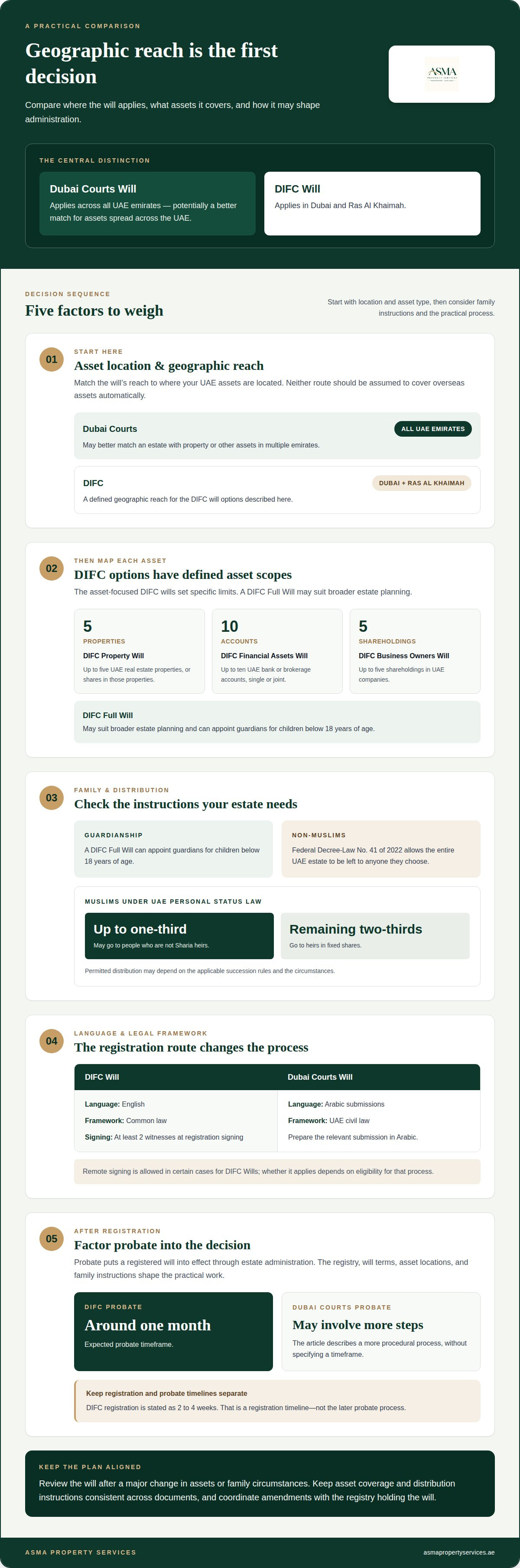
A Dubai Courts Will may be a better fit when your estate includes assets across the UAE: it applies across all emirates, while a DIFC Will applies only in Dubai and Ras Al Khaimah. That distinction is central when comparing DIFC wills and a Dubai Courts Will. The right route also depends on eligibility, language and how you want the will administered after death.
It is easy to focus on registration and overlook what happens during probate. The two routes differ in their legal frameworks and procedures, and DIFC probate is expected to take around one month. Dubai Courts probate may involve more procedural steps.
This comparison explains who can register each type of will, where it can apply and how the probate processes compare. It also explains when a Dubai Courts Will may suit your circumstances, helping you assess the practical trade-offs before deciding.
Key Takeaways
- Match the will’s geographic reach to your assets: a DIFC Will applies in Dubai and Ras Al Khaimah, while a Dubai Courts Will applies across the UAE.
- Compare the legal framework and working language: DIFC Wills use a common-law framework and English; Dubai Courts Wills use UAE civil law and require Arabic submissions.
- Check eligibility before choosing a DIFC Will. Check whether you meet the eligibility requirements before choosing a DIFC Will.
- Factor probate into your decision: DIFC probate is expected to take around one month, while Dubai Courts probate may involve more procedural steps.
- Consider how your assets and family circumstances fit each route, including estate administration and any guardianship instructions.
When Is Dubai Courts Will the Better Choice?
Start with the location and type of your assets, then consider your family’s needs and the intended distribution. A Dubai Courts Will may suit an estate spread across the UAE’s emirates; a DIFC Will is limited to Dubai and Ras Al Khaimah.
Choose by asset location and coverage
For assets in Dubai or Ras Al Khaimah, a DIFC Will can provide a route tailored to specific asset categories. A Dubai Courts Will applies across all UAE emirates, which may better match an estate containing property or other assets in multiple emirates. Neither route should be assumed to cover overseas assets automatically. Consider their location and the applicable process before relying on a UAE will for them.
DIFC Wills include several asset-focused options. A DIFC Property Will can cover up to five UAE real estate properties or shares in those properties. A DIFC Financial Assets Will can cover up to ten UAE bank or brokerage accounts, whether single or joint. A DIFC Business Owners Will can cover up to five shareholdings in UAE companies. A DIFC Full Will may suit broader estate planning and can appoint guardians for children below 18 years of age.
| Option | Geographic reach | Coverage and family considerations |
|---|---|---|
| DIFC Property Will | Dubai and Ras Al Khaimah | Up to five UAE properties or shares in them |
| DIFC Financial Assets Will | Dubai and Ras Al Khaimah | Up to ten UAE bank or brokerage accounts |
| DIFC Business Owners Will | Dubai and Ras Al Khaimah | Up to five UAE company shareholdings |
| Dubai Courts Will | All UAE emirates | May fit assets held across emirates |
Match each asset’s location and type to the will’s coverage, then account for family instructions such as guardianship.
Amendments and Estate Distribution
Major changes in your assets or family circumstances are a reason to review a will. The practical distinction is scope: a DIFC asset-specific will names defined categories, while a Dubai Courts Will applies across the UAE’s emirates. For a Muslim’s estate under UAE Personal Status Law, up to one-third may go to people who are not Sharia heirs; the remaining two-thirds go to heirs in fixed shares. The permitted distribution may depend on the applicable succession rules and the circumstances.
A will can be amended, revoked or challenged. Coordinate any change with the registry holding it, and make sure the intended distribution is clear. Review the will after a major life change, such as acquiring another property or changing guardianship instructions.
Challenges and Conflicting Wills
The key risk is a mismatch between the will’s reach and the estate: a DIFC Will applies only to Dubai and Ras Al Khaimah, while a Dubai Courts Will applies across all emirates. Another risk is inconsistent instructions across documents, such as naming different beneficiaries for the same account. List the assets covered by each will and keep the distribution instructions aligned.
For non-Muslims, Federal Decree-Law No. 41 of 2022 allows the entire UAE estate to be left to anyone they choose. For Muslims, the one-third limit and fixed shares affect distribution. Identify the applicable position before selecting a will and documenting beneficiaries.
DIFC Wills compared with wills registered through Dubai courts
The main differences are the legal framework, language, registration process and geographic reach. ADJD is another UAE registration route, with separate fees and timing.
Registration Steps and Signing
DIFC Will registration is conducted in English, while Dubai Courts submissions require Arabic. Prepare the will and supporting documents for the chosen registry, then complete its signing requirements. A DIFC Will registration signing requires at least 2 witnesses. Remote signing is allowed in certain cases for DIFC Wills, so the signing method depends on eligibility for that process.
Dubai Courts registration follows a UAE civil-law framework, unlike the common-law framework used for DIFC Wills. The relevant submission must be in Arabic. This affects document preparation and registration, particularly if your instructions were drafted in English. ADJD has its own route and is a separate registry from Dubai Courts and DIFC.
Compare the practical requirements before choosing:
- DIFC: English process, common-law framework, and at least 2 witnesses at registration signing.
- Dubai Courts: Arabic submissions and a UAE civil-law framework.
- ADJD: Separate will-registration route with its own fee and processing timeline.
Registration Fees and Costs
These are registration comparisons, not a complete measure of the work involved in preparing documents.
Compare the will type and registry, not just the headline figure.
The stated DIFC registration timeline is 2 to 4 weeks; ADJD registration takes under a week. These figures distinguish registration routes, not the later probate process. A mirror will also changes the total government fee, so identify whether one will or mirrored wills are intended before comparing totals.
For property owners, the registration choice connects to how UAE assets are recorded and managed. UAE property ownership updates can support accurate property records alongside will planning.
DIFC probate process and expected timeframe
Probate puts a registered will into effect through estate administration. The registry, will terms, asset locations and family instructions shape the practical work.
Probate Process
DIFC probate is expected to take around one month. The process gives effect to the will’s instructions so the estate can be administered. The executor’s practical task is to identify the covered assets, understand the distribution instructions and coordinate the steps needed to transfer them to beneficiaries.
Preparation starts with a clear record of the estate. The executor can group assets by type and location, such as a Dubai property, a Ras Al Khaimah account or company shares. The will’s terms should then be matched against those records. This helps identify which assets fall within its scope and where instructions need to be carried out.
Family arrangements also affect administration. If a DIFC Full Will appoints guardians for children below 18 years of age, the executor should keep those instructions accessible alongside the estate provisions. Dubai Courts retain final responsibility for confirming guardianship instructions in a child’s best interest. Guardians appointed under a DIFC Will must be for children habitually resident in Dubai or Ras Al Khaimah.
Probate Timing
The stated DIFC probate timeframe is around one month. This period concerns probate, not will registration. Registration happens while the testator is alive; probate follows death and concerns administration under the will. Keeping those stages separate avoids treating a registration timeline as a forecast for estate distribution.
Dubai Courts probate may involve more procedural steps than DIFC probate. No comparable duration is provided here, so the useful comparison is process complexity, not a specific number of days. The executor’s workload depends on the will’s instructions, asset records, number of beneficiaries and whether assets are located across different emirates.
A practical sequence helps keep administration organized:
- Locate the registered will and identify the appointed executor.
- Compile a working inventory of assets and their locations.
- Compare each asset with the will’s coverage and distribution instructions.
- Track property, account and share transfers against the relevant instructions.
- Keep any guardianship provisions for children distinct from asset distribution.
For example, an estate with a Dubai property and UAE bank accounts requires the executor to match each asset to the will’s terms. Clear drafting can make those instructions easier to apply during probate. The same care helps distinguish estate administration from guardianship decisions made in the child’s best interest.
Eligibility for non-Muslim residents and non-residents
DIFC Wills Service eligibility turns on religion and age, not UAE residency alone. Non-Muslim residents and non-residents over 18 years of age may register a will through the service. However, DIFC Will registration is restricted to people who are non-Muslim and have never been Muslim. A non-resident can therefore meet the residency criterion, but still needs to meet the stated religious and age conditions.
Before choosing DIFC, establish whether the testator meets both conditions. Then identify the assets and family instructions the will should cover. For example, a non-Muslim living abroad who owns a Dubai property may consider DIFC registration if they meet the eligibility rules. A person who has ever been Muslim does not meet the DIFC restriction, even if they live outside the UAE.
Dubai Courts provides another registration route for people planning a UAE will. The stated general age rule is that a person must be over 18 years old to make a will in Dubai. The available eligibility facts do not establish an equivalent religious restriction for Dubai Courts. Do not assume the DIFC condition applies to both routes; compare the registration requirements for the intended registry.
Religion also affects the distribution rules that may apply. Federal Decree-Law No. 41 of 2022 allows non-Muslims to leave their entire UAE estate to anyone they choose. For Muslims, UAE Personal Status Law allows up to one-third of the estate to go to people who are not Sharia heirs; the remaining two-thirds go to heirs in fixed shares. A Muslim who leaves more than one-third to others needs heirs’ consent.
Language is another practical factor. DIFC Will processes are conducted in English, while Dubai Courts submissions require Arabic. This matters when preparing instructions and understanding the final documents. For example, someone planning their estate in English should account for the Arabic submission requirement when comparing the routes. Registration language and the rules governing distribution are separate considerations.
Use this eligibility sequence before selecting a registry:
- Confirm the testator is over 18 years old.
- For DIFC registration, confirm the person is non-Muslim and has never been Muslim.
- Separate UAE assets from overseas assets, then match each asset to the will’s intended coverage.
- Consider the applicable distribution rules and whether beneficiary instructions align with them.
- Account for English DIFC processes or Arabic Dubai Courts submissions when preparing documents.
Residents and non-residents can both qualify for DIFC registration if they meet its stated conditions. The practical choice then depends on the testator’s eligibility, asset locations, distribution instructions and preferred registration language.
Executors and estate administration
An executor turns the will’s instructions into an organised estate administration process. Choosing between a DIFC Will and a Dubai Courts Will affects the registry and geographic scope, but clear records and consistent instructions matter under either route.
Start by naming an executor who can locate the registered will, identify estate assets and follow the distribution instructions. The person should understand the estate’s practical structure. For example, a Dubai property, UAE bank accounts and company shares may require separate records and transfer steps. The will should identify beneficiaries and link each instruction to the relevant asset.
Prepare an asset schedule alongside the will before registration. Record each asset’s type, location and ownership details. A DIFC Property Will, Financial Assets Will or Business Owners Will has defined coverage limits, so the executor’s records should make the covered assets identifiable. For assets outside the will’s stated scope, the executor must not assume its instructions automatically apply.
Family provisions need separate handling. A DIFC Full Will can appoint guardians for children below 18 years of age. Children for whom guardians are appointed must be habitually resident in Dubai or Ras Al Khaimah, and Dubai Courts retain final responsibility for confirming guardianship instructions in a child’s best interest. Keep these provisions distinct from instructions distributing property or accounts.
Use a practical file structure to reduce gaps during administration:
- Keep the registered will and any later amendment together.
- List each property, account and shareholding with its location and ownership details.
- Record the executor’s contact details and the relevant beneficiaries.
- Separate guardianship instructions from asset distribution provisions.
- Review the file after a major life change or asset acquisition.
For an estate involving more than one emirate, map every asset to the will’s reach before finalising instructions. A DIFC Will applies only to Dubai and Ras Al Khaimah; a Dubai Courts Will applies across all UAE emirates. This helps the executor identify which assets the document addresses and where further estate planning may be needed.
Keep the will aligned with current ownership records. If a property changes hands, update the estate schedule and review the will’s wording. If beneficiaries or guardians change, revise the relevant instructions so the executor is not left reconciling conflicting documents. Arrange support with will planning and keep the estate instructions aligned with your UAE property records.
ASMA Property Services: conveyancing
ASMA Property Services supports property owners who need to align UAE asset records with estate planning. Its conveyancing service supports property transactions, while Property Gifting / Granting helps owners arrange a property transfer as a gift. The firm also offers Power of Attorney support for decisions involving authority to act. These services address property administration; they do not replace the decision about which will registry suits your circumstances.
Turn to ASMA Property Services when a property transfer, gift, or ownership matter needs coordination alongside your will planning. It also offers Non Muslim Wills for non-Muslim estate planning. The relevant next step depends on whether you need help with a will, property transaction, gifting, or authority documentation.
Contact ASMA Property Services to discuss the property or will matter you need to address.
Put Your Estate Instructions Into Action
Choosing between a DIFC Will and a Dubai Courts Will is only one part of estate planning. The next step is aligning your instructions with how your property is owned, transferred and managed. Clear records help connect those practical arrangements to your intentions.
ASMA Property Services supports the property-related work around that planning through conveyancing, Property Gifting / Granting and Power of Attorney services. These may be relevant when you are transferring property, arranging a gift or authorising someone to act on your behalf. Each addresses a different administrative need; the right step depends on the transaction or authority you need to put in place.
Move forward by identifying the property or documentation task that needs attention, then keep it aligned with your estate instructions. For support with the next property or authority step, contact ASMA Property Services. A clear sequence makes it easier to turn your planning into practical action.
Frequently Asked Questions
What are the types of wills in UAE?
Common registration routes include DIFC Wills, Dubai Courts Wills and wills registered through ADJD. DIFC options include a Full Will and asset-focused wills for property, financial accounts, business interests, guardianship and digital assets. The right type depends on the assets and instructions to cover. For example, an owner with company shares may compare a Business Owners Will with a broader will covering their estate.
Ultimately, which one should you choose?
Choose the route that matches your eligibility, asset locations, family instructions and preferred registration language. For example, an eligible non-Muslim with English-language instructions and Dubai assets may favour the DIFC route. Someone whose estate includes assets in several emirates may prefer the wider geographic reach of a Dubai Courts Will. Compare the requirements together, rather than choosing solely on registration fees or expected probate procedures.
What assets are covered in a Dubai Will?
A Dubai Will should identify the assets and distribution instructions it is intended to cover. For UAE property, accounts or company interests, list the asset type, location and ownership details when preparing the estate plan. A Dubai Courts Will applies across the UAE’s emirates. That does not establish automatic coverage of assets held overseas, so distinguish foreign holdings from UAE assets when setting out instructions.
When should you choose a DIFC Will?
Consider a DIFC Will if you meet its eligibility rules, want an English-language process and need to address assets in Dubai or Ras Al Khaimah. For example, an eligible non-Muslim living abroad with a Dubai bank account may consider this route without being a UAE resident. Match the will type to the assets and instructions, such as property, financial accounts, business interests or guardianship provisions.
Why do I need a Will in the UAE?
A will records how you want covered assets distributed and can set out family instructions, including guardianship arrangements where available. Without clear written instructions, estate administration may not follow the plan you intended. UAE personal status matters are usually governed by Federal Law No. 28 of 2005 unless a registered will says otherwise. A will also gives an executor documented instructions to apply during estate administration.
What is the difference between a DIFC Will and a Dubai Courts Will?
The routes differ in legal framework, language and geographic reach. DIFC Wills use a common-law framework and English-language processes, while Dubai Courts Wills use UAE civil law and require Arabic submissions. A DIFC Will applies in Dubai and Ras Al Khaimah; a Dubai Courts Will applies across the UAE’s emirates. These distinctions make asset locations and document language important comparison points.
Who can register a DIFC Will in Dubai, including eligibility and residency requirements?
Non-Muslims over 18 years of age may register through the DIFC Courts Wills Service, whether residents or non-residents. Registration is restricted to people who are non-Muslim and have never been Muslim. Residency in Dubai is therefore not required under the stated eligibility criteria. A non-resident with eligible assets in Dubai or Ras Al Khaimah can assess this route, subject to the religious and age conditions.
Who can make a Dubai Courts Will, and what are the eligibility requirements?
A person must be over 18 years old to make a will in Dubai. A Dubai Courts Will applies across all UAE emirates, making it relevant to people with assets in more than one emirate. Prepare clear instructions identifying the intended beneficiaries and assets. The stated age rule is a key eligibility point; the will’s practical suitability also depends on the estate, family circumstances and distribution instructions.

Article by
Suhail Ibrahim
Suhail has guided more than 3,000 Dubai property transactions and built the reputation that leading brokerages rely on — calm under pressure, precise with paperwork, and always reachable when a deal needs completing.


