

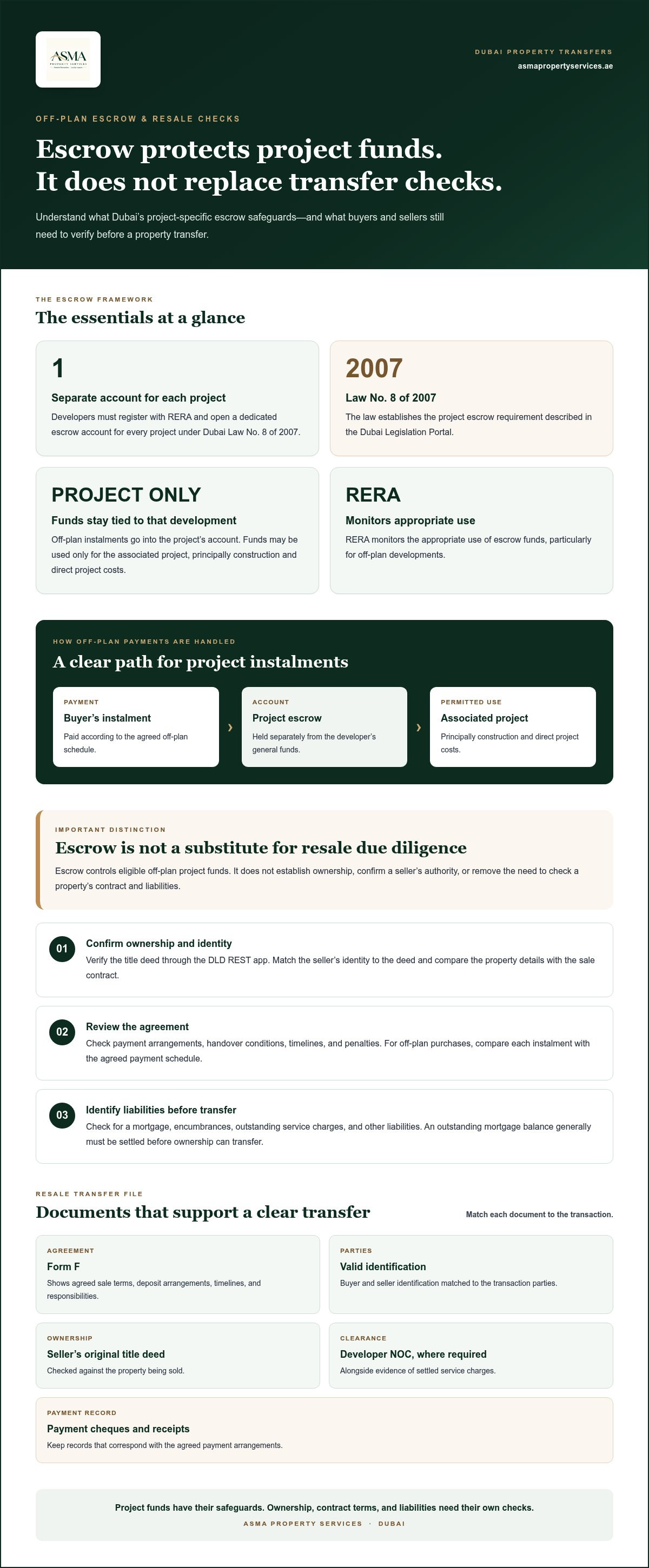
Escrow is a key safeguard for off-plan purchases in Dubai, but it doesn’t replace checks on a resale transfer. Under Dubai Law No. 8 of 2007, developers must register with RERA and open a separate escrow account for each project, according to Dubai Legislation Portal. Buyers’ off-plan instalments go into that project account, and the funds are restricted to project-related use. This is the central protection behind secure property transaction services in Dubai.
That distinction matters. Escrow helps control how off-plan project payments are held and used, but buyers and sellers must still understand the agreement, confirm ownership details, and complete the transfer correctly. For an owner outside the UAE, a power of attorney can authorise a representative to sign agreements and handle transfer formalities, within the powers granted.
This guide explains when escrow applies, how it protects buyers and sellers, and what to expect during a Dubai property transfer. It also covers remote transactions using a power of attorney, showing how funds, documents, and ownership registration fit together.
Key Takeaways
- Understand when escrow applies and how project-specific accounts protect off-plan payments.
- See how title details, outstanding charges, and transfer documents help protect both sides in a resale.
- Learn how an existing mortgage affects the transfer sequence and the lender’s role in registration.
- For a remote transaction, define a power of attorney’s authority around the specific tasks your representative must complete.
- Follow the transfer through the Dubai trustee office, from required approvals to registration of the buyer’s title deed.
What is Escrow in Real Estate Transactions?
Buyers can verify a Dubai title deed through the DLD REST app and compare the property details with the sale contract. Match the seller’s identity to the deed and establish whether a mortgage or other liability affects the transfer. An outstanding mortgage balance generally must be settled before ownership can transfer.
For off-plan estate purchases, escrow separates project payments from a developer’s general funds. Dubai Law No. 8 of 2007 mandates developers to register with RERA and open an escrow account for each project, according to Dubai Legislation Portal. Each account is tied to its specific development, rather than shared across a developer’s projects.
This framework controls where off-plan instalments go and how developers may use them. RERA monitors the appropriate use of escrow funds, particularly for off-plan developments. Developers may use the funds only for the project linked to the account, principally for construction and direct project costs. Escrow safeguards project funds, but it does not replace checks on ownership or contract terms.
Contract negotiations should define payment arrangements, handover conditions, timelines, and penalties. For example, a buyer reviewing an off-plan contract can compare each instalment with the payment schedule and confirm that the agreement explains the relevant handover conditions. Clear terms set out what each party must do and when. A legal review can flag inconsistent dates, unclear payment triggers, or responsibilities that do not fit the transaction.
Property due diligence addresses different risks. Review the official title deed to confirm the seller’s authority and check that the property details match the sale documents. Look for encumbrances, outstanding service charges, and other liabilities attached to the property. For a resale, understand how any mortgage affects settlement and transfer. These checks distinguish escrow protection for project payments from the ownership and liability checks required for a particular property.
- Compare the title deed with the seller’s identification and the contract’s property details.
- Review the contract’s payment schedule, handover terms, deadlines, and penalties together.
- Identify mortgage balances, encumbrances, and outstanding charges that may affect transfer.
A professional legal review connects the documents to the transaction’s compliance and completion requirements. The reviewer can assess whether the contract’s payment terms align with the escrow arrangement, whether the seller has authority to transfer, and whether mortgage settlement or property liabilities need attention. For a gift or grant, the legal documents and ownership record must also reflect the intended transfer. Each check serves a distinct purpose: escrow controls eligible project funds, while document review tests the contract and property details.
How escrow accounts protect buyers and sellers
Escrow protects off-plan buyers by directing instalments into the account for the specific project, rather than the developer’s general funds. Buyers should still verify the seller’s authority and review the transaction documents. Escrow does not establish ownership or eliminate every fraud risk.
For buyers, protection depends on matching the payment record to the project and contract. Dubai developers may use escrow funds only for the associated project, principally for construction and direct project costs. For an off-plan purchase, keep each payment receipt and compare it with the agreed instalment schedule. This creates a clear record if a payment amount or milestone is disputed.
Sellers also benefit from clear documentation. A resale file should identify the property, parties, agreed sale terms, and transfer requirements. The buyer and seller can compare the Memorandum of Understanding, often called Form F, with the intended payment arrangements and timelines. A clear record helps prevent disagreements about the deposit, completion date, and each party’s responsibilities.
Fraud risks include someone falsely claiming authority to sell, altered transaction documents, or liabilities affecting the property. Buyers can reduce these risks by matching the seller’s identification to the official title deed, checking that the property details correspond, and confirming outstanding charges or encumbrances before transfer. Follow the documented payment arrangements, and verify any changed payment instructions before acting.
Use documents to answer specific questions, rather than collecting paperwork without a purpose. A Dubai property transfer file may include:
- Form F, showing the agreed sale terms, deposit arrangements, timelines, and responsibilities.
- Valid identification for the buyer and seller, matched to the transaction parties.
- The seller’s original title deed, checked against the property being sold.
- The developer’s NOC, where required, alongside evidence of settled service charges.
- Payment cheques and receipts that correspond with the agreed arrangements.
Due diligence should link each document to a specific question. Does the seller named in the agreement have authority to transfer? Do the deed and contract describe the same property? Are service charges, mortgage balances, and other liabilities addressed before registration? These checks benefit both sides: buyers get a clearer view of the property and its obligations, while sellers can demonstrate readiness to complete.
Escrow is most relevant to off-plan project payments; it does not replace the transfer checks required for a resale. Keep supporting property transaction documentation aligned with the contract and the parties’ records.
For an off-plan purchase, pay instalments into the escrow account for the specific project. For other transfers, use payment cheques that match the documented arrangements and keep receipts. Verify changed payment instructions before acting.
Mortgage registration during transfer
A mortgage affects the funds, documents, and registration steps in a Dubai property transfer. For a mortgaged resale, the seller’s outstanding balance generally must be settled before ownership transfers to the buyer. The lender’s requirements therefore shape the sequence. The buyer, seller, and lender need aligned completion arrangements before the trustee registers the transfer.
For an off-plan purchase financed by a mortgage, mortgage funds are also deposited into the project’s escrow account. This keeps the payment within the project-specific funding arrangement. Buyers should match the bank’s release instructions with the purchase contract’s instalment schedule and payment milestones. The payment route matters: an off-plan mortgage payment and a resale mortgage settlement serve different purposes.
Mortgage registration fees in Dubai are generally 0.25% of the loan amount. The fee is based on the loan, not the property’s full sale price. For example, the relevant calculation starts with the mortgage amount stated in the bank’s financing documents. Parties should account for this registration charge alongside the transfer arrangements and other transaction costs.
For a resale with an existing mortgage, the outstanding balance must be addressed before transfer can proceed. The lender sets the settlement requirements, and the parties coordinate payment so the mortgage can be cleared as part of completion. The bank and trustee then align release of the existing interest with registration of the buyer’s ownership. An international buyer or seller may need to coordinate across time zones, but the process still follows the lender’s requirements and trustee appointment.
Keep the mortgage file consistent throughout the transaction. It should connect the bank’s loan details and settlement instructions with the property records and transfer appointment. A change in the loan amount or payment timing can affect fee calculations or the completion sequence. Before registration, match any bank certificate or settlement record to the property and parties named in the sale documents.
- Confirm the loan amount used to calculate the 0.25% mortgage registration fee.
- For an off-plan purchase, match mortgage payments to the project escrow instructions.
- For a mortgaged resale, coordinate settlement of the seller’s outstanding balance before transfer.
- Align bank instructions with the trustee’s registration process and the transfer appointment.
At transfer, the Dubai trustee oversees issuance of the buyer’s new title deed and coordinates with the bank to register its interest if the buyer takes a mortgage. This final step connects financing with legal ownership in Dubai. Mortgage coordination helps keep payment, settlement, and registration documents consistent, including when a buyer or seller is based overseas.
Remote property transactions using a power of attorney
A property owner outside the UAE can complete a Dubai transfer remotely through conveyancing based on a power of attorney. The document authorises a representative to act within defined limits. Depending on its wording, that representative can sign agreements, submit transfer applications, attend developer meetings, and complete registration formalities with the Dubai Land Department. Remote handling can reduce travel, but unclear authority or incomplete documents can still cause delays.
Define the scope before the representative acts. A power of attorney can be general or limited. For a sale, the owner may authorise the representative to sign the sale and purchase agreement and complete transfer steps. A narrower authority could allow document collection only, such as obtaining a title deed, developer letter, or clearance certificate. Limiting the authority avoids granting transaction powers the representative does not need.
Set out the powers in relation to the transaction. Identify the property, permitted actions, and any required validity period. A representative authorised only to collect documents cannot automatically sign a sale agreement or complete ownership registration. Keep certified copies secure and ensure the representative relies on the same authority when dealing with the seller, buyer, developer, and land department.
Prepare the information commonly required for a Dubai property power of attorney:
- Valid identification and passport copies for the relevant parties.
- Property details that identify the asset covered by the authority.
- Contact information for both parties, so transaction communications reach the right people.
- A clear description of the representative’s permitted actions and any validity period.
Online processes may involve drafting the authority with defined powers, identity verification through approved channels, digital notarisation or authentication, and sharing certified copies with relevant authorities. Digital appointments and remote verification can reduce administrative steps for an overseas owner. Consistency is essential: names, identification, property details, and the wording of the authority should match across the power of attorney and transaction documents.
Due diligence remains necessary when a representative handles paperwork. The owner should understand the transaction terms the representative is authorised to sign, and the representative must act within the written scope. For example, authority limited to collecting a developer’s clearance certificate does not itself authorise buying, selling, or receiving payments. This distinction matters to buyers and sellers, especially when a representative coordinates with several developers or handles multiple transaction stages.
Before signing, match each required task to a specific power in the document. Then give the representative the relevant property records and certified copies. This creates a clear chain of authority for a remote transaction, from document handling through registration, without treating a power of attorney as proof of ownership.
What are the steps to complete a secure property transfer through a Dubai trustee office?
Dubai property ownership and transfers are registered through the Dubai Land Department, which maintains the official land records. Conveyancing begins after an offer is accepted and continues through the ownership transfer. The trustee office handles formal registration, while the parties prepare the documents, approvals, and payments needed for that stage.
- Agree and document the sale. For a resale, Form F records the agreed price, deposit arrangements, timelines, and each party’s responsibilities. Read it alongside the payment terms and handover conditions. The details should match the property and the parties’ identification documents.
- Verify ownership and property details. Compare the seller’s title deed with the property described in Form F. The DLD REST app can be used to verify the title deed before transfer. Resolve differences in names, property identifiers, or ownership records before the trustee appointment.
- Obtain the developer’s NOC where required. Many secondary-market sales need a developer No Objection Certificate before transfer. The seller applies to the developer; the NOC confirms no objection and that relevant service charges and community payments have been settled.
- Prepare transfer documents and funds. The file includes Form F, valid IDs, the seller’s original title deed, the developer’s NOC, and payment cheques. The parties should align the payment arrangements with the sale agreement and account for the applicable transfer and administrative charges.
- Attend the trustee office and register ownership. On transfer day, the buyer and seller, or their authorised representatives, appear at an authorised Dubai Trustee Centre service centre. The trustee processes the transfer, collects applicable fees and charges, and the Dubai Land Department issues an updated title deed in the buyer’s name.
The Dubai Land Department transfer fee is 4% of the property’s sale price. Include these charges in the completion arrangements, not as substitutes for the agreed sale payment.
Mortgage status can affect the transfer sequence. An outstanding mortgage balance generally must be settled before ownership transfers, so the parties should coordinate the lender’s requirements before arranging completion. At the trustee stage, the updated title deed records the buyer’s ownership. If the buyer takes a mortgage, the trustee coordinates registration of the bank’s interest.
Prepare the file and coordinate your Dubai property transfer with property conveyancing support.
ASMA Property Services: conveyancing
ASMA Property Services provides conveyancing for buyers and sellers handling a Dubai property transfer. Turn to its team when the transaction needs coordination across sale documents, transfer requirements, and ownership registration. Clear, milestone-led support keeps the transaction record aligned from accepted offer through completed transfer.
For owners who cannot attend in person, power of attorney support can establish a representative’s authority for defined property tasks. Property Gifting / Granting applies when ownership is transferred as a gift rather than through a sale. These transactions have different documents and objectives, so choose support that fits the type of transfer.
For support with a Dubai property transfer, contact ASMA Property Services through asmapropertyservices.ae.
Set the transaction up for its next stage
Start by defining what must happen before ownership changes hands. Identify the transaction type, who is authorised to act, and which documents must be completed. This gives each party a clear administrative path for a sale, a gift, or a remote owner’s representative.
For secure property transaction services in Dubai, match procedural support to the task. ASMA Property Services provides conveyancing, Property Gifting / Granting, and power of attorney support. Each addresses a different need: conveyancing supports the transfer process, while gifting and authorisation cover distinct ownership arrangements.
Bring the transaction details together before work begins: the property, the parties, the intended ownership change, and any representative’s authority. A defined scope connects the required documents to the intended outcome and gives you a practical starting point for resolving outstanding transfer matters.
Contact ASMA Property Services to discuss support for your Dubai property transaction. A clear next step can make the transfer easier to manage.
Frequently Asked Questions
How does the power of attorney for property work?
A power of attorney allows an appointed representative to carry out property tasks within the authority written in the document. For example, an owner abroad could authorise someone to sign specified transaction documents, while another owner might grant authority only to collect property records. Define the property, permitted actions, and any validity period. For remote arrangements, identity verification and legal authentication are part of preparing and using the authorisation.
How to Make Your Property Transaction in Dubai Smooth and Efficient?
Keep the transaction record consistent from offer acceptance through registration. Use the same names, property identifiers, and agreed terms in the sale documents and supporting records. For example, resolve a mismatch between a passport name and the contract before arranging completion. Mortgage settlement, developer approvals, and outstanding property charges can affect readiness, so assign responsibility for each item early and track its status with the relevant party.
What is Conveyancing?
Conveyancing is the legal and administrative work involved in transferring property ownership between parties. In Dubai, it can include reviewing or preparing contracts, analysing the case, coordinating required documents and approvals, and progressing the transaction toward registration. A resale, for example, may require coordination among the buyer, seller, developer, lender, and trustee office. The work follows the transaction through key ownership-transfer milestones.
What secure property transaction services are available in Dubai?
In Dubai, transaction support can include conveyancing, property gifting or granting, powers of attorney, remote ownership updates, and mortgage coordination. Each serves a different need. A buyer and seller completing a resale may need conveyancing; an owner outside the UAE may need a power of attorney for a representative. Escrow is a separate mechanism for eligible off-plan project funds, not a substitute for transfer documents or ownership registration.
How does Dubai Land Department verify and register property transactions?
The Dubai Land Department maintains official land records and registers property transfers. At completion, the trustee office processes the transfer documents and applicable payments, then an updated title deed records the buyer as owner. Before the appointment, compare the property details and seller’s information with the title deed and sale documents. Registration records the change in ownership, distinct from the buyer’s earlier contract with the seller.
What documents and identity checks are required to buy or sell property in Dubai?
A typical transfer file includes Form F, valid identification for the parties, the seller’s original title deed, the developer’s NOC where required, and payment cheques. Check that names and property details match across the documents. For example, the seller named in the sale agreement should match the ownership record. A representative attending for either party also needs authority that covers the tasks being completed.
What are Dubai property transfer fees and service charges?
The Dubai Land Department transfer fee is 4% of the property’s sale price. Service charges are separate property liabilities; outstanding amounts may need to be settled for a developer NOC before a secondary-market transfer proceeds.
How do Dubai property conveyancing firms, trustee offices, and online transaction services compare?
Conveyancing firms coordinate documents, checks, and completion; the DLD trustee office handles the formal ownership transfer and issues the updated title deed. Online transaction support can help remote clients through power-of-attorney preparation, identity verification, and digital authentication, enabling an authorised representative to manage specified tasks.

Article by
Suhail Ibrahim
Suhail has guided more than 3,000 Dubai property transactions and built the reputation that leading brokerages rely on — calm under pressure, precise with paperwork, and always reachable when a deal needs completing.


