

A property transfer can stall even after buyer and seller agree on the deal. Documents, approvals and transaction milestones still need to align. A property conveyancing Dubai team coordinates these moving parts, helping each party understand what is needed and when.
It can be unclear where your responsibilities end and those of your agent, lender or other service providers begin. Conveyancing support brings the administrative work into one coordinated process. This article explains what that work covers, how transfers progress and why the steps can differ for resale, off-plan and mortgage transactions.
You’ll also learn what to prepare and how professional coordination can keep follow-up organised. ASMA Property Services supports buyers, sellers, investors and real estate professionals with transfer administration and sales progression in Dubai. Operating since 2022, the firm has completed more than 3,000 property transfers. The sections ahead explain the process and the support that can help keep your transaction on track.
Key Takeaways
- Property conveyancing Dubai covers the administration and coordination of a transfer, connecting the parties involved while each retains their own responsibilities.
- Map the transfer from agreed terms through completion and the ownership record update. The sequence can change with financing, property status and the parties involved.
- Identify the buyer’s and seller’s financing positions early, since these affect which lender actions need to be coordinated.
- Prepare party details, financing information, property status and transaction contacts, then keep records consistent across everyone involved.
- Professional conveyancing support can coordinate paperwork, approvals and milestones, helping organise follow-up without promising a fixed completion date.
What Property Conveyancing in Dubai Covers, and What It Does Not
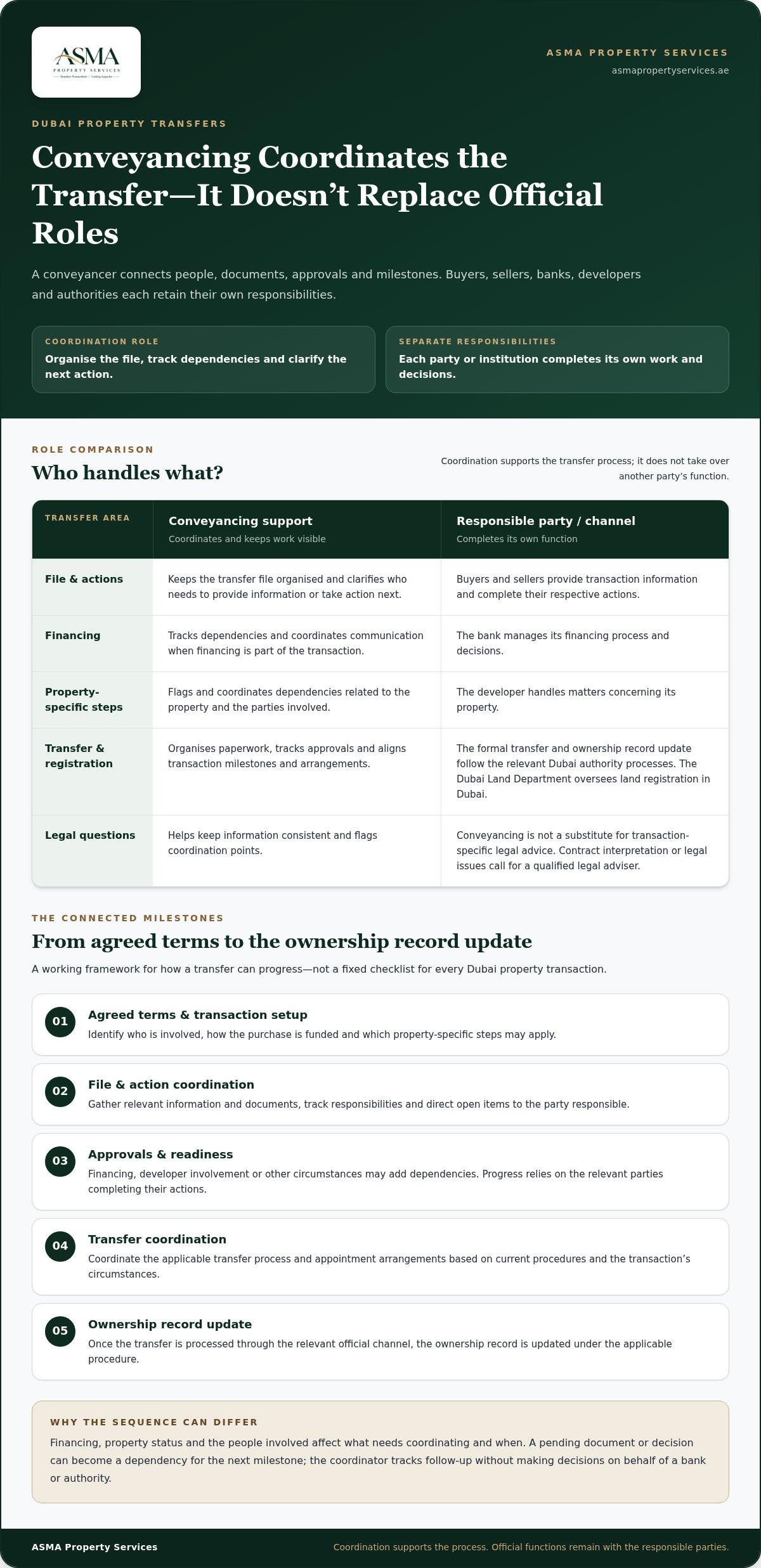
Property conveyancing Dubai is the administration and coordination that supports a property ownership transfer. It connects the people, documents, approvals and milestones involved in moving a sale from agreed terms towards completion. The conveyancer keeps the transfer file organised and clarifies who needs to provide information or take action next.
That coordination can involve buyers, sellers, real estate agents, banks, developers and relevant authorities. Their tasks are connected, but not interchangeable. A lender manages its financing process, a developer handles matters concerning its property, and official registration follows the responsible authority’s process. The conveyancer tracks dependencies between these workstreams rather than taking over the parties’ separate responsibilities.
Conveyancing support is not a substitute for transaction-specific legal advice, a bank’s decisions or an authority’s requirements. Those can depend on the property, the parties and the transaction structure. The role is to manage administration and sales progression, flag coordination points and help the parties work from consistent information.
When conveyancing support becomes relevant
Coordination usually becomes relevant once buyer and seller have agreed to proceed. From there, the transaction moves through connected steps towards transfer completion. The sequence is not identical in every sale. Financing, property status and the people involved all affect what needs coordinating and when.
For example, a financed purchase may involve communication with a bank as well as the buyer and seller. A property with developer-related steps may require separate coordination with the developer. If updates reach participants at different times, a document or decision can become a dependency for the next milestone.
Buyers and sellers need clarity about their respective actions. Investors may be coordinating across several parties or transactions, while agents need the sale progression to remain visible. A conveyancer organises follow-up and maintains a shared view of outstanding items without taking over each party’s responsibilities.
Conveyancing support versus official transfer functions
Administrative coordination and formal ownership registration are distinct functions. A conveyancer can organise paperwork, track approvals and align transaction milestones. The official transfer and ownership record update follow the relevant Dubai authority processes. A private coordination provider does not act in place of the authority.
The Dubai Land Department (DLD) oversees land registration in Dubai. Trustee offices are part of the transaction-processing landscape, but the steps and terminology can depend on the current procedure and transaction. The Real Estate Regulatory Agency (RERA) is associated with the DLD and regulates aspects of Dubai’s real estate sector. Its overview provides context, while the relevant official instructions govern a specific transfer.
In practice, conveyancing support works alongside official channels, banks and legal advisers. It does not confer authority to approve a transfer or determine legal rights. For a contract interpretation or legal issue, seek transaction-specific advice from a qualified legal adviser. This distinction sets clear expectations: the coordinator manages the process, while the relevant institution performs its official function.
How Dubai Property Conveyancing Connects the Main Transaction Milestones
A transfer progresses through linked milestones, not one isolated appointment. Conveyancing coordinates transaction milestones, documents and participants from agreed terms through transfer completion and the resulting ownership record update. The sequence is a working framework, not a fixed checklist for every Dubai property transaction.
- Agreed terms and transaction setup. The parties establish the basis of the sale and identify who is involved, how the purchase is funded and which property-specific steps may apply.
- File and action coordination. Relevant information and documents are gathered, responsibilities are tracked, and open items are directed to the party responsible for them.
- Approvals and readiness. Financing, developer involvement or other transaction circumstances may create additional dependencies. Progress relies on the necessary parties completing their respective actions.
- Transfer coordination. The parties coordinate the applicable transfer process and appointment arrangements based on current procedures and the transaction’s circumstances.
- Ownership record update. Once the transfer is processed through the relevant official channel, the ownership record is updated under the applicable procedure.
Document readiness and appointment coordination matter because a pending item can affect the next milestone. For example, if one participant has not provided information, another party may be unable to complete its part. A coordinator keeps outstanding actions visible and follows up across the transaction, without making decisions on behalf of a bank or authority.
Who participates in a Dubai property transfer?
The buyer and seller provide transaction information and complete their respective actions. Agents help manage communication around the sale. A bank is involved when financing applies, while a developer may have a role in property-specific matters. Relevant officials handle formal steps through the applicable process. Each participant has distinct responsibilities and decision points. Coordination makes dependencies clearer, but it does not give the coordinator authority to approve finance, issue approvals or register ownership.
Why financing and property status can change the sequence
A cash transaction and a mortgage-backed transaction can follow different coordination paths. Financing may add bank-related actions, while an existing mortgage or developer involvement may introduce further points to organise. These are examples, not universal requirements. The precise sequence depends on the parties, property status and current procedure.
Use current guidance from the Dubai Land Department (DLD) and relevant official channels when confirming process details. Procedures and terminology can change, and the applicable steps depend on the case. Property conveyancing Dubai support helps maintain a clear record of dependencies while the parties complete their own responsibilities. For transaction administration and milestone coordination, ASMA’s conveyancing support serves buyers, sellers, investors and real estate professionals.
Cash or Mortgage Sale? How the Dubai Conveyancing Route Changes
Not every Dubai property transfer follows the same sequence. The buyer’s and seller’s financing positions affect which parties need to coordinate and which actions may depend on others. A different route does not automatically signal a problem. It means the transfer has a different set of administrative dependencies to track.
| Transaction route | Main coordination difference |
|---|---|
| Cash-to-cash | No buyer or seller mortgage workstream is part of the route. Coordination still centres on the sale file, parties and transfer milestones. |
| Cash-to-mortgage | The buyer’s lender adds a financing workstream, with its own decisions and actions to coordinate alongside the sale. |
| Mortgage-to-cash | The seller’s existing finance may require coordination with their lender, while the buyer’s purchase does not involve a new mortgage. |
| Mortgage-to-mortgage | Both sides have lender-related processes, so the coordinator tracks dependencies across two financing workstreams as well as the sale. |
This comparison is a planning aid, not a definitive procedural checklist. The route and applicable steps depend on the transaction, property status, parties and current official procedures. Bank processes also differ. Use the relevant channels to confirm requirements for the specific transaction before relying on a particular sequence.
What changes when one or both parties use a mortgage?
A mortgage introduces lender actions into the transaction’s coordination plan. These may affect how other milestones are sequenced because one party’s next step can depend on a lender’s response or process. With mortgages on both sides, there are separate lender workstreams to track. Mortgage coordination keeps communications and dependencies visible; it does not replace either bank’s decisions or procedures.
Rather than assuming that one route always takes longer or follows a fixed order, identify the financing position on both sides early. Then track which lender-related actions affect the next transaction milestone. Verify the current procedure for the specific case.
Other circumstances that can affect coordination
Developer involvement can add property-specific communication or approvals to the file. Overseas parties may need additional coordination around how information, documents and transaction actions are managed. The effect depends on the circumstances, so it should not be treated as a universal extra step.
Gifting or family transfers are distinct from a standard sale and may follow a different route. Use dedicated property gifting guidance for that transaction type. Complex ownership arrangements also call for support tailored to the parties and property. In each case, property conveyancing Dubai support can organise the administrative workstream while banks, developers and official bodies retain their own roles.
ASMA Property Services provides conveyancing and mortgage coordination for Dubai property transfers, aligning paperwork, approvals and milestones across buyers, sellers, investors and real estate professionals.
What to Prepare Before a Dubai Property Transfer Begins
Start preparation with a clear picture of the transaction, not a stack of documents. Before coordination begins, align the party details, financing position, property status and key contacts. In property conveyancing Dubai, consistent information helps everyone work from the same transaction record and makes open actions easier to track.
Use this readiness framework to identify gaps before they become follow-up tasks:
- Party details: Confirm that the buyer’s and seller’s names and contact details are recorded consistently in the transaction information shared with relevant parties.
- Financing position: Record whether the buyer and seller are proceeding with cash or mortgage financing, and note any existing lender involvement.
- Property status: Clarify the property’s current status and whether a developer has a role in the transaction.
- Transaction contacts: Keep the agent, lender, developer and other relevant contacts together, with each person’s role and preferred communication channel.
Readiness questions for buyers and sellers
Start by identifying the agreed transaction route and who is responsible for each action. Has each party’s role been communicated? Is a lender or developer involved? Are there unresolved ownership or financing matters that could affect the next steps? Flag these early for transaction-specific review. They may need input from the relevant party or professional, rather than an assumption that the standard route applies.
Keep names, contact details and transaction updates consistent across emails, shared records and information provided to participants. If details change, make the update visible to everyone who relies on them. Small inconsistencies can lead to avoidable clarification and follow-up.
How to reduce avoidable coordination delays
Choose one point of contact to consolidate updates and outstanding actions. Maintain a current shared record that lists each item, its responsible party, status and next action. Track approvals and milestones as they progress. Avoid relying on scattered messages or memory to establish what remains open.
Keep preparation proportionate. This section is a readiness framework, not a complete document inventory. Use the dedicated Dubai transfer checklist and document guide for item-by-item preparation, and follow the current instructions that apply to the specific transaction.
ASMA Property Services coordinates paperwork, approvals and milestones for buyers, sellers, investors and real estate professionals. If you want support organising the transfer workstream, explore ASMA’s conveyancing support.
How ASMA Property Services Supports Conveyancing in Dubai
ASMA Property Services provides conveyancing and sales progression support for Dubai property transfers. The work centres on coordination: organising paperwork, tracking approvals and keeping transaction milestones visible to the parties involved. Buyers, sellers, investors and real estate professionals can use this support to maintain a clear view of responsibilities and outstanding actions.
Since beginning operations in 2022, ASMA has completed more than 3,000 successful property transfers. That experience informs a practical approach to property conveyancing Dubai: manage the administrative workstream with attention to the transaction’s parties, financing route and property circumstances, without promising a fixed completion date.
What ASMA coordinates during a property transfer
ASMA supports transfer administration and sales progression from transaction setup through the relevant milestones. Its coordination can include:
- Paperwork: Organising transaction documentation and tracking information needed from the parties.
- Approvals: Monitoring approval-related actions and following up with the relevant participants.
- Milestones: Keeping the transaction’s progress and open items clear as the transfer advances.
- Mortgage coordination: Aligning lender-related communications and dependencies when financing forms part of the transaction.
Each party retains its own role. Buyers and sellers provide information and complete their actions; banks make their own financing decisions; developers and authorities perform their respective functions. ASMA coordinates the administrative process around them. It does not replace an official authority or determine legal outcomes.
Coordination is most useful when participants need a consistent view of what has been completed and what remains open. If a lender action, approval or piece of information affects the next milestone, keeping that dependency visible helps the parties direct follow-up to the right place. The transaction’s route and circumstances shape the work involved.
A clear next step for buyers, sellers, and investors
Before proceeding, bring together three points: who is involved, whether either party is using mortgage financing, and which milestone the transaction has reached. Note any developer involvement and unresolved ownership or financing matters. This gives the coordination process a practical starting point and helps distinguish outstanding actions from completed ones.
ASMA’s conveyancing support is designed for buyers, sellers, investors and real estate professionals who need transfer administration and sales progression coordinated across the transaction. It covers paperwork, approvals and milestone tracking, with mortgage coordination where relevant. The focus is clear process management, not a guaranteed timeline or legal outcome.
To arrange coordinated support for a Dubai property transfer, explore ASMA’s conveyancing service.
Set a Clear Starting Point for Your Transfer
Turn the transaction in front of you into a clear working brief. Record the parties, financing position, property context and current milestone in one place. This gives everyone a shared starting point and helps identify where coordination support fits before follow-up becomes fragmented.
Property conveyancing Dubai is most useful when the coordination approach reflects the actual transaction, not a generic checklist. Clarify which administrative actions need coordination and which decisions remain with a lender, authority or legal adviser. A defined remit keeps responsibilities visible and expectations practical.
ASMA Property Services supports transfer administration and sales progression for Dubai property transactions. Explore ASMA’s property conveyancing support to establish a coordinated next step for your transfer.
With responsibilities mapped out, you can move forward with greater clarity.
Frequently Asked Questions
What does a conveyancer do in Dubai?
A conveyancer coordinates the administrative work involved in a property transfer. This can include organising transaction paperwork, tracking approvals and keeping relevant parties aligned around key milestones. For example, if a bank’s action affects the next step, the coordinator can keep that dependency visible. A conveyancer does not replace the Dubai Land Department, a trustee office, a bank or legal counsel. The scope depends on the transaction and service arrangement.
Is conveyancing required to transfer property in Dubai?
Conveyancing support is separate from the formal requirements for registering a Dubai property transfer. Buyers and sellers can arrange coordination to help manage communications and transaction administration; the transfer itself still follows the applicable official process. Requirements can vary by transaction. For a specific sale, use current guidance from the relevant Dubai authorities, particularly if ownership, financing or property status introduces additional considerations.
How long does property conveyancing take in Dubai?
There is no single timeline that applies to every Dubai transfer. Timing can depend on the transaction route, financing, property status, approvals and how promptly parties provide information. A delay in one party’s response may affect a dependent action. Coordination support can track outstanding items and follow-up, but it cannot control the pace of banks, authorities or other participants, or guarantee completion by a particular date.
How much does property conveyancing cost in Dubai?
The service fee depends on the coordination scope and transaction circumstances. Official and third-party charges may be separate from the conveyancing fee, so distinguish the service scope from other transaction costs when reviewing an estimate. A useful comparison shows what administrative work is covered and identifies applicable charges separately. Costs can differ with the route, financing and process involved, so a single general figure may not reflect your transaction.
Can I complete a Dubai property transfer remotely?
Some ownership or transfer administration may be handled remotely, depending on the transaction, participants and current official procedures. Remote handling does not automatically remove requirements for identity checks, authorisation, document execution or attendance. For example, an overseas owner may need to account for how documents are executed and accepted. Follow the relevant official process when making arrangements; a coordinator can track communications and milestones.
What happens if the buyer or seller has a mortgage?
A mortgage can add lender-related actions and sequencing dependencies to a Dubai property transfer. The coordination path depends on which party has financing and the status of the property and loan. That does not by itself mean the transfer cannot proceed. Identify the lender-related workstream early and account for it in the transaction plan. The bank and relevant authorities determine their own current requirements for the specific case.
Is property conveyancing the same as escrow in Dubai?
No. Property conveyancing refers to administrative coordination around a property transfer, while escrow is a separate function. The terms are not interchangeable, and a coordinator’s role does not mean they hold or manage funds. Before proceeding, make sure the scope and responsibilities attached to each arrangement are clear.

Article by
Suhail Ibrahim
Suhail has guided more than 3,000 Dubai property transactions and built the reputation that leading brokerages rely on — calm under pressure, precise with paperwork, and always reachable when a deal needs completing.