

Agreement on price doesn’t put a Dubai property purchase on a transfer timetable. Buyer conveyancing Dubai coordinates paperwork, approvals, and transaction milestones so the buyer, seller, bank, and transfer arrangements stay aligned. A mortgage adds lender requirements and funding steps; a cash purchase follows a different path.
It can be unclear who is responsible for each follow-up. The broker supports the deal, the bank manages its financing requirements, and the trustee office handles formal ownership transfer registration. Conveyancing coordinates administrative progress around these responsibilities without replacing them.
This guide explains the main milestones, the buyer’s responsibilities, and the differences between cash and mortgage purchases. It also shows what to track, where timing can become difficult, and how coordination can reduce scattered follow-ups. ASMA Property Services provides conveyancing and sales progression support in Dubai, including paperwork, approvals, mortgage coordination, and transaction milestone tracking.
Key Takeaways
- Buyer conveyancing Dubai organises administrative steps towards transfer while keeping each party’s responsibilities distinct.
- Track each purchase milestone by its status, owner, next action, and any dependency.
- Compare cash and mortgage routes to identify whether lender approvals and funding steps affect transfer readiness.
- Keep transaction details in one current record and communicate decisions or changes promptly.
- ASMA coordinates paperwork, approvals, mortgage follow-ups, and milestones as part of its buyer conveyancing support.
Buyer Conveyancing in Dubai: What the Service Covers
Buyer conveyancing in Dubai coordinates the paperwork, approvals, and transaction milestones involved in progressing a property purchase. It gives the buyer and relevant parties a way to track outstanding actions and prepare for the next stage. It does not replace brokerage, lender decisions, legal advice, or formal transfer registration.
Conveyancing generally covers steps involved in transferring property ownership. What is Conveyancing? provides general context. In a Dubai purchase, buyer-side support focuses on connecting administrative tasks to the transaction’s actual parties, requirements, and milestones.
What does buyer conveyancing include in Dubai?
The work centres on coordination: gathering and progressing paperwork, tracking required approvals, and keeping transaction milestones visible. The sequence depends on the purchase and its funding route, so the relevant actions should be tracked for that transaction rather than assumed to be identical for every buyer.
For each open item, record what remains, who owns the next action, and whether another milestone depends on it. For example, if an approval is outstanding, note the responsible party and whether it affects transfer planning. A conveyancing coordinator keeps these follow-ups organised and shares progress with the relevant parties. The bank makes its lending decisions, and the trustee office handles formal registration.
Who does what in a Dubai property purchase?
Several parties contribute to one transaction, but their responsibilities are distinct. Giving each action a clear owner helps prevent missed follow-ups and assumptions about who can approve or complete a step.
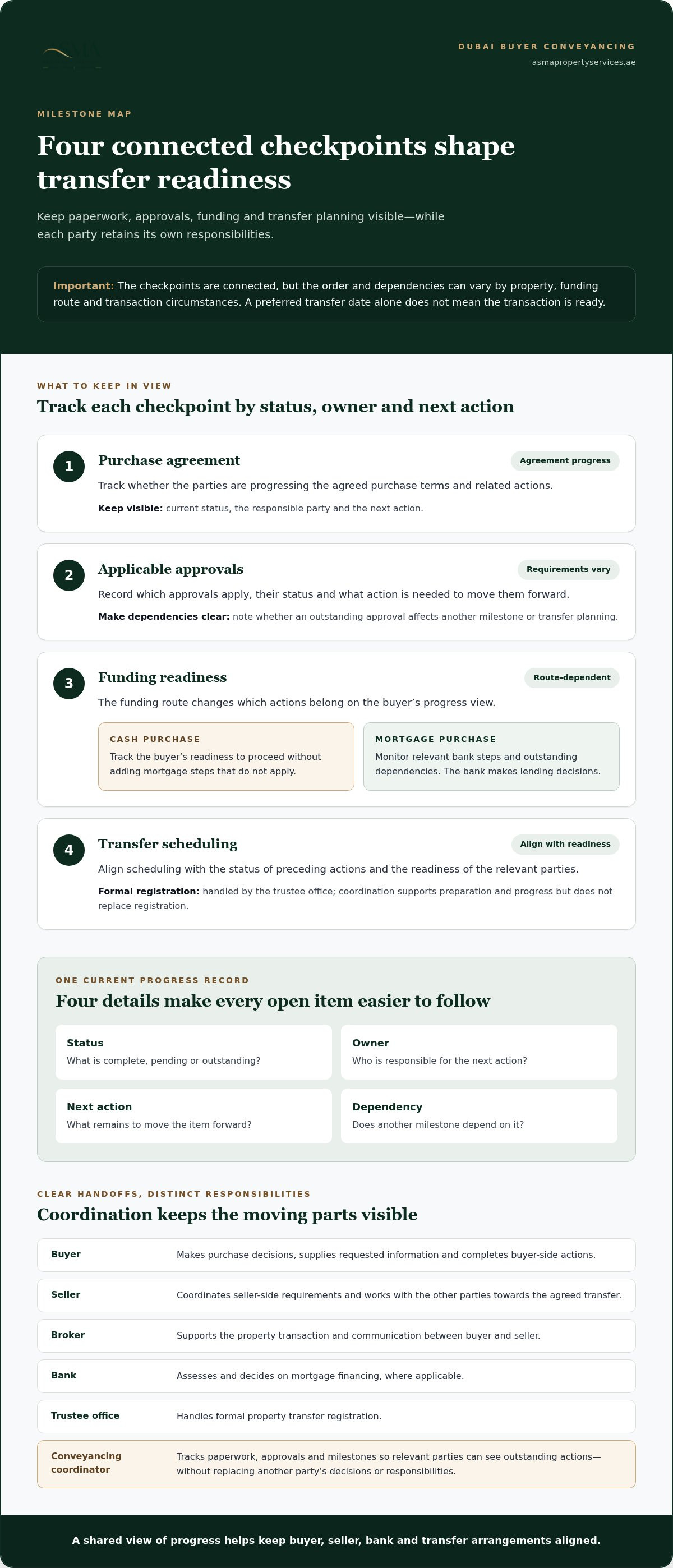
- Buyer: Makes purchase decisions, supplies requested information, and completes buyer-side actions.
- Seller: Coordinates seller-side requirements and works with the other parties towards the agreed transfer.
- Broker: Supports the property transaction and communication between buyer and seller. Brokerage is separate from administrative conveyancing coordination.
- Bank: Assesses and decides on mortgage financing, where applicable. A coordinator can track mortgage milestones but cannot make the lender’s decision.
- Trustee office: Handles formal property transfer registration. Coordination supports preparation and progress but does not replace registration.
- Conveyancing coordinator: Tracks paperwork, approvals, and transaction milestones so relevant parties can see outstanding actions.
ASMA Property Services provides buyer-side conveyancing and sales progression support, including paperwork, approvals, and milestone coordination. Its mortgage coordination helps align the administrative steps of a financed purchase, while the bank retains control of lending decisions and the trustee office handles registration.
Clear responsibility matters when one milestone depends on another. If mortgage steps, paperwork, and transfer readiness are tracked in separate conversations, buyers may have to chase several updates. A coordinator maintains a shared view of what has progressed, what remains pending, and who owns the next action. This helps keep the process organised without bypassing another party’s decisions or formal responsibilities.
How Buyer Conveyancing Keeps Dubai Purchase Milestones Moving
A property purchase moves through connected checkpoints. The buyer and seller progress the agreement; applicable approvals and financing steps follow; and transfer arrangements are made as the parties become ready. Some actions can happen in parallel, while others depend on an earlier step. The sequence varies with the property and transaction.
Progress depends on coordinated actions by the buyer, seller, bank, and relevant authorities. Conveyancing support keeps those actions visible without taking over each party’s role or promising a transfer date. A useful progress view shows what is complete, what is pending, who owns the next action, and whether it affects scheduling.
Which milestones should a buyer track?
Track the purchase agreement, applicable approvals, funding readiness, and transfer scheduling as connected checkpoints. For each, record the current status, responsible party, next action, and any dependency. The order and dependencies can vary with the property, funding route, and transaction circumstances.
- Agreement progress: Track whether the parties are progressing the agreed purchase terms and related actions.
- Approvals: Record which approvals apply, their status, and what action is needed to move them forward.
- Funding readiness: For a financed purchase, monitor relevant bank steps and outstanding dependencies. For a cash purchase, track the buyer’s readiness to proceed without adding mortgage steps that do not apply.
- Transfer scheduling: Align scheduling with the status of preceding actions. A preferred date alone does not mean the transaction is ready.
This is a progress framework, not a universal checklist or procedural instruction. For task-by-task transfer guidance, see a dedicated Dubai transfer how-to guide. A coordinator can help keep the milestones relevant to the specific transaction in view.
How are handoffs managed between transaction parties?
A handoff is easier to follow when the pending action is recorded with its owner and dependencies. If a bank action affects funding readiness, the bank remains responsible for it. If the buyer needs to provide information, the buyer owns that response. The coordinator tracks status and keeps relevant parties informed rather than making decisions on their behalf.
This shared view can reduce duplicate follow-up. Instead of several parties asking for the same update, each can see the current status and focus on the action assigned to them. It can also surface dependencies early. For example, transfer scheduling may need to wait until an applicable approval or funding step has progressed. Updates should reflect the actual status, not an assumed completion date.
ASMA Property Services coordinates paperwork, approvals, and transaction milestones as part of its buyer conveyancing support. Its conveyancing coordination connects follow-ups across a purchase while leaving brokerage, lender decisions, and formal registration to their respective parties. A maintained view of pending actions helps buyers track progress and prepare for the next milestone.
Cash vs Mortgage: How the Buyer’s Conveyancing Route Differs
The funding route changes the coordination involved, not the need to organise the transaction. A mortgage purchase adds lender requirements to the property transfer workflow. A cash purchase avoids those financing steps but still involves relevant paperwork, approvals, and transfer readiness. In both cases, buyer conveyancing Dubai helps keep applicable actions and their owners visible.
| Buyer funding route | Additional coordination | Potential dependencies |
|---|---|---|
| Cash purchase | Track the buyer’s funding readiness alongside shared transaction paperwork, approvals, and transfer arrangements. | Progress may depend on actions and approvals relevant to the property and transaction. |
| Mortgage purchase | Coordinate lender-related requirements with the purchase workflow and keep financing progress visible. | Transfer readiness may depend on lender decisions, financing steps, and other applicable approvals. |
This is a practical comparison, not a fixed process map. Requirements vary by transaction, lender, and property circumstances. Confirm the applicable steps against current Dubai procedures and the lender’s requirements rather than assuming one sequence applies to every purchase.
What changes when the buyer uses a mortgage?
Financing brings another decision-making party and a parallel set of requirements. The buyer progresses lender matters while the purchase moves forward. Conveyancing coordination can align the status of financing, relevant approvals, and transfer scheduling, making dependencies easier to identify.
Consider a preferred transfer date alongside the actual financing position and other outstanding actions. The bank controls its assessment and decisions; the coordinator tracks relevant milestones and communicates progress. Banks may use different processes, so one lender’s sequence should not be treated as universal.
Does a cash purchase remove the need for coordination?
No. Cash removes the mortgage workflow, not the transaction’s shared administrative requirements. The buyer still needs to progress relevant paperwork and approvals, coordinate with the seller, and prepare for transfer. Track funding readiness alongside the other applicable milestones.
The distinction is straightforward: financing coordination applies to a mortgage purchase, while core transfer coordination applies to both routes. A cash purchase can still have pending actions if a document, approval, or party’s readiness is unresolved. Treating “cash” as “administration-free” can leave transfer planning based on assumptions rather than current status.
ASMA Property Services provides mortgage coordination alongside conveyancing support for paperwork, approvals, and transaction milestones. This helps connect lender-related follow-up to the wider purchase without replacing the bank’s decisions or formal registration. Assess the relevant requirements and sequence for the transaction before treating transfer arrangements as final.
How Buyers Can Prepare for Conveyancing in Dubai
Preparation starts with a clear transaction record, not a last-minute document search. For buyer conveyancing Dubai, keep agreed details, current milestone status, and the responsible parties for outstanding actions in one organised place. This gives you a reference for updates and helps prevent conflicting versions of the transaction from circulating.
What should buyers organise before the transfer stage?
Maintain a concise working record instead of duplicating a full document checklist. Track agreed transaction details, key contacts, pending actions, and the latest status of each milestone. Respond promptly to requests from relevant transaction participants and record any changes to decisions or details. For a task-by-task reference, use the separate Dubai property transfer checklist.
- Decisions: Keep a current note of agreed terms and changes communicated by the parties.
- Contacts: Record who is handling each open action, including the relevant broker, bank contact, seller-side contact, or conveyancing coordinator.
- Progress: Mark actions as pending, in progress, or completed, and note what they depend on.
- Communication: Share requested information through the appropriate transaction channel and flag changes that could affect planning.
This record helps separate confirmed progress from assumptions. If a milestone has no clear owner or status, raise the gap early so its effect on the next step is understood. Keep the record current, as an old update can be as unhelpful as no update.
How can buyers reduce avoidable delays?
Review pending actions regularly and identify dependencies. A transfer appointment does not prove that every preceding requirement is ready. Mortgage buyers can coordinate financing early so lender requirements and their connection to transfer planning are visible before scheduling becomes urgent.
Early coordination cannot control a bank’s decision or another party’s actions. It can help surface an outstanding requirement, clarify who needs to act, and give the buyer a more accurate view of readiness. For a cash purchase, review shared paperwork, approvals, and transfer preparation as well, even though lender coordination is not part of the route.
- Check each pending item against its owner and any dependent milestone.
- Share relevant updates with parties whose actions or planning may be affected.
- Review transfer scheduling when the status of financing and other applicable requirements changes.
Preparation can reduce avoidable follow-up, but it cannot eliminate delays outside the buyer’s control. ASMA Property Services coordinates paperwork, approvals, mortgage coordination, and transaction milestones for buyers. Arrange buyer conveyancing support to keep your purchase’s administrative progress organised.
ASMA Buyer Conveyancing Support: From Coordination to Transfer
Buyer conveyancing in Dubai involves multiple parties, separate responsibilities, and connected administrative actions. ASMA Property Services provides conveyancing and sales progression support to organise buyer-side paperwork, approvals, and transaction milestones. The aim is practical: keep progress and outstanding actions visible as the purchase advances.
What ASMA coordinates for property buyers
ASMA brings administrative follow-up into a coordinated view. Paperwork and approvals are tracked alongside relevant transaction milestones, so buyers can see what has progressed and what needs attention. For a mortgage purchase, mortgage coordination can align lender-related follow-up with the wider transaction workflow.
The roles remain distinct. Brokers support the property transaction; banks make their own financing decisions; and relevant authorities and trustee offices perform their formal functions. ASMA coordinates paperwork, approvals, and transaction progress around those responsibilities. It does not replace another party’s decision, guarantee registration, or make every transaction follow the same sequence.
That separation matters in practice. If a buyer is waiting on another party, coordination helps clarify the status and keep the related milestone visible. If the buyer has an outstanding action, it can be tracked alongside the steps that depend on it. This gives the buyer a working picture of progress without confusing coordination with formal authority or lender approval.
What happens when a buyer engages conveyancing support?
The transaction’s scope and current milestone status shape the coordination. A purchase already in progress may have different outstanding actions from one at an earlier stage. The buyer’s funding route matters too: mortgage-related follow-up applies when a lender is involved, while other applicable paperwork and approvals remain part of the broader transfer process.
As milestones progress, administrative follow-up keeps outstanding items and their status in view. Buyers can see what needs attention, which party is responsible, and whether another step depends on it. The process does not promise a fixed completion timeline; progress remains subject to the circumstances and actions of the relevant transaction parties.
ASMA reports more than 3,000 successful property transfers since beginning operations in 2022. This experience provides context for its conveyancing and property transfer support, while each transaction retains its own requirements and outcome. Coordination keeps administrative work organised; it does not guarantee a particular result.
ASMA coordinates progress around the property purchase, while brokers, banks, and relevant authorities retain their respective functions. Arrange buyer conveyancing support with ASMA to organise paperwork, approvals, mortgage coordination, and transaction milestones for your purchase.
Set Your Purchase Up for a Clear Next Step
A property purchase is easier to manage when the next action is clear and has an owner. As you move towards transfer, keep decisions current, respond to outstanding requests, and do not treat a preferred date as confirmation that every dependency is complete. A focused coordination plan helps you track progress whether your purchase is cash-funded or mortgage-financed.
If you are considering buyer conveyancing Dubai, start by recording the transaction’s current position and identifying where coordination would help. ASMA Property Services supports buyers with the administrative progression of their purchase, while banks, brokers, and authorities retain their respective roles.
Arrange buyer conveyancing support with ASMA to organise the coordination around your purchase and approach the next milestone with a clearer view of the actions and follow-ups involved.
Frequently Asked Questions
Do I need a conveyancer to buy property in Dubai?
A conveyancer can provide administrative coordination, but one arrangement should not be treated as mandatory for every purchase. Whether separate legal representation is appropriate depends on your transaction and needs. A company purchase or unusual ownership arrangement, for example, may raise different considerations from an individual purchase. Conveyancing support is distinct from brokerage, bank services, and formal registration. Check current legal and procedural requirements for your circumstances.
What does a buyer conveyancer do in Dubai?
A buyer conveyancer helps manage the administrative progression of a purchase. Support can include tracking paperwork and approvals, coordinating updates between relevant parties, and keeping transaction milestones visible. If an approval is pending while another party prepares for the next stage, a coordinator can help clarify the status and responsible party. The broker, lender, and trustee office retain their own functions. Scope depends on the agreed service and transaction.
Can I buy property in Dubai with a mortgage and use conveyancing support?
Yes. Conveyancing coordination can support a mortgage-funded purchase alongside the lender’s process. Financing may add dependencies, such as aligning funding progress with other transaction requirements before transfer planning advances. The lender makes its own decisions, and requirements can differ between banks and purchases. Track lender actions and avoid assuming another buyer’s sequence will apply to your transaction.
Does a cash purchase in Dubai still need conveyancing coordination?
Yes. Paying without a mortgage removes lender-related coordination, but the purchase still involves shared administrative steps. The buyer and seller need to keep applicable paperwork, approvals, and transfer planning aligned. Coordination can identify an outstanding action and its owner instead of assuming cash funding makes every part of the transaction ready. Applicable steps depend on the property and transaction, so cash purchases should not be treated as administration-free.
What is the role of a Dubai trustee office in a property purchase?
A Dubai trustee office is involved in formal property transfer processing, a function separate from conveyancing coordination. A coordinator can track administrative progress leading towards transfer but does not replace the trustee office’s role in registration. Appointment procedures and operational requirements may change. Before acting on a particular process, consult current Dubai Land Department information and follow the instructions that apply to your transaction.
Can a buyer complete a Dubai property transfer remotely?
Remote completion depends on the transaction, identity requirements, and accepted authorisation arrangements. Do not assume every step can be handled remotely. A buyer who cannot attend in person, for example, may need to consider whether an authorised representative is appropriate and which current requirements apply. Conveyancing support can coordinate administrative progress, but any power of attorney or remote ownership procedure must follow applicable rules. Verify the process for your circumstances.
When should a buyer arrange conveyancing support in Dubai?
Arrange support early enough to map responsibilities and open actions before transfer scheduling becomes urgent. For a mortgage purchase, early coordination can make lender-related dependencies visible while other transaction steps are progressing. For a cash purchase, it can clarify who is handling shared actions. Starting early cannot control the timing of banks, sellers, or authorities, but it can give you a clearer view of what remains and who owns each follow-up.

Article by
Suhail Ibrahim
Suhail has guided more than 3,000 Dubai property transactions and built the reputation that leading brokerages rely on — calm under pressure, precise with paperwork, and always reachable when a deal needs completing.
